|
Arrangement of Sections
|
-
THE VALUE ADDED TAX (DISTRAINT) REGULATIONS, 1990
-
THE VALUE ADDED TAX (TRIBUNAL) RULES, 1990
-
THE VALUE ADDED TAX (DISTRAINT) REGULATIONS, 1990
-
THE VALUE ADDED TAX REGULATIONS, 1994
-
THE VALUE ADDED TAX REGULATIONS, 1994
-
THE VALUE ADDED TAX REGULATIONS, 1994
-
THE VALUE ADDED TAX REGULATIONS, 1994
-
THE VALUE ADDED TAX REGULATIONS, 1994
-
THE VALUE ADDED TAX REGULATIONS, 1994
-
THE VALUE ADDED TAX REGULATIONS, 1994
-
THE VALUE ADDED TAX REGULATIONS, 1994
-
THE VALUE ADDED TAX REGULATIONS, 1994
-
THE VALUE ADDED TAX REGULATIONS, 1994
-
THE VALUE ADDED TAX REGULATIONS, 1994
-
THE VALUE ADDED TAX REGULATIONS, 1994
-
THE VALUE ADDED TAX REGULATIONS, 1994
-
THE VALUE ADDED TAX REGULATIONS, 1994
-
THE VALUE ADDED TAX REGULATIONS, 1994
-
THE VALUE ADDED TAX REGULATIONS, 1994
-
THE VALUE ADDED TAX REGULATIONS, 1994
-
THE VALUE ADDED TAX REGULATIONS, 1994
-
THE VALUE ADDED TAX REGULATIONS, 1994
-
THE VALUE ADDED TAX ACT ORDER, 2002
-
THE VALUE ADDED TAX ACT ORDER, 2002
-
THE VALUE ADDED TAX (REMISSION) (OFFICIAL AID FUNDED PROJECTS) ORDER, 2003
-
THE VALUE ADDED TAX (REMISSION) (OFFICIAL AID FUNDED PROJECTS) ORDER, 2003
-
THE VALUE ADDED TAX (REMISSION) (OFFICIAL AID FUNDED PROJECTS) ORDER, 2003
-
THE VALUE ADDED TAX (REMISSION) (INVESTMENTS) REGULATIONS, 2004
-
THE VALUE ADDED TAX (TAX WITHHOLDING) REGULATIONS, 2004
-
THE VALUE ADDED TAX (TAX WITHHOLDING) REGULATIONS, 2004
-
THE VALUE ADDED TAX (REMISSION) (INVESTMENTS) REGULATIONS, 2004
-
THE VALUE ADDED TAX (ELECTRONIC TAX REGISTERS) REGULATIONS, 2004
-
THE VALUE ADDED TAX (ELECTRONIC TAX REGISTERS) REGULATIONS, 2004
-
THE VALUE ADDED TAX (REMISSION) ORDER, 2007
-
THE VALUE ADDED TAX (REMISSION) ORDER
-
THE VALUE ADDED TAX (REMISSION) (LOW INCOME HOUSING PROJECTS) ORDER, 2008
-
THE VALUE ADDED TAX (REMISSION) (LOW INCOME HOUSING PROJECTS) ORDER, 2008
-
THE VALUE ADDED TAX REGULATIONS, 2017
-
THE VALUE ADDED TAX REGULATIONS, 2017
-
THE VALUE ADDED TAX REGULATIONS, 2017
-
THE VALUE ADDED TAX REGULATIONS
-
THE VALUE ADDED TAX (DIGITAL MARKETPLACE SUPPLY) REGULATIONS, 2020
-
THE VALUE ADDED TAX (ELECTRONIC TAX INVOICE) REGULATIONS, 2020
-
THE VALUE ADDED TAX (DIGITAL MARKETPLACE SUPPLY) REGULATIONS, 2020
-
THE VALUE ADDED TAX (DIGITAL MARKETPLACE SUPPLY) REGULATIONS
-
THE VALUE ADDED TAX (ELECTRONIC TAX INVOICE) REGULATIONS
-
THE VALUE ADDED TAX (ELECTRONIC, INTERNET AND DIGITAL MARKETPLACE SUPPLY) REGULATIONS, 2023
-
THE VALUE ADDED TAX (ELECTRONIC TAX INVOICE) (REVOCATION) REGULATIONS, 2023
|
|
THE VALUE ADDED TAX (DISTRAINT) REGULATIONS, 1990
ARRANGEMENT OF REGULATIONS
| 4. |
Distraint agent to furnish security
|
| 8. |
Steps subsequent to attachment
|
| 9. |
Limitation on sale of attached goods
|
| 10. |
Return on completion of sale
|
| 11. |
Restoration of attached goods on payment, etc.
|
| 13. |
Costs for levying distress
|
| 14. |
Remuneration of distraint agents
|
| 15. |
Commission payable to auctioneer
|
| 16. |
Matters included in rates of remuneration
|
SCHEDULES
| SCHEDULE — |
RATES OF REMUNERATION
|
THE VALUE ADDED TAX (DISTRAINT) REGULATIONS, 1990
Revoked by Legal Notice 54 of 2017 on 7th April, 2017
| 1. |
Citation
These Regulations may be cited as the Value Added Tax (Distraint) Regulations, 1990.
|
| 2. |
Interpretation
In these Regulations, unless the context otherwise requires—
"distrainee" means the registered person or debtor named in an order;
"distrainor" means an officer in the service of the Value Added Tax Department who is authorized to levy distress;
"distraint agent" means a person appointed as such under regulation 3;
"distress" means a distress levied pursuant to an order;
"distress debt" means the amount of tax, and interest charged thereon, specified in the order;
"goods" means all movable property of distrainee (other than growing crops and goods which are liable to perish within ten days of attachment) which is liable under the law to attachment and sale in execution of a decree of a court;
"order" means an order issued by the Commissioner under section 18(I) of the Act.
|
| 3. |
Distraint agents
| (1) |
An authorized officer may appoint distraint agents to assist him in the execution of orders.
|
| (2) |
No person shall be appointed a distraint agent unless he satisfies the authorized officer that he—
| (a) |
is of good repute and of good financial standing;
|
| (b) |
is qualified under the law relating thereto to levy distress by way of attachment of movable property in execution of a decree of a court; and
|
| (c) |
has contracted a policy of insurance in an adequate sum against theft, damage or destruction by fire of goods which may be placed in his custody by reason of the performance of his duties as a distraint agent.
|
|
|
| 4. |
Distraint agent to furnish security
| (1) |
A distraint agent shall on appointment furnish the Commissioner with security, by means of deposit of the sum of thirty thousand shillings, or in such other manner as the Commissioner may approve, and that security shall be refunded or cancelled on the termination of the appointment of the agent unless it is forfeited under this regulation.
|
| (2) |
If a distraint agent is convicted of an offence involving fraud or dishonesty in connection with any function performed by him as agent, the court by which he is convicted may make an order as to forfeiture of the security furnished by him under paragraph (1), or any part thereof, and the provisions of the Criminal Procedure Code (Cap. 75), in so far as they relate to forfeiture of recognizance, shall apply mutatis mutandis to the forfeiture of security under this regulation.
|
|
| 5. |
Execution of orders
| (1) |
An order may be executed at any time after it has been duly served on the distrainee in the manner provided by regulation 6.
|
| (2) |
An order shall be executed by attachment of such goods of the distrainee as in the opinion of the distrainor are of a value which on sale by public auction, would realize a sum sufficient to meet the distress debt and the costs and expenses of the distress incurred by the distrainor.
|
|
| 6. |
Service of orders
| (1) |
Every order shall be issued by the Commissioner in duplicate and service thereof shall be affected by service by the distrainor of a copy of the order on the distrainee in person or, if after using all due and reasonable diligence the distrainee cannot be found, by service of a copy on an agent of the distrainee empowered to accept service or an adult member of the family of the distrainee who is residing with him.
|
| (2) |
A person served with a copy of an order under this regulation shall endorse on the order acknowledgement of service, and if he refuses to make endorsement the distrainor shall leave the copy of the order with the person or his agent after stating in writing thereon that the person or his agent upon whom he served the order refused to sign the acknowledgement and that he left at the time, date and place stated therein, a copy of the order with that person and the name and address of the person (if any) by whom the person on whom the order was served was identified, and thereupon the order shall he deemed to have been duly served.
|
|
| 7. |
Forceable entry
| (1) |
In executing any distress, no outer door of a dwelling-house shall be broken open unless the dwelling-house is in the occupancy of the distrainee and he refuses or in any way prevents access thereto, but when the distrainor executing distress has duly gained access to a dwelling-house he may break open the door of any room in which he has reason to believe any goods of the distrainee to be.
|
| (2) |
When a room in a dwelling-house is in the actual occupancy of a woman who, according to her religion or local custom does not appear in public the distrainor shall give notice to her that she is at liberty to withdraw; and after allowing reasonable time for her to withdraw and giving her reasonable facility for withdrawing, he may enter the room for the purpose of attaching any goods therein, using at the time every precaution consistent with these provisions to prevent their clandestine removal.
|
|
| 8. |
Steps subsequent to attachment
As soon as practicable after the attachment of goods under these Regulations, the distrainor shall—
| (a) |
issue a receipt in respect thereof to the distrainee;
|
| (b) |
forward to the Commissioner a report containing an inventory of all items attached, the value of each item as estimated by the distrainor, the address of the premises at which the the goods are kept pending sale, the name and address of the distraint agent in whose custody the goods have been placed and the arrangements, if any, made or to be made for the sale by public auction of the goods on the expiration of ten days from the date of attachment.
|
|
| 9. |
Limitation on sale of attached goods
On the sale by public auction of any goods attached under these Regulations, the distrainor shall cause the sale to be stopped when the sale has realized a sum equal to or exceeding the distress debt and the costs and expenses incurred by the distrainor, and there-upon any of the goods remaining unsold shall at the cost of the distrainee be restored to the distrainee.
|
| 10. |
Return on completion of sale
Immediately after the completion of a sale by publication of goods attached under these Regulations, the distrainor shall make a return to the Commissioner specifying the items which have been sold, the amount realized by the sale and the manner in which the proceeds of the sale were applied.
|
| 11. |
Restoration of attached goods on payment, etc.
| (1) |
Where a distrainee has within ten days of attachment of his goods under these Regulations, paid or given security accepted by the Commissioner for the whole of the tax due from him together with the whole of the costs and expenses incurred by the distrainor in executing the distress, the distrainor shall at the cost of the distrainee forthwith restore the attached goods to the distrainee and return the order to the Commissioner who shall cancel it.
|
| (2) |
Any money paid by a distrainee under this regulation shall be applied by the Commissioner first in settlement of the costs and expenses incurred by the distrainor and as to the balance in settlement of the distress debt or such part thereof as the Commissioner shall direct.
|
|
| 12. |
Livestock
Where any goods attached under these Regulations comprise or include livestock, the distrainor may make appropriate arrangements for the transport, safe custody and feeding thereof and any costs and expenses incurred by the distrainor.
|
| 13. |
Costs for levying distress
In addition to a claim for any other costs and expenses which may be incurred by the Commissioner or the distrainor in levying distress under these Regulations, there may be claimed by the distrainor and recovered under regulations 9 and 11, as the case may be, costs at the rate specified in the Schedule.
|
| 14. |
Remuneration of distraint agents
The maximum rates of remuneration which a distraint agent shall be entitled to demand from the distrainor for his assistance in executing a distress under these Regulations, and which may be recovered by the distrainor under regulation 9 or 11, as the case may be, shall be those specified in the Schedule.
|
| 15. |
Commission payable to auctioneer
The maximum rates of commission to be paid to an auctioneer by the distrainor as remuneration for his services for the sale by public auction of any goods attached under these Regulations, and which may be recovered by the distrainor under regulation 9, shall be five per cent of the amount realized on the sale, and where an auctioneer has also rendered services as a distraint agent he shall be entitled, in addition to any commission, to remuneration for those services as provided in regulation 14.
|
| 16. |
Matters included in rates of remuneration
The rates of remuneration specified in the Schedule shall be deemed to include all expenses of advertisements, inventories, catalogues, insurance and necessary charges for safeguarding goods attached under these Regulations.
|
SCHEDULE
RATES OF REMUNERATION
[Reg. 16.]
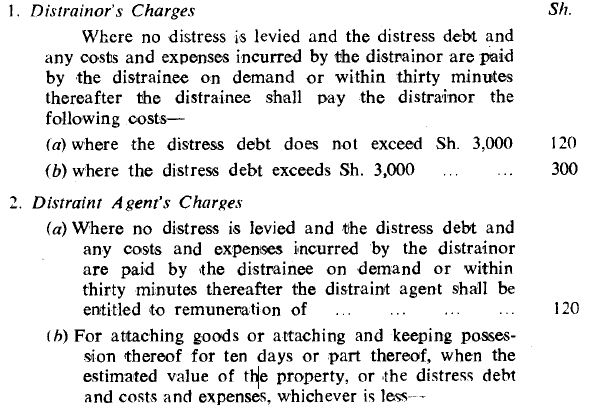

| (c) |
Where the goods or any part thereof are sold by public auction, the distraint agent's charges shall instead be calculated in the manner directed above by reference to the total amount realized on sale after deduction of the auctioneer's commission under regulation 15.
|
| (d) |
For keeping possession of any attached goods after the expiration of ten days from the date of attachment for each day, or part thereof—
1/4 per cent of the value of the goods with a maximum of Sh. 60.
|
| (e) |
Reasonable expenses incurred by the distraint agent in transporting goods attached, and such travelling expenses by car, or a rateable proportion thereof, as the Commissioner may approve.
|
THE VALUE ADDED TAX (DISTRAINT) REGULATIONS, 1990
Revoked by Legal Notice 54 of 2017 on 7th April, 2017
| 1. |
Citation
These Regulations may be cited as the Value Added Tax (Distraint) Regulations, 1990.
|
| 2. |
Interpretation
In these Regulations, unless the context otherwise requires—
"distrainee" means the registered person or debtor named in an order;
"distrainor" means an officer in the service of the Value Added Tax Department who is authorized to levy distress;
"distraint agent" means a person appointed as such under regulation 3;
"distress" means a distress levied pursuant to an order;
"distress debt" means the amount of tax, and interest charged thereon, specified in the order;
"goods" means all movable property of distrainee (other than growing crops and goods which are liable to perish within ten days of attachment) which is liable under the law to attachment and sale in execution of a decree of a court;
"order" means an order issued by the Commissioner under section 18(I) of the Act.
|
| 3. |
Distraint agents
| (1) |
An authorized officer may appoint distraint agents to assist him in the execution of orders.
|
| (2) |
No person shall be appointed a distraint agent unless he satisfies the authorized officer that he—
| (a) |
is of good repute and of good financial standing;
|
| (b) |
is qualified under the law relating thereto to levy distress by way of attachment of movable property in execution of a decree of a court; and
|
| (c) |
has contracted a policy of insurance in an adequate sum against theft, damage or destruction by fire of goods which may be placed in his custody by reason of the performance of his duties as a distraint agent.
|
|
|
| 4. |
Distraint agent to furnish security
| (1) |
A distraint agent shall on appointment furnish the Commissioner with security, by means of deposit of the sum of thirty thousand shillings, or in such other manner as the Commissioner may approve, and that security shall be refunded or cancelled on the termination of the appointment of the agent unless it is forfeited under this regulation.
|
| (2) |
If a distraint agent is convicted of an offence involving fraud or dishonesty in connection with any function performed by him as agent, the court by which he is convicted may make an order as to forfeiture of the security furnished by him under paragraph (1), or any part thereof, and the provisions of the Criminal Procedure Code (Cap. 75), in so far as they relate to forfeiture of recognizance, shall apply mutatis mutandis to the forfeiture of security under this regulation.
|
|
| 5. |
Execution of orders
| (1) |
An order may be executed at any time after it has been duly served on the distrainee in the manner provided by regulation 6.
|
| (2) |
An order shall be executed by attachment of such goods of the distrainee as in the opinion of the distrainor are of a value which on sale by public auction, would realize a sum sufficient to meet the distress debt and the costs and expenses of the distress incurred by the distrainor.
|
|
| 6. |
Service of orders
| (1) |
Every order shall be issued by the Commissioner in duplicate and service thereof shall be effected by service by the distrainor of a copy of the order on the distrainee in person or, if after using all due and reasonable diligence the distrainee cannot be found, by service of a copy on an agent of the distrainee empowered to accept service or an adult member of the family of the distrainee who is residing with him.
|
| (2) |
A person served with a copy of an order under this regulation shall endorse on the order acknowledgement of service, and if he refuses to make endorsement the distrainor shall leave the copy of the order with the person or his agent after stating in writing thereon that the person or his agent upon whom he served the order refused to sign the acknowledgement and that he left at the time, date and place stated therein, a copy of the order with that person and the name and address of the person (if any) by whom the person on whom the order was served was identified, and thereupon the order shall he deemed to have been duly served.
[L.N. 123/1996, r. 2(i).]
|
|
| 7. |
Forceable entry
| (1) |
In executing any distress, no outer door of a dwelling-house shall be broken open unless the dwelling-house is in the occupancy of the distrainee and he refuses or in any way prevents access thereto, but when the distrainor executing distress has duly gained access to a dwelling-house he may break open the door of any room in which he has reason to believe any goods of the distrainee to be.
|
| (2) |
When a room in a dwelling-house is in the actual occupancy of a woman who, according to her religion or local custom does not appear in public the distrainor shall give notice to her that she is at liberty to withdraw; and after allowing reasonable time for her to withdraw and giving her reasonable facility for withdrawing, he may enter the room for the purpose of attaching any goods therein, using at the time every precaution consistent with these provisions to prevent their clandestine removal.
|
|
| 8. |
Steps subsequent to attachment
As soon as practicable after the attachment of goods under these Regulations, the distrainor shall—
| (a) |
issue a receipt in respect thereof to the distrainee;
|
| (b) |
forward to the Commissioner a report containing an inventory of all items attached, the value of each item as estimated by the distrainor, the address of the premises at which the the goods are kept pending sale, the name and address of the distraint agent in whose custody the goods have been placed and the arrangements, if any, made or to be made for the sale by public auction of the goods on the expiration of ten days from the date of attachment.
|
|
| 9. |
Limitation on sale of attached goods
On the sale by public auction of any goods attached under these Regulations, the distrainor shall cause the sale to be stopped when the sale has realized a sum equal to or exceeding the distress debt and the costs and expenses incurred by the distrainor, and there-upon any of the goods remaining unsold shall at the cost of the distrainee be restored to the distrainee.
|
| 10. |
Return on completion of sale
Immediately after the completion of a sale by publication of goods attached under these Regulations, the distrainor shall make a return to the Commissioner specifying the items which have been sold, the amount realized by the sale and the manner in which the proceeds of the sale were applied.
|
| 11. |
Restoration of attached goods on payment, etc.
| (1) |
Where a distrainee has within ten days of attachment of his goods under these Regulations, paid or given security accepted by the Commissioner for the whole of the tax due from him together with the whole of the costs and expenses incurred by the distrainor in executing the distress, the distrainor shall at the cost of the distrainee forthwith restore the attached goods to the distrainee and return the order to the Commissioner who shall cancel it.
|
| (2) |
Any money paid by a distrainee under this regulation shall be applied by the Commissioner first in settlement of the costs and expenses incurred by the distrainor and as to the balance in settlement of the distress debt or such part thereof as the Commissioner shall direct.
|
|
| 12. |
Livestock
Where any goods attached under these Regulations comprise or include livestock, the distrainor may make appropriate arrangements for the transport, safe custody and feeding thereof and any costs and expenses incurred by the distrainor thereby shall be recoverable from the distrainee under regulation 9 or 11, as the case may be, as costs and expenses.
[L.N. 123/1996, r. 2(ii).]
|
| 13. |
Costs for levying distress
In addition to a claim for any other costs and expenses which may be incurred by the Commissioner or the distrainor in levying distress under these Regulations, there may be claimed by the distrainor and recovered under regulations 9 and 11, as the case may be, costs at the rate specified in the Schedule.
|
| 14. |
Remuneration of distraint agents
The maximum rates of remuneration which a distraint agent shall be entitled to demand from the distrainor for his assistance in executing a distress under these Regulations, and which may be recovered by the distrainor under regulation 9 or 11, as the case may be, shall be those specified in the Schedule.
|
| 15. |
Commission payable to auctioneer
The maximum rates of commission to be paid to an auctioneer by the distrainor as remuneration for his services for the sale by public auction of any goods attached under these Regulations, and which may be recovered by the distrainor under regulation 9, shall be five per cent of the amount realized on the sale, and where an auctioneer has also rendered services as a distraint agent he shall be entitled, in addition to any commission, to remuneration for those services as provided in regulation 14.
|
| 16. |
Matters included in rates of remuneration
The rates of remuneration specified in the Schedule shall be deemed to include all expenses of advertisements, inventories, catalogues, insurance and necessary charges for safeguarding goods attached under these Regulations.
|
SCHEDULE
RATES OF REMUNERATION
[Reg. 16.]
| (c) |
Where the goods or any part thereof are sold by public auction, the distraint agent's charges shall instead be calculated in the manner directed above by reference to the total amount realized on sale after deduction of the auctioneer's commission under regulation 15.
|
| (d) |
For keeping possession of any attached goods after the expiration of ten days from the date of attachment for each day, or part thereof—
1/4 per cent of the value of the goods with a maximum of Sh. 60.
|
| (e) |
Reasonable expenses incurred by the distraint agent in transporting goods attached, and such travelling expenses by car, or a rateable proportion thereof, as the Commissioner may approve.
|
THE VALUE ADDED TAX (DISTRAINT) REGULATIONS, 1990
Revoked by Legal Notice 54 of 2017 on 7th April, 2017
THE VALUE ADDED TAX (TRIBUNAL) RULES, 1990
ARRANGEMENT OF RULES
| 3. |
Appointment of secretary
|
| 4. |
Form and time for lodging an appeal
|
| 6. |
Statement of facts of Commissioner
|
| 7. |
Service of memorandum of appeal
|
| 8. |
Statement of facts of Commissioner
|
| 9. |
Notice and place of hearing
|
| 10. |
Procedure at hearing of appeal
|
| 11. |
Tribunal to determine own procedure in certain matters
|
| 12. |
Copies of documents admissible
|
THE VALUE ADDED TAX (TRIBUNAL) RULES, 1990
Revoked by Legal Notice 54 of 2017 on 7th April, 2017
| 1. |
Citation
These Rules may be cited as the Value Added Tax (Tribunal) Rules, 1990.
|
| 2. |
Interpretation
In these Rules, unless the context otherwise requires—
"appeal" means an appeal to the Tribunal under section 33(2);
"appellant" means a person entering an appeal and the advocate or duly authorized agent of that person;
"chairman" means the chairman of the Tribunal appointed under section 32(2);
"memorandum" means a memorandum of appeal presented under rule 4;
"secretary" means the secretary to the Tribunal appointed pursuant to rule 3;
"section" means a section of the Act.
|
| 3. |
Appointment of secretary
| (1) |
The Commissioner shall appoint a person to be the secretary to the Tribunal, and that person may be an officer of the Value Added Tax Department.
|
| (2) |
The secretary shall, in matters relating to appeals to the Tribunal and procedure therefor, comply with general and special directions lawfully given by the chairman.
|
| (3) |
The secretary shall by notice in the Gazette notify his address for the presentation or service of documents for the purposes of these Rules, and shall in the same manner notify any change in that address.
|
|
| 4. |
Form and time for lodging an appeal
An appeal shall be entered by presentation of a memorandum of appeal, together with five copies thereof, to the secretary within fourteen days after the date on which the appellant gives notice of appeal in writing to the Commissioner pursuant to section 33(2); but where the Tribunal is satisfied that, owing to absence from his normal place of residence, sickness or other reasonable cause, the appellant was prevented from presenting a memorandum within that period, and that there has been no unreasonable delay on his part, the Tribunal may extend that period notwithstanding that the period has already expired.
|
| 5. |
Memorandum of appeal
A memorandum shall be signed by the appellant and shall set out concisely under distinct heads, numbered consecutively, the grounds of appeal without argument or narrative.
|
| 6. |
Statement of facts of Commissioner
Each copy of a memorandum shall be accompanied by—
| (a) |
a copy of the decision of the Commissioner disputed by the appellant;
|
| (b) |
a copy of the notice of appeal; and
|
| (c) |
a statement, signed by the appellant, setting out precisely all the facts on which the appeal is based and referring specifically to documentary or other evidence which it is proposed to adduce at the hearing of the appeal, and to which shall be annexed a copy of each document or extract from a document upon which the appellant proposes to rely as evidence at the hearing of the appeal.
|
|
| 7. |
Service of memorandum of appeal
Within forty-eight hours after the presentation of a memorandum to the secretary, a copy thereof and of the statement of facts of the appellant and the documents annexed thereto shall be served by the appellant upon the Commissioner.
|
| 8. |
Statement of facts of Commissioner
| (1) |
The Commissioner shall, if he does not accept any of the facts of the appellant, within twenty-one days after service thereof upon him under rule 7, file with the secretary a statement of facts together with five copies thereof and the provisions of rule 6(c) shall mutatis mutandis apply to the statement of facts.
|
| (2) |
At the time of filing a statement of facts pursuant to paragraph (1), the Commissioner shall serve a copy thereof, together with copies of any documents annexed thereto, upon the appellant.
|
| (3) |
If the Commissioner does not desire to file a statement of facts under this rule, he shall forthwith give written notice to that effect to the secretary and to the appellant, and in that case the Commissioner shall be deemed at the hearing of the appeal to have accepted the facts set out in the statement of facts of the appellant.
|
|
| 9. |
Notice and place of hearing
| (1) |
As soon as may be convenient after receipt by him of the memorandum the secretary shall notify the chairman thereof.
|
| (2) |
The chairman shall, after the Commissioner has filed a state-ment of facts or has notified the secretary that he does not intend to do so, fix a time, date and place for a meeting of the Tribunal for the purpose of hearing the appeal, and the secretary shall cause notice thereof to be served on the appellant and the Commissioner.
|
| (3) |
The secretary shall cause to be supplied to each member of the Tribunal a copy of the notice of hearing and of all documents received by him from the parties to the appeal.
|
| (4) |
Unless the parties to the appeal otherwise agree, each party shall be entitled to not less than seven days' notice of the time, date and place fixed for the hearing of the appeal.
|
|
| 10. |
Procedure at hearing of appeal
At the hearing of an appeal, the following procedure shall be observed—
| (a) |
the Commissioner shall be entitled to he present or be represented;
|
| (b) |
the appellant shall state the grounds of his appeal and may support it by any relevant evidence, but, save with the consent of the Tribunal and upon such terms as it may determine, the appellant may not at the hearing rely on a ground of appeal other than a ground stated in the memoran-dum and may not adduce evidence of facts or documents unless those facts have been referred to in, and copies of those documents have been annexed to, the statement of facts of the appellants;
|
| (c) |
at the conclusion of the statement, and evidence on behalf of the appellant, the Commissioner may make submissions, supported by relevant evidence, and subparagraph (b) shall mutatis mutandis apply to evidence of facts and documents to be adduced by the Commissioner;
|
| (d) |
the appellant shall be entitled to reply but may not raise a new issue or argument;
|
| (e) |
the chairman or a member of the Tribunal may at any stage of the hearing ask any questions of the appellant or the Commissioner or a witness examined at the hearing, which he considers necessary to the determination of the appeal;
|
| (f) |
a witness called and examined by either party may be cross-examined by the other party to the appeal;
|
| (g) |
a witness called and examined by the Tribunal may be cross-examined by either party to the appeal;
|
| (h) |
the Tribunal may adjourn the hearing of the appeal for the production of further evidence or for other good cause, as it considers necessary, on such terms as it may determine;
|
| (i) |
before the Tribunal considers its decision, the parties to the appeal shall withdraw from the meeting, and the Tribunal shall deliberate the issue according to law and reach its decision thereon;
|
| (j) |
the decision of the Tribunal shall be determined by a majority of the members present and voting at the meeting, and in the case of an equality of votes the chairman shall have a casting vote in addition to his deliberative vote;
|
| (k) |
minutes of the meeting shall be kept and the decision of the Tribunal recorded therein.
|
|
| 11. |
Tribunal to determine own procedure in certain matters
In matters of procedure not governed by these Rules or the Act, the Tribunal may determine its own procedure.
|
| 12. |
Copies of documents admissible
Save where the Tribunal in any particular case otherwise directs or where a party to the appeal objects, copies of documents shall be admissible in evidence, but the Tribunal may at any time
(INCOMPLETE - YET TO GET MISING CONTENT -PGS)
NEXT VERSION as amended by LN 71/2000.. which Not found
|
THE VALUE ADDED TAX (TRIBUNAL) RULES, 1990
Revoked by Legal Notice 54 of 2017 on 7th April, 2017
THE VALUE ADDED TAX REGULATIONS, 1994
ARRANGEMENT OF SECTIONS
| 1. |
Citation and commencement
|
| 3. |
Application for registration
|
| 5. |
Simplified tax invoice
|
| 6. |
Credit note and debit note
|
| 7. |
Records to be kept by taxable persons
|
| 8. |
Samples of taxable goods
|
| 9. |
VAT returns and payments by cheques
|
| 10. |
Export of taxable goods and services
|
| 11. |
Application for tax refund
|
| 12. |
Claims for tax refund
|
| 13. |
Tax paid on stocks on hand, assets, building, etc.
|
| 15. |
Powers of Commissioner of Customs
|
| 16. |
Determination of selling price
|
| 18. |
Sale of taxable goods in returnable containers
|
| 19. |
Where taxable goods or taxable services are supplied to unregistered persons
|
| 20. |
Services supplied in Kenya
|
| 20. |
Revocation of Legal Notice 400 of 1989
|
THE VALUE ADDED TAX REGULATIONS, 1994
Revoked by Legal Notice 54 of 2017 on 7th April, 2017
| 1. |
Citation and commencement
These Regulations may be cited as the Value Added Tax Regulations, 1994 and shall come into operation on the 17th June, 1994.
|
| 2. |
Interpretation
In these Regulations, unless the context otherwise requires—
"personal identification number" means the personal identification number required under section 132 of the Income Tax Act.
|
| 3. |
Application for registration
| (1) |
Applications for registration under paragraphs 1 and 3 of the Sixth Schedule to the Act shall be submitted on Form VAT 1.
|
| (2) |
Any person who knowingly:—
| (a) |
gives false information on Form VAT 1; or
|
| (b) |
fails to give full information on Form VAT 1; or
|
| (c) |
makes application on Form VAT 1 to register a person who is already registered,
|
shall be guilty of an offence.
|
| (3) |
The certificate of registration shall be issued on Form VAT 2.
|
|
| 4. |
Tax invoice
| (1) |
The tax invoice to be issued under paragraph 1 of the Seventh Schedule to the Act shall be serially numbered and shall be issued in serial number order.
|
| (2) |
The tax invoice shall include the following information—
| (a) |
the name, address, VAT registration number and personal identification number of the person making the supply;
|
| (b) |
the serial number of the invoice;
|
| (d) |
the date of the supply, if different from that given under sub-paragraph (c);
|
| (e) |
the name and address, and VAT registration number, if any, of the person to whom the supply was made, if known to the supplier;
|
| (f) |
the description, quantity and price of the goods or services being supplied;
|
| (g) |
the taxable value of the goods or services, if different from the price charged;
|
| (h) |
the rate and amount of tax charged on each of those goods and services;
|
| (i) |
details of whether the supply is a cash or credit sale and details of cash or other discounts, if any, that apply to the supply; and
|
| (j) |
the total value of the supply and the total amount of VAT charged.
|
|
|
| 5. |
Simplified tax invoice
| (1) |
The simplified tax invoice referred to in the proviso to paragraph 1 of the Seventh Schedule to the Act shall include the following information—
| (a) |
the name, address, VAT registration number and personal identification number of the person making the supply;
|
| (b) |
the serial number of the invoice;
|
| (d) |
a brief description of the goods or services being supplied;
|
| (e) |
the total amount charged to the customer, VAT included; and
|
| (f) |
the explicit statement that the price includes VAT.
|
|
| (2) |
Where, under the proviso to paragraph 1 of the Seventh Schedule to the Act, the Commissioner has authorised other methods of accounting for tax—
| (a) |
the registered person shall record the value and brief details of each supply as it occurs and before the goods, or the customer, leaves the business premises;
|
| (b) |
the registered person shall keep a cash register, book, or other suitable record at each point of sale in which shall be entered details of all cash received and cash payments made at the time that they are made and at the end of each day the record shall be totalled and a balance shall be struck;
|
| (c) |
at the end of each day the output tax chargeable on supplies made and the deductible input tax shown on tax invoices in respect of supplies received shall be recorded in the appropriate records.
|
|
|
| 6. |
Credit note and debit note
| (1) |
Where goods are returned to the registered person or, for good and valid reason the registered person decides for business reasons to reduce the value of a supply after the issue of a tax invoice, a credit note may be issued for the amount of the reduction.
|
| (2) |
Where a credit note is issued under this regulation it shall be serially numbered and shall include details of the name, address, registration number and personal identification number of the person to whom it is issued and sufficient details to identify the tax invoice on which the supply was made and the tax that was originally charged.
|
| (3) |
A registered person who issues a credit note under the conditions specified in this regulation may reduce the amount of his output tax in the month in which the credit note was issued by an amount that bears the same proportion to the tax originally charged as the amount credited bears to the total amount originally charged and the amount of tax so credited shall be specified on the credit note.
|
| (4) |
A registered person who receives a credit note for the supply in respect of which he has claimed deductible input tax, shall reduce the amount of deductible input tax in the month in which the credit note is received, by the amount of tax so credited.
|
| (5) |
Where a registered person has issued a tax invoice in respect of a taxable supply and subsequently makes a further charge in respect of that supply, or any transaction associated with that supply, he shall in respect of the further charge being made, issue either a further tax invoice, or a serially numbered debit note containing all the details specified in regulation 4, and shall show on it the details of the tax invoice issued at the time of the original supply.
|
| (6) |
A registered person who receives a further tax invoice or a debit note issued in compliance with paragraph (5) may, if the supply is eligible therefor and in so far as it has not previously been claimed, claim as deductible input tax such further amount of tax that is being charged, in the month in which the further charge was made, or in the next subsequent month.
|
|
| 7. |
Records to be kept by taxable persons
| (1) |
Records to be kept and produced to an officer under this regulation include —
| (a) |
copies of all invoices issued in serial number order;
|
| (b) |
copies of all credit and debit notes issued, in chronological order;
|
| (c) |
all purchase invoices, copies of customs entries, receipts for the payment of customs duty or tax, and credit and debit notes received, to be filed chronologically either by date of receipt or under each supplier's name;
|
| (d) |
details of the amounts of tax charged on each supply made or received;
|
| (e) |
totals of the output tax and the input tax in each period and a net total of the tax payable or the excess tax carried forward, as the case may be, at the end of each month;
|
| (f) |
details of goods manufactured and delivered from the factory of the taxable person;
|
| (g) |
details of each supply of goods and services from the business premises, unless such details are available at the time of supply on invoices issued at, or before, that time.
|
|
| (2) |
All records required to be kept under this regulation shall be included in the audit of accounts of the taxable person that may be subject to such audit by a competent person.
|
| (3) |
Where the Commissioner considers that a taxable person is not complying with requirements of this regulation, or where he considers that other records should be kept by the taxable person to safeguard the tax revenue, he shall issued a notice to the taxable person requiring him to keep such records or take such action as the Commissioner may specify and any person failing to comply with such notice shall be guilty of an offence.
|
| (4) |
Where a notice issued under sub-paragraph (3) is not complied with and without prejudice to any other action that he may take, the Commissioner may, from such information as is available to him, assess the amount of tax that he considers to be due from the taxable person during each period that the offence continues.
|
| (5) |
All records required to be kept under this regulation shall be maintained up-to-date and details of all tax charged shall be entered in the appropriate records without delay.
|
| (6) |
All records shall be kept in the Kiswahili or English language and shall be kept for a period of seven years from the date of the last entry made therein.
|
| (7) |
Where records relating to a business are being kept in any language other than those prescribed, the Commissioner may require a registered person to produce, at that person's expense, an authenticated translation of those records.
|
|
| 8. |
Samples of taxable goods
| (a) |
are distributed free as samples by a registered person for furtherance of his business; and
|
| (b) |
have a value of less than two hundred shillings for each sample; and
|
| (c) |
are freely available; and
|
| (d) |
are not limited in distribution to fewer than thirty persons in any one calender month,
|
they shall not be liable to tax.
|
| 9. |
VAT returns and payments by cheques
| (1) |
The return required by paragraph 6 of the Seventh Schedule to the Act shall be on Form VAT 3.
|
| (2) |
Where payment is made by cheque, the cheque shall be made payable to the "Commissioner of Value Added Tax" and shall be crossed and endorsed with the words "account payee only".
|
| (3) |
Where tax exceeds Kenya shillings twenty thousand payment thereof shall be made by banker's cheque or bank guaranteed cheque.
|
| (4) |
Where any cheque is not honoured upon presentation, the amount stated thereon shall be deemed not to have been paid and additional tax shall become due and payable in respect of that amount until such time as it is paid, notwithstanding that the cheque may subsequently be honoured on representation.
|
| (5) |
Any fraction of a shilling due on any return shall be ignored.
|
|
| 10. |
Export of taxable goods and services
| (1) |
Subject to section 8 of the Act and the Fifth Schedule to the Act, any taxable goods or taxable services exported by a registered person shall be zero-rated if evidence of exportation consisting of —
| (a) |
a copy of the invoice showing the sale of the goods or services to the purchaser; and
|
| (b) |
in the case of goods, copies of the bill of lading, road manifest or airway bill, as the case may be; and
|
| (c) |
in the case of goods, the export entry duly certified by the proper officer of customs at the port of export,
|
is maintained on file by the registered person for examination by an authorized officer on demand.
|
| (2) |
Subject to section 8 of the Act and the Fifth Schedule to the Act, any taxable goods or taxable services supplied by a registered person to an export processing zone enterprise, or to a registered person manufacturing goods in a customs bonded factory for export, or to any person or organization as specified in the Eighth Schedule to the Act shall be zero rated if evidence of the supply consisting of—
| (a) |
a copy of the invoice showing the supply of the goods or services to the purchaser;
|
| (b) |
proof of the payment made in respect of the goods or services supplied; and
|
| (c) |
a certificate signed by the purchaser that the goods have been received,
|
is maintained on the file by the registered person for examination by an authorized officer on demand.
|
| (3) |
Subject to paragraph (4), where an exporter who is not a registered person exports by way of business any taxable goods that he has imported or purchased from a registered person and claims a refund of the tax paid on those goods he shall submit his claim to the Commissioner on Form VAT 4 and shall attach to any such claim, the following —
| (a) |
a copy of the invoice showing the sale of the goods to the purchaser; and
|
| (b) |
the export entry duly certified by the proper officer of customs at the port of export; and
|
| (c) |
evidence of the value of the goods and the payment by him of tax due thereon, being a copy of the tax invoice issued by a registered person, or a copy of the customs entry on which the goods were imported, as the case may be; and
|
| (d) |
evidence that foreign exchange has been credited to the account of the purchaser with his commercial bank in Kenya.
|
|
| (4) |
The Commissioner shall not issue a tax remission certificate referred to in Form VAT 4B unless the application is accompanied by—
| (a) |
bond security on Form VAT 4 B1 duly executed and guaranteed by a bank, insurance company or financial institution licensed to operate in Kenya; and
|
| (b) |
an irrevocable letter of credit, or evidence that the account of the exporter has been credited with payment in foreign currency for the exported goods; and
|
| (c) |
a proforma invoice from the registered manufacturer or dealer.
|
|
| (5) |
A VAT remission certificate issued under paragraph (4) shall be valid for ninety days only from the date of issue.
|
| (6) |
Upon completion of exportation, the exporter shall resubmit to the Commissioner within ninety days from the date of issue, the duplicate copy of the VAT remission certificate supported by documentary evidence of exportation of the goods.
|
| (7) |
A bond security provided under paragraph 4(a) shall be cancelled upon the exporter satisfying the Commissioner —
| (a) |
that the goods have been duly exported;
|
| (b) |
that the appropriate payment in foreign currency or in an approved manner has been received by him.
|
|
| (8) |
Where an exporter fails to comply with the provisions of paragraphs (6) and (7), the appropriate tax shall be payable in full forthwith together with a penalty of 3% per month or part thereof calculated from the date of issue of the tax remission certificate by the Commissioner under paragraph (4).
|
| (9) |
No refund shall be made under this regulation—
| (a) |
where the amount to be refunded is less than five hundred shillings; or
|
| (b) |
where the exportation took place more than twelve calendar months previously or such further period as the Commissioner may in any particular case determine.
|
|
| (10) |
Zero-rating of exported goods or refund of tax paid shall not be allowed under this regulation in respect of any goods which have been used before they were exported.
|
| (11) |
Where the Commissioner considers that there is doubt about the exportation of any goods he may require any person exporting the goods to produce to him within a reasonable time a certificate, signed and stamped by a competent customs authority overseas, that the goods were duly landed and reported to the proper customs authority at the port or place of foreign destination, and payment of any claim may be deferred until such a certificate has been produced and accepted as satisfactory by the Commissioner.
|
| (12) |
Where a person who is not a registered person supplies by way of business any taxable goods that he has imported or purchased from a registered person to an export processing zone or to a foreign aid funded investment project and claims a refund of the tax paid on those goods he shall submit his claim to the commissioner on Form VAT 4 and shall attach to any such claim, the following—
| (a) |
a copy of the invoice showing the sale of the goods to the purchaser; and
|
| (b) |
evidence of the value of the goods and the payment by him of tax due thereon, being a copy of the tax invoice issued by a registered person or a copy of the Customs entry on which the goods were imported, as the case may be; and
|
| (c) |
a certificate signed by the purchaser that the goods have been received and that they have been purchased as part of a specified project or in accordance with the approved operations of the export processing zone, as the case may be.
|
|
|
| 11. |
Application for tax refund
An application for tax refund under section 24(b) and (c) of the Act shall be made on Form VAT 4.
|
| 12. |
Claims for tax refund
| (1) |
Any claim for refund of tax by a registered person under section 24A of the Act shall be accompanied by—
| (a) |
a document issued to him by the person with whom he proves in the insolvency of the debtor, specifying the total amount proved, except where a claim is made because over three years have elapsed since the registered person paid the tax;
|
| (b) |
a copy of the tax invoice provided in respect of each taxable supply upon which the claim is based;
|
| (c) |
records or other documents, showing that the tax has been accounted for and paid on each supply upon which the claim for a refund of tax is based;
|
| (d) |
evidence that every reasonable effort has been made to have the debt settled; and
|
| (e) |
a declaration by him that he and the buyers are independent of each other.
|
|
| (2) |
No refund is payable unless the registered person is up-to-date in submitting all VAT returns on Form VAT 3 together with the appropriate tax.
|
|
| 13. |
Tax paid on stocks on hand, assets, building, etc.
| (1) |
A registered person shall submit to the Commissioner, his claim for relief from tax paid on stocks on hand, assets, building or civil works on the date he becomes registered on Form VAT 5 within thirty days of that date.
|
| (2) |
Where the Commissioner considers that there is good and valid reason why the registered person could not submit his claim under paragraph (1) within the thirty days he may accept a claim made within such longer period as he deems to be fair and reasonable.
|
| (3) |
The Commissioner may require the registered person to produce to an authorised officer evidence of—
| (a) |
the quantities, descriptions and values of goods in stock on the date of registration;
|
| (b) |
the proper use or disposal of such goods after the date of registration.
|
|
|
| 14. |
Security
| (1) |
A security required by the Commissioner under section 29 of the Act shall be in such sum not exceeding the total tax payable and, unless the person from whom the security is required opts to deposit the required sum or equivalent securities with the Commissioner, shall take the form of a bond in such form, and given by such sureties, as the Commissioner may approve.
|
| (2) |
Where a bond given under this regulation is discharged, the Commissioner shall cause the bond to be cancelled and shall advise the person giving it accordingly.
|
| (3) |
Where any person who is a surety to a bond under this regulation—
| (b) |
is adjudged bankrupt or enters into any composition with his creditors; or
|
the person on whose behalf the bond was given shall notify the Commissioner accordingly and the Commissioner may cancel the bond and require a fresh surety to be given.
|
|
| 15. |
Powers of Commissioner of Customs & Excise
By virtue of section 57 of the Act—
| (a) |
the Commissioner of Customs and Excise appointed under section 3 of the Customs and Excise Act (Cap. 472) shall be responsible for the collection of tax chargeable in respect of imported taxable goods and shall account for that tax to the Commissioner; and
|
| (b) |
the Commissioner of Customs and Excise and other proper officers of Customs appointed under the Customs and Excise Act shall, subject to the Act and Customs and Excise Act have and exercise in respect of imported taxable goods all the powers and duties conferred or imposed on them by the Customs and Excise Act.
|
|
| 16. |
Determination of selling price
For the purposes of section 9(b) of the Act, the price determined by the Commissioner shall be the open market selling price where the seller and buyer are independent of each other.
|
| 17. |
Deductible input tax
| (1) |
Where a registered person supplies both taxable goods and services and exempt goods and services, he can only deduct that part of his input tax which is attributable to taxable supplies which attribution shall be approved by the Commissioner, but he may use either of the under mentioned methods to determine the amount of deductible input tax without the approval of the Commissioner—
| (a) |
Value of taxable supplies x Input tax = Deductible input tax
Value of total supplies
|
| (b) |
(i) full deduction of all the input tax attributable to taxable goods purchased and sold in the same state;
| (ii) |
no deduction of any input tax which is directly attributable to exempt outputs; and |
| (iii) |
deduction of the input tax attributable to the remainder of the taxable supplies, calculated as under sub-paragraph (a). |
|
|
| (2) |
Notwithstanding paragraph (1) where the amount of input tax attributable to exempt supplies is less than five per cent of the total input tax, then all the input tax can be deducted.
|
|
| 18. |
Sale of taxable goods in returnable containers
Where taxable goods are sold by a registered person in returnable containers then—
| (a) |
if the registered person has purchased or imported those containers tax paid, the amount of any tax payable by virtue of subsection (2) of section 9 of the Act in respect of the containers shall be remitted; or
|
| (b) |
in any other case, the amount of tax so payable upon those containers which are returned to the registered person, and upon which he has given a credit to the purchaser, shall be remitted by means of a credit taken by the registered person on his next succeeding tax return.
|
|
| 19. |
Where taxable goods or taxable services are supplied to unregistered persons
| (a) |
Where a registered person is a retailer or is primarily supplying taxable goods or taxable services to unregistered persons, prices of such goods or services shall be quoted or labelled including the amount of the tax;
|
| (b) |
Where prices are quoted inclusive of tax, the value of the tax shall be estimated in the case of ad valorem tax rate by a tax that is multiplied by such a tax inclusive price reduced by any exclusion from the taxable value allowed under section 9 of the Act. The tax factor is equal to (t/(l + t)) where t is the ad valorem tax rate specified in the First Schedule to the Act.
|
|
| 20. |
Revocation of Legal Notice 400 of 1989
The Value Added Fax Regulations are revoked (L.N. 400/1989).
|
THE VALUE ADDED TAX REGULATIONS, 1994
Revoked by Legal Notice 54 of 2017 on 7th April, 2017
| 1. |
Citation and commencement
These Regulations may be cited as the Value Added Tax Regulations, 1994 and shall come into operation on the 17th June, 1994.
|
| 2. |
Interpretation
In these Regulations, unless the context otherwise requires—
"personal identification number" means the personal identification number required under section 132 of the Income Tax Act.
|
| 3. |
Application for registration
| (1) |
Applications for registration under paragraphs 1 and 3 of the Sixth Schedule to the Act shall be submitted on Form VAT 1.
|
| (2) |
Any person who knowingly:—
| (a) |
gives false information on Form VAT 1; or
|
| (b) |
fails to give full information on Form VAT 1; or
|
| (c) |
makes application on Form VAT 1 to register a person who is already registered,
|
shall be guilty of an offence.
|
| (3) |
The certificate of registration shall be issued on Form VAT 2.
|
|
| 4. |
Tax invoice
| (1) |
The tax invoice to be issued under paragraph 1 of the Seventh Schedule to the Act shall be serially numbered and shall be issued in serial number order.
|
| (2) |
The tax invoice shall include the following information—
| (a) |
the name, address, VAT registration number and personal identification number of the person making the supply;
|
| (b) |
the serial number of the invoice;
|
| (d) |
the date of the supply, if different from that given under sub-paragraph (c);
|
| (e) |
the name and address, and VAT registration number, if any, of the person to whom the supply was made, if known to the supplier;
|
| (f) |
the description, quantity and price of the goods or services being supplied;
|
| (g) |
the taxable value of the goods or services, if different from the price charged;
|
| (h) |
the rate and amount of tax charged on each of those goods and services;
|
| (i) |
details of whether the supply is a cash or credit sale and details of cash or other discounts, if any, that apply to the supply; and
|
| (j) |
the total value of the supply and the total amount of VAT charged.
|
|
|
| 5. |
Simplified tax invoice
| (1) |
The simplified tax invoice referred to in the proviso to paragraph 1 of the Seventh Schedule to the Act shall include the following information—
| (a) |
the name, address, VAT registration number and personal identification number of the person making the supply;
|
| (b) |
the serial number of the invoice;
|
| (d) |
a brief description of the goods or services being supplied;
|
| (e) |
the total amount charged to the customer, VAT included; and
|
| (f) |
the explicit statement that the price includes VAT.
|
|
| (2) |
Where, under the proviso to paragraph 1 of the Seventh Schedule to the Act, the Commissioner has authorised other methods of accounting for tax—
| (a) |
the registered person shall record the value and brief details of each supply as it occurs and before the goods, or the customer, leaves the business premises;
|
| (b) |
the registered person shall keep a cash register, book, or other suitable record at each point of sale in which shall be entered details of all cash received and cash payments made at the time that they are made and at the end of each day the record shall be totalled and a balance shall be struck;
|
| (c) |
at the end of each day the output tax chargeable on supplies made and the deductible input tax shown on tax invoices in respect of supplies received shall be recorded in the appropriate records.
|
|
|
| 6. |
Credit note and debit note
| (1) |
Where goods are returned to the registered person or, for good and valid reason the registered person decides for business reasons to reduce the value of a supply after the issue of a tax invoice, a credit note may be issued for the amount of the reduction.
|
| (2) |
Where a credit note is issued under this regulation it shall be serially numbered and shall include details of the name, address, registration number and personal identification number of the person to whom it is issued and sufficient details to identify the tax invoice on which the supply was made and the tax that was originally charged.
|
| (3) |
A registered person who issues a credit note under the conditions specified in this regulation may reduce the amount of his output tax in the month in which the credit note was issued by an amount that bears the same proportion to the tax originally charged as the amount credited bears to the total amount originally charged and the amount of tax so credited shall be specified on the credit note.
|
| (4) |
A registered person who receives a credit note for the supply in respect of which he has claimed deductible input tax, shall reduce the amount of deductible input tax in the month in which the credit note is received, by the amount of tax so credited.
|
| (5) |
Where a registered person has issued a tax invoice in respect of a taxable supply and subsequently makes a further charge in respect of that supply, or any transaction associated with that supply, he shall in respect of the further charge being made, issue either a further tax invoice, or a serially numbered debit note containing all the details specified in regulation 4, and shall show on it the details of the tax invoice issued at the time of the original supply.
|
| (6) |
A registered person who receives a further tax invoice or a debit note issued in compliance with paragraph (5) may, if the supply is eligible therefor and in so far as it has not previously been claimed, claim as deductible input tax such further amount of tax that is being charged, in the month in which the further charge was made, or in the next subsequent month.
|
|
| 7. |
Records to be kept by taxable persons
| (1) |
Records to be kept and produced to an officer under this regulation include —
| (a) |
copies of all invoices issued in serial number order;
|
| (b) |
copies of all credit and debit notes issued, in chronological order;
|
| (c) |
all purchase invoices, copies of customs entries, receipts for the payment of customs duty or tax, and credit and debit notes received, to be filed chronologically either by date of receipt or under each supplier's name;
|
| (d) |
details of the amounts of tax charged on each supply made or received;
|
| (e) |
totals of the output tax and the input tax in each period and a net total of the tax payable or the excess tax carried forward, as the case may be, at the end of each month;
|
| (f) |
details of goods manufactured and delivered from the factory of the taxable person;
|
| (g) |
details of each supply of goods and services from the business premises, unless such details are available at the time of supply on invoices issued at, or before, that time.
|
|
| (2) |
All records required to be kept under this regulation shall be included in the audit of accounts of the taxable person that may be subject to such audit by a competent person.
|
| (3) |
Where the Commissioner considers that a taxable person is not complying with requirements of this regulation, or where he considers that other records should be kept by the taxable person to safeguard the tax revenue, he shall issued a notice to the taxable person requiring him to keep such records or take such action as the Commissioner may specify and any person failing to comply with such notice shall be guilty of an offence.
|
| (4) |
Where a notice issued under sub-paragraph (3) is not complied with and without prejudice to any other action that he may take, the Commissioner may, from such information as is available to him, assess the amount of tax that he considers to be due from the taxable person during each period that the offence continues.
|
| (5) |
All records required to be kept under this regulation shall be maintained up-to-date and details of all tax charged shall be entered in the appropriate records without delay.
|
| (6) |
All records shall be kept in the Kiswahili or English language and shall be kept for a period of seven years from the date of the last entry made therein.
|
| (7) |
Where records relating to a business are being kept in any language other than those prescribed, the Commissioner may require a registered person to produce, at that person's expense, an authenticated translation of those records.
|
|
| 8. |
Samples of taxable goods
| (a) |
are distributed free as samples by a registered person for furtherance of his business; and
|
| (b) |
have a value of less than two hundred shillings for each sample; and
|
| (c) |
are freely available; and
|
| (d) |
are not limited in distribution to fewer than thirty persons in any one calender month,
|
they shall not be liable to tax.
|
| 9. |
VAT returns and payments by cheques
| (1) |
The return required by paragraph 6 of the Seventh Schedule to the Act shall be on Form VAT 3.
|
| (2) |
Where payment is made by cheque, the cheque shall be made payable to the "Commissioner of Value Added Tax" and shall be crossed and endorsed with the words "account payee only".
|
| (3) |
Where tax exceeds Kenya shillings twenty thousand payment thereof shall be made by banker's cheque or bank guaranteed cheque.
|
| (4) |
Where any cheque is not honoured upon presentation, the amount stated thereon shall be deemed not to have been paid and additional tax shall become due and payable in respect of that amount until such time as it is paid, notwithstanding that the cheque may subsequently be honoured on representation.
|
| (5) |
Any fraction of a shilling due on any return shall be ignored.
|
|
| 10. |
Export of taxable goods and services
| (1) |
Subject to section 8 of the Act and the Fifth Schedule to the Act, any goods or taxable services exported by a registered person or supplied by that person to an export processing zone enterprise shall be zero-rated if evidence of exportation consisting of—
| (a) |
a copy of the invoice showing the sale of the goods or services to the purchaser; and
|
| (b) |
in the case of goods, copies of the bill of lading, road manifest or airway bill, as the case may be; and
|
| (c) |
in the case of goods, the export entry duly certified by the proper officer of Customs at the port of export;
|
is maintained on file by the registered person for examination by an authorized officer on demand.
|
| (2) |
Subject to section 8 of the Act and the Fifth Schedule to the Act, any taxable goods or taxable services supplied by a registered person to a registered person manufacturing goods in a customs bonded factory for export, or to any person or organization as specified in the Eighth Schedule to the Act shall be zero rated if evidence of the supply consisting of—
| (a) |
a copy of the invoice showing the supply of the goods or services to the purchaser;
|
| (b) |
proof of the payment made in respect of the goods or services supplied; and
|
| (c) |
a certificate signed by the purchaser that the goods have been received,
|
is maintained on the file by the registered person for examination by an authorized officer on demand.
|
| (3) |
Subject to paragraph (4), where an exporter who is not a registered person exports by way of business any taxable goods that he has imported or purchased from a registered person and claims a refund of the tax paid on those goods he shall submit his claim to the Commissioner on Form VAT 4 and shall attach to any such claim, the following —
| (a) |
a copy of the invoice showing the sale of the goods to the purchaser; and
|
| (b) |
the export entry duly certified by the proper officer of customs at the port of export; and
|
| (c) |
evidence of the value of the goods and the payment by him of tax due thereon, being a copy of the tax invoice issued by a registered person, or a copy of the customs entry on which the goods were imported, as the case may be; and
|
| (d) |
evidence that foreign exchange has been credited to the account of the purchaser with his commercial bank in Kenya.
|
|
| (4) |
The Commissioner shall not issue a tax remission certificate referred to in Form VAT 4B unless the application is accompanied by—
| (a) |
bond security on Form VAT 4 B1 duly executed and guaranteed by a bank, insurance company or financial institution licensed to operate in Kenya; and
|
| (b) |
an irrevocable letter of credit, or evidence that the account of the exporter has been credited with payment in foreign currency for the exported goods; and
|
| (c) |
a proforma invoice from the registered manufacturer or dealer.
|
|
| (5) |
A VAT remission certificate issued under paragraph (4) shall be valid for ninety days only from the date of issue.
|
| (6) |
Upon completion of exportation, the exporter shall resubmit to the Commissioner within ninety days from the date of issue, the duplicate copy of the VAT remission certificate supported by documentary evidence of exportation of the goods.
|
| (7) |
A bond security provided under paragraph 4(a) shall be cancelled upon the exporter satisfying the Commissioner —
| (a) |
that the goods have been duly exported;
|
| (b) |
that the appropriate payment in foreign currency or in an approved manner has been received by him.
|
|
| (8) |
Where an exporter fails to comply with the provisions of paragraphs (6) and (7), the appropriate tax shall be payable in full forthwith together with a penalty of 3% per month or part thereof calculated from the date of issue of the tax remission certificate by the Commissioner under paragraph (4).
|
| (9) |
No refund shall be made under this regulation—
| (a) |
where the amount to be refunded is less than five hundred shillings; or
|
| (b) |
where the exportation took place more than twelve calendar months previously or such further period as the Commissioner may in any particular case determine.
|
|
| (10) |
Zero-rating of exported goods or refund of tax paid shall not be allowed under this regulation in respect of any goods which have been used before they were exported.
|
| (11) |
Where the Commissioner considers that there is doubt about the exportation of any goods he may require any person exporting the goods to produce to him within a reasonable time a certificate, signed and stamped by a competent customs authority overseas, that the goods were duly landed and reported to the proper customs authority at the port or place of foreign destination, and payment of any claim may be deferred until such a certificate has been produced and accepted as satisfactory by the Commissioner.
|
| (12) |
Where a person who is not a registered person supplies by way of business any taxable goods that he has imported or purchased from a registered person to an export processing zone or to a foreign aid funded investment project and claims a refund of the tax paid on those goods he shall submit his claim to the commissioner on Form VAT 4 and shall attach to any such claim, the following—
| (a) |
a copy of the invoice showing the sale of the goods to the purchaser; and
|
| (b) |
evidence of the value of the goods and the payment by him of tax due thereon, being a copy of the tax invoice issued by a registered person or a copy of the Customs entry on which the goods were imported, as the case may be; and
|
| (c) |
a certificate signed by the purchaser that the goods have been received and that they have been purchased as part of a specified project or in accordance with the approved operations of the export processing zone, as the case may be.
|
|
|
| 11. |
Application for tax refund
An application for tax refund under section 24(b) and (c) of the Act shall be made on Form VAT 4.
|
| 12. |
Claims for tax refund
| (1) |
Any claim for refund of tax by a registered person under section 24A of the Act shall be accompanied by—
| (a) |
a document issued to him by the person with whom he proves in the insolvency of the debtor, specifying the total amount proved, except where a claim is made because over three years have elapsed since the registered person paid the tax;
|
| (b) |
a copy of the tax invoice provided in respect of each taxable supply upon which the claim is based;
|
| (c) |
records or other documents, showing that the tax has been accounted for and paid on each supply upon which the claim for a refund of tax is based;
|
| (d) |
evidence that every reasonable effort has been made to have the debt settled; and
|
| (e) |
a declaration by him that he and the buyers are independent of each other.
|
|
| (2) |
No refund is payable unless the registered person is up-to-date in submitting all VAT returns on Form VAT 3 together with the appropriate tax.
|
|
| 13. |
Tax paid on stocks on hand, assets, building, etc.
| (1) |
A registered person shall submit to the Commissioner, his claim for relief from tax paid on stocks on hand, assets, building or civil works on the date he becomes registered on Form VAT 5 within thirty days of that date.
|
| (2) |
Where the Commissioner considers that there is good and valid reason why the registered person could not submit his claim under paragraph (1) within the thirty days he may accept a claim made within such longer period as he deems to be fair and reasonable.
|
| (3) |
The Commissioner may require the registered person to produce to an authorised officer evidence of—
| (a) |
the quantities, descriptions and values of goods in stock on the date of registration;
|
| (b) |
the proper use or disposal of such goods after the date of registration.
|
|
|
| 14. |
Security
| (1) |
A security required by the Commissioner under section 29 of the Act shall be in such sum not exceeding the total tax payable and, unless the person from whom the security is required opts to deposit the required sum or equivalent securities with the Commissioner, shall take the form of a bond in such form, and given by such sureties, as the Commissioner may approve.
|
| (2) |
Where a bond given under this regulation is discharged, the Commissioner shall cause the bond to be cancelled and shall advise the person giving it accordingly.
|
| (3) |
Where any person who is a surety to a bond under this regulation—
| (b) |
is adjudged bankrupt or enters into any composition with his creditors; or
|
the person on whose behalf the bond was given shall notify the Commissioner accordingly and the Commissioner may cancel the bond and require a fresh surety to be given.
|
|
| 15. |
Powers of Commissioner of Customs & Excise
By virtue of section 57 of the Act—
| (a) |
the Commissioner of Customs and Excise appointed under section 3 of the Customs and Excise Act (Cap. 472) shall be responsible for the collection of tax chargeable in respect of imported taxable goods and shall account for that tax to the Commissioner; and
|
| (b) |
the Commissioner of Customs and Excise and other proper officers of Customs appointed under the Customs and Excise Act shall, subject to the Act and Customs and Excise Act have and exercise in respect of imported taxable goods all the powers and duties conferred or imposed on them by the Customs and Excise Act.
|
|
| 16. |
Determination of selling price
For the purposes of section 9(b) of the Act, the price determined by the Commissioner shall be the open market selling price where the seller and buyer are independent of each other.
|
| 17. |
Deductible input tax
| (1) |
Where a registered person supplies both taxable goods and services and exempt goods and services, he can only deduct that part of his input tax which is attributable to taxable supplies which attribution shall be approved by the Commissioner, but he may use either of the under mentioned methods to determine the amount of deductible input tax without the approval of the Commissioner—
| (a) |
Value of taxable supplies x Input tax = Deductible input tax
Value of total supplies
|
| (b) |
(i) full deduction of all the input tax attributable to taxable goods purchased and sold in the same state;
| (ii) |
no deduction of any input tax which is directly attributable to exempt outputs; and |
| (iii) |
deduction of the input tax attributable to the remainder of the taxable supplies, calculated as under sub-paragraph (a). |
|
|
| (2) |
Notwithstanding paragraph (1) where the amount of input tax attributable to exempt supplies is less than five per cent of the total input tax, then all the input tax can be deducted.
|
|
| 18. |
Sale of taxable goods in returnable containers
Where taxable goods are sold by a registered person in returnable containers then—
| (a) |
if the registered person has purchased or imported those containers tax paid, the amount of any tax payable by virtue of subsection (2) of section 9 of the Act in respect of the containers shall be remitted; or
|
| (b) |
in any other case, the amount of tax so payable upon those containers which are returned to the registered person, and upon which he has given a credit to the purchaser, shall be remitted by means of a credit taken by the registered person on his next succeeding tax return.
|
|
| 19. |
Where taxable goods or taxable services are supplied to unregistered persons
| (a) |
Where a registered person is a retailer or is primarily supplying taxable goods or taxable services to unregistered persons, prices of such goods or services shall be quoted or labelled including the amount of the tax;
|
| (b) |
Where prices are quoted inclusive of tax, the value of the tax shall be estimated in the case of ad valorem tax rate by a tax that is multiplied by such a tax inclusive price reduced by any exclusion from the taxable value allowed under section 9 of the Act. The tax factor is equal to (t/(l + t)) where t is the ad valorem tax rate specified in the First Schedule to the Act.
|
|
| 20. |
Revocation of Legal Notice 400 of 1989
The Value Added Fax Regulations are revoked (L.N. 400/1989).
|
THE VALUE ADDED TAX REGULATIONS, 1994
Revoked by Legal Notice 54 of 2017 on 7th April, 2017
| 1. |
Citation and commencement
These Regulations may be cited as the Value Added Tax Regulations, 1994 and shall come into operation on the 17th June, 1994.
|
| 2. |
Interpretation
In these Regulations, unless the context otherwise requires—
"personal identification number" means the personal identification number required under section 132 of the Income Tax Act.
|
| 3. |
Application for registration
| (1) |
Applications for registration under paragraphs 1 and 3 of the Sixth Schedule to the Act shall be submitted on Form VAT 1.
|
| (2) |
Any person who knowingly:—
| (a) |
gives false information on Form VAT 1; or
|
| (b) |
fails to give full information on Form VAT 1; or
|
| (c) |
makes application on Form VAT 1 to register a person who is already registered,
|
shall be guilty of an offence.
|
| (3) |
The certificate of registration shall be issued on Form VAT 2.
|
|
| 4. |
Tax invoice
| (1) |
The tax invoice to be issued under paragraph 1 of the Seventh Schedule to the Act shall be serially numbered and shall be issued in serial number order.
|
| (2) |
The tax invoice shall include the following information—
| (a) |
the name, address, VAT registration number and personal identification number of the person making the supply;
|
| (b) |
the serial number of the invoice;
|
| (d) |
the date of the supply, if different from that given under sub-paragraph (c);
|
| (e) |
the name and address, and VAT registration number, if any, of the person to whom the supply was made, if known to the supplier;
|
| (f) |
the description, quantity and price of the goods or services being supplied;
|
| (g) |
the taxable value of the goods or services, if different from the price charged;
|
| (h) |
the rate and amount of tax charged on each of those goods and services;
|
| (i) |
details of whether the supply is a cash or credit sale and details of cash or other discounts, if any, that apply to the supply; and
|
| (j) |
the total value of the supply and the total amount of VAT charged.
|
|
|
| 5. |
Simplified tax invoice
| (1) |
The simplified tax invoice referred to in the proviso to paragraph 1 of the Seventh Schedule to the Act shall include the following information—
| (a) |
the name, address, VAT registration number and personal identification number of the person making the supply;
|
| (b) |
the serial number of the invoice;
|
| (d) |
a brief description of the goods or services being supplied;
|
| (e) |
the total amount charged to the customer, VAT included; and
|
| (f) |
the explicit statement that the price includes VAT.
|
|
| (2) |
Where, under the proviso to paragraph 1 of the Seventh Schedule to the Act, the Commissioner has authorised other methods of accounting for tax—
| (a) |
the registered person shall record the value and brief details of each supply as it occurs and before the goods, or the customer, leaves the business premises;
|
| (b) |
the registered person shall keep a cash register, book, or other suitable record at each point of sale in which shall be entered details of all cash received and cash payments made at the time that they are made and at the end of each day the record shall be totalled and a balance shall be struck;
|
| (c) |
at the end of each day the output tax chargeable on supplies made and the deductible input tax shown on tax invoices in respect of supplies received shall be recorded in the appropriate records.
|
|
|
| 6. |
Credit note and debit note
| (1) |
Where goods are returned to the registered person or, for good and valid reason the registered person decides for business reasons to reduce the value of a supply after the issue of a tax invoice, a credit note may be issued for the amount of the reduction.
|
| (2) |
Where a credit note is issued under this regulation it shall be serially numbered and shall include details of the name, address, registration number and personal identification number of the person to whom it is issued and sufficient details to identify the tax invoice on which the supply was made and the tax that was originally charged.
|
| (3) |
A registered person who issues a credit note under the conditions specified in this regulation may reduce the amount of his output tax in the month in which the credit note was issued by an amount that bears the same proportion to the tax originally charged as the amount credited bears to the total amount originally charged and the amount of tax so credited shall be specified on the credit note.
|
| (4) |
A registered person who receives a credit note for the supply in respect of which he has claimed deductible input tax, shall reduce the amount of deductible input tax in the month in which the credit note is received, by the amount of tax so credited.
|
| (5) |
Where a registered person has issued a tax invoice in respect of a taxable supply and subsequently makes a further charge in respect of that supply, or any transaction associated with that supply, he shall in respect of the further charge being made, issue either a further tax invoice, or a serially numbered debit note containing all the details specified in regulation 4, and shall show on it the details of the tax invoice issued at the time of the original supply.
|
| (6) |
A registered person who receives a further tax invoice or a debit note issued in compliance with paragraph (5) may, if the supply is eligible therefor and in so far as it has not previously been claimed, claim as deductible input tax such further amount of tax that is being charged, in the month in which the further charge was made, or in the next subsequent month.
|
|
| 7. |
Records to be kept by taxable persons
| (1) |
Records to be kept and produced to "an authorised officer under this regulation include —
| (a) |
copies of all invoices issued in serial number order;
|
| (b) |
copies of all credit and debit notes issued, in chronological order;
|
| (c) |
all purchase invoices, copies of customs entries, receipts for the payment of customs duty or tax, and credit and debit notes received, to be filed chronologically either by date of receipt or under each supplier's name;
|
| (d) |
details of the amounts of tax charged on each supply made or received;
|
| (e) |
totals of the output tax and the input tax in each period and a net total of the tax payable or the excess tax carried forward, as the case may be, at the end of each period;
|
| (f) |
details of goods manufactured and delivered from the factory of the taxable person;
|
| (g) |
details of each supply of goods and services from the business premises, unless such details are available at the time of supply on invoices issued at, or before, that time.
|
|
| (2) |
All records required to be kept under this regulation shall be included in the audit of accounts of the taxable person that may be subject to such audit by a competent person.
|
| (3) |
Where the Commissioner considers that a taxable person is not complying with requirements of this regulation, or where he considers that other records should be kept by the taxable person to safeguard the tax revenue, he shall issue a notice to the taxable person requiring him to keep such records or take such action as the Commissioner may specify and any person failing to comply with such notice shall be guilty of an offence.
|
| (4) |
Where a notice issued under paragraph (3) is not complied with and without prejudice to any other action that he may take, the Commissioner may, from such information as is available to him, assess the amount of tax that he considers to be due from the taxable person during each period that the offence continues.
|
| (5) |
All records required to be kept under this regulation shall be maintained up-to-date and details of all tax charged shall be entered in the appropriate records without delay.
|
| (6) |
All records shall be kept in the Kiswahili or English language and shall be kept for a period of seven years from the date of the last entry made therein.
|
| (7) |
Where records relating to a business are being kept in any language other than those prescribed, the Commissioner may require a registered person to produce, at that person's expense, an authenticated translation of those records.
[L.N 121/1996, r. 2.]
|
|
| 8. |
Samples of taxable goods
| (a) |
are distributed free as samples by a registered person for furtherance of his business; and
|
| (b) |
have a value of less than two hundred shillings for each sample; and
|
| (c) |
are freely available; and
|
| (d) |
are not limited in distribution to fewer than thirty persons in any one calender month,
|
they shall not be liable to tax.
|
| 9. |
VAT returns and payments by cheques
| (1) |
The return required by paragraph 7 of the Seventh Schedule to the Act shall be on Form VAT 3.
|
| (2) |
Where payment is made by cheque, the cheque shall be made payable to the "Commissioner of Value Added Tax" and shall be crossed and endorsed with the words "account payee only".
|
| (3) |
All tax payments shall be made by banker's cheque, bank guaranteed cheque or cash.
|
| (4) |
Where any cheque is not honoured upon presentation, the amount stated thereon shall be deemed not to have been paid and additional tax shall become due and payable in respect of that amount until such time as it is paid, notwithstanding that the cheque may subsequently be honoured on representation.
|
| (5) |
Any fraction of a shilling due on any return shall be ignored.
[L.N 121/1996, r. 3.]
|
|
| 10. |
Export of taxable goods and services
| (1) |
Subject to section 8 of the Act and the Fifth Schedule to the Act, any goods or taxable services exported by a registered person or supplied by that person to an export processing zone enterprise shall be zero-rated if evidence of exportation consisting of—
| (a) |
a copy of the invoice showing the sale of the goods or services to the purchaser; and
|
| (b) |
in the case of goods, copies of the bill of lading, road manifest or airway bill, as the case may be; and
|
| (c) |
in the case of goods, the export entry duly certified by the proper officer of Customs at the port of export;
|
is maintained on file by the registered person for examination by an authorized officer on demand.
|
| (2) |
Subject to section 8 of the Act and the Fifth Schedule to the Act, any taxable goods or taxable services supplied by a registered person to a registered person manufacturing goods in a customs bonded factory for export, or to any person or organization as specified in the Eighth Schedule to the Act shall be zero rated if evidence of the supply consisting of—
| (a) |
a copy of the invoice showing the supply of the goods or services to the purchaser;
|
| (b) |
proof of the payment made in respect of the goods or services supplied; and
|
| (c) |
a certificate signed by the purchaser that the goods have been received,
|
is maintained on the file by the registered person for examination by an authorized officer on demand.
|
| (3) |
Subject to paragraph (4), where an exporter who is not a registered person exports by way of business any taxable goods that he has imported or purchased from a registered person and claims a refund of the tax paid on those goods he shall submit his claim to the Commissioner on Form VAT 4 and shall attach to any such claim, the following —
| (a) |
a copy of the invoice showing the sale of the goods to the purchaser; and
|
| (b) |
the export entry duly certified by the proper officer of customs at the port of export; and
|
| (c) |
evidence of the value of the goods and the payment by him of tax due thereon, being a copy of the tax invoice issued by a registered person, or a copy of the customs entry on which the goods were imported, as the case may be; and
|
| (d) |
evidence that foreign exchange has been credited to the account of the purchaser with his commercial bank in Kenya.
|
|
| (4) |
The Commissioner shall not issue a tax remission certificate referred to in Form VAT 4B unless the application is accompanied by—
| (a) |
bond security on Form VAT 4 B1 duly executed and guaranteed by a bank, insurance company or financial institution licensed to operate in Kenya; and
|
| (b) |
an irrevocable letter of credit, or evidence that the account of the exporter has been credited with payment in foreign currency for the exported goods; and
|
| (c) |
a proforma invoice from the registered manufacturer or dealer.
|
|
| (5) |
A VAT remission certificate issued under paragraph (4) shall be valid for ninety days only from the date of issue.
|
| (6) |
Upon completion of exportation, the exporter shall resubmit to the Commissioner within ninety days from the date of issue, the duplicate copy of the VAT remission certificate supported by documentary evidence of exportation of the goods.
|
| (7) |
A bond security provided under paragraph 4(a) shall be cancelled upon the exporter satisfying the Commissioner —
| (a) |
that the goods have been duly exported;
|
| (b) |
that the appropriate payment in foreign currency or in an approved manner has been received by him.
|
|
| (8) |
Where an exporter fails to comply with the provisions of paragraphs (6) and (7), the appropriate tax shall be payable in full forthwith together with a penalty of 3% per month or part thereof calculated from the date of issue of the tax remission certificate by the Commissioner under paragraph (4).
|
| (9) |
No refund shall be made under this regulation—
| (a) |
where the amount to be refunded is less than five hundred shillings; or
|
| (b) |
where the exportation took place more than twelve calendar months previously or such further period as the Commissioner may in any particular case determine.
|
|
| (10) |
Zero-rating of exported goods or refund of tax paid shall not be allowed under this regulation in respect of any goods which have been used before they were exported.
|
| (11) |
Where the Commissioner considers that there is doubt about the exportation of any goods he may require any person exporting the goods to produce to him within a reasonable time a certificate, signed and stamped by a competent customs authority outside Kenya, that the goods were duly landed and reported to the proper customs authority at the port or place of foreign destination, and payment of any claim may be deferred until such a certificate has been produced and accepted as satisfactory by the Commissioner.
|
| (12) |
Where a person who is not a registered person supplies by way of business any taxable goods that he has imported or purchased from a registered person to an export processing zone to a foreign aid funded investment project or to a person manufacturing goods in a customs bonded factory and claims a refund of the tax paid on those goods he shall submit his claim to the commissioner on Form VAT 4 and shall attach to any such claim, the following—
| (a) |
a copy of the invoice showing the sale of the goods to the purchaser; and
|
| (b) |
evidence of the value of the goods and the payment by him of tax due thereon, being a copy of the tax invoice issued by a registered person or a copy of the Customs entry on which the goods were imported, as the case may be; and
|
| (c) |
a certificate signed by the purchaser that the goods have been received and that they have been purchased as part of a specified project or in accordance with the approved operations of the export processing zone, as the case may be.
|
[L.N. 213/1995, L.N 121/1996, r. 4.]
|
|
| 11. |
Application for tax refund
An application for tax refund under Sections 11(2), 24(a), (b) or (c) and 24A shall be made in Form VAT 4.
[L.N. 121/1996, r. 5.]
|
| 12. |
Claims for tax refund
| (1) |
Any claim for refund of tax by a registered person under section 24A of the Act shall be accompanied by—
| (a) |
a document issued to him by the person with whom he proves in the insolvency of the debtor, specifying the total amount proved, except where a claim is made because over three years have elapsed since the registered person paid the tax;
|
| (b) |
a copy of the tax invoice provided in respect of each taxable supply upon which the claim is based;
|
| (c) |
records or other documents, showing that the tax has been accounted for and paid on each supply upon which the claim for a refund of tax is based;
|
| (d) |
evidence that every reasonable effort has been made to have the debt settled; and
|
| (e) |
a declaration by him that he and the buyers are independent of each other.
|
|
| (2) |
No refund is payable unless the registered person is up-to-date in submitting all VAT returns on Form VAT 3 together with the appropriate tax.
|
|
| 13. |
Tax paid on stocks on hand, assets, building, etc.
| (1) |
A registered person shall submit to the Commissioner, his claim for relief from tax paid on stocks on hand, assets, building or civil works on the date he becomes registered on Form VAT 5 within thirty days of that date.
|
| (2) |
Where the Commissioner considers that there is good and valid reason why the registered person could not submit his claim under paragraph (1) within the thirty days he may accept a claim made within such longer period as he deems to be fair and reasonable.
|
| (3) |
The Commissioner may require the registered person to produce to an authorised officer evidence of—
| (a) |
the quantities, descriptions and values of goods in stock on the date of registration;
|
| (b) |
the proper use or disposal of such goods after the date of registration.
|
|
|
| 14. |
Security
| (1) |
A security required by the Commissioner under section 29 of the Act shall be in such sum not exceeding the total tax payable and, unless the person from whom the security is required opts to deposit the required sum or equivalent securities with the Commissioner, shall take the form of a bond in such form, and given by such sureties, as the Commissioner may approve.
|
| (2) |
Where a bond given under this regulation is discharged, the Commissioner shall cause the bond to be cancelled and shall advise the person giving it accordingly.
|
| (3) |
Where any person who is a surety to a bond under this regulation—
| (b) |
is adjudged bankrupt or enters into any composition with his creditors; or
|
the person on whose behalf the bond was given shall notify the Commissioner accordingly and the Commissioner may cancel the bond and require a fresh surety to be given.
|
|
| 15. |
Powers of Commissioner of Customs & Excise
By virtue of section 57 of the Act—
| (a) |
the Commissioner of Customs and Excise appointed under section 3 of the Customs and Excise Act (Cap. 472) shall be responsible for the collection of tax chargeable in respect of imported taxable goods and shall account for that tax to the Commissioner; and
|
| (b) |
the Commissioner of Customs and Excise and other proper officers of Customs appointed under the Customs and Excise Act shall, subject to the Act and Customs and Excise Act have and exercise in respect of imported taxable goods all the powers and duties conferred or imposed on them by the Customs and Excise Act.
|
|
| 16. |
Determination of selling price
For the purposes of section 9(b) of the Act, the price determined by the Commissioner shall be the open market selling price where the seller and buyer are independent of each other.
|
| 17. |
Deductible input tax
| (1) |
Where a registered person supplies both taxable goods and services and exempt goods and services, he can only deduct that part of his input tax which is attributable to taxable supplies which attribution shall be approved by the Commissioner, but he may use either of the under mentioned methods to determine the amount of deductible input tax without the approval of the Commissioner—
| (a) |
Value of taxable supplies x Input tax = Deductible input tax
Value of total supplies
|
| (b) |
(i) full deduction of all the input tax attributable to taxable goods purchased and sold in the same state;
| (ii) |
no deduction of any input tax which is directly attributable to exempt outputs; and |
| (iii) |
deduction of the input tax attributable to the remainder of the taxable supplies, calculated as under subparagraph (a). |
|
|
| (2) |
Notwithstanding paragraph (1) where the amount of input tax attributable to exempt supplies is less than five per cent of the total input tax, then all the input tax can be deducted.
|
| (3) |
Where there is a difference between the amount of claimable input tax for a year and the total amount deducted for the same period, the amount so calculated shall be declared as over declaration or under declaration, as the case may be, and such amount shall be entered in the return for the first tax period following the end of the calendar year.
[L.N. 121/1996, r. 6.]
|
|
| 18. |
Sale of taxable goods in returnable containers
Where taxable goods are sold by a registered person in returnable containers then—
| (a) |
if the registered person has purchased or imported those containers tax paid, the amount of any tax payable by virtue of subsection (2) of section 9 of the Act in respect of the containers shall be remitted; or
|
| (b) |
in any other case, the amount of tax so payable upon those containers which are returned to the registered person, and upon which he has given a credit to the purchaser, shall be remitted by means of a credit taken by the registered person on his next succeeding tax return.
|
|
| 19. |
Where taxable goods or taxable services are supplied to unregistered persons
| (a) |
Where a registered person is a retailer or is primarily supplying taxable goods or taxable services to unregistered persons, prices of such goods or services shall be quoted or labelled including the amount of the tax;
|
| (b) |
Where prices are quoted inclusive of tax, the value of the tax shall be estimated in the case of ad valorem tax rate by a tax that is multiplied by such a tax inclusive price reduced by any exclusion from the taxable value allowed under section 9 of the Act. The tax factor is equal to (t/(l + t)) where t is the ad valorem tax rate specified in the First Schedule to the Act.
|
|
| 20. |
Revocation of Legal Notice 400 of 1989
The Value Added Fax Regulations are revoked (L.N. 400/1989).
|
THE VALUE ADDED TAX REGULATIONS, 1994
Revoked by Legal Notice 54 of 2017 on 7th April, 2017
| 1. |
Citation and commencement
These Regulations may be cited as the Value Added Tax Regulations, 1994 and shall come into operation on the 17th June, 1994.
|
| 2. |
Interpretation
In these Regulations, unless the context otherwise requires—
"personal identification number" means the personal identification number required under section 132 of the Income Tax Act.
|
| 3. |
Application for registration
| (1) |
Applications for registration under paragraphs 1 and 3 of the Sixth Schedule to the Act shall be submitted on Form VAT 1.
|
| (2) |
Any person who knowingly:—
| (a) |
gives false information on Form VAT 1; or
|
| (b) |
fails to give full information on Form VAT 1; or
|
| (c) |
makes application on Form VAT 1 to register a person who is already registered,
|
shall be guilty of an offence.
|
| (3) |
The certificate of registration shall be issued on Form VAT 2.
|
|
| 4. |
Tax invoice
| (1) |
The tax invoice to be issued under paragraph 1 of the Seventh Schedule to the Act shall be serially numbered and shall be issued in serial number order.
|
| (2) |
The tax invoice shall include the following information—
| (a) |
the name, address, VAT registration number and personal identification number of the person making the supply;
|
| (b) |
the serial number of the invoice;
|
| (d) |
the date of the supply, if different from that given under sub-paragraph (c);
|
| (e) |
the name and address, and VAT registration number, if any, of the person to whom the supply was made, if known to the supplier;
|
| (f) |
the description, quantity and price of the goods or services being supplied;
|
| (g) |
the taxable value of the goods or services, if different from the price charged;
|
| (h) |
the rate and amount of tax charged on each of those goods and services;
|
| (i) |
details of whether the supply is a cash or credit sale and details of cash or other discounts, if any, that apply to the supply; and
|
| (j) |
the total value of the supply and the total amount of VAT charged.
|
|
|
| 5. |
Simplified tax invoice
| (1) |
The simplified tax invoice referred to in the proviso to paragraph 1 of the Seventh Schedule to the Act shall include the following information—
| (a) |
the name, address, VAT registration number and personal identification number of the person making the supply;
|
| (b) |
the serial number of the invoice;
|
| (d) |
a brief description of the goods or services being supplied;
|
| (e) |
the total amount charged to the customer, VAT included; and
|
| (f) |
the explicit statement that the price includes VAT.
|
|
| (2) |
Where, under the proviso to paragraph 1 of the Seventh Schedule to the Act, the Commissioner has authorised other methods of accounting for tax—
| (a) |
the registered person shall record the value and brief details of each supply as it occurs and before the goods, or the customer, leaves the business premises;
|
| (b) |
the registered person shall keep a cash register, book, or other suitable record at each point of sale in which shall be entered details of all cash received and cash payments made at the time that they are made and at the end of each day the record shall be totalled and a balance shall be struck;
|
| (c) |
at the end of each day the output tax chargeable on supplies made and the deductible input tax shown on tax invoices in respect of supplies received shall be recorded in the appropriate records.
|
|
|
| 6. |
Credit note and debit note
| (1) |
Where goods are returned to the registered person or, for good and valid reason the registered person decides for business reasons to reduce the value of a supply after the issue of a tax invoice, a credit note may be issued for the amount of the reduction.
|
| (2) |
Where a credit note is issued under this regulation it shall be serially numbered and shall include details of the name, address, registration number and personal identification number of the person to whom it is issued and sufficient details to identify the tax invoice on which the supply was made and the tax that was originally charged.
|
| (3) |
A registered person who issues a credit note under the conditions specified in this regulation may reduce the amount of his output tax in the month in which the credit note was issued by an amount that bears the same proportion to the tax originally charged as the amount credited bears to the total amount originally charged and the amount of tax so credited shall be specified on the credit note.
|
| (4) |
A registered person who receives a credit note for the supply in respect of which he has claimed deductible input tax, shall reduce the amount of deductible input tax in the month in which the credit note is received, by the amount of tax so credited.
|
| (5) |
Where a registered person has issued a tax invoice in respect of a taxable supply and subsequently makes a further charge in respect of that supply, or any transaction associated with that supply, he shall in respect of the further charge being made, issue either a further tax invoice, or a serially numbered debit note containing all the details specified in regulation 4, and shall show on it the details of the tax invoice issued at the time of the original supply.
|
| (6) |
A registered person who receives a further tax invoice or a debit note issued in compliance with paragraph (5) may, if the supply is eligible therefor and in so far as it has not previously been claimed, claim as deductible input tax such further amount of tax that is being charged, in the month in which the further charge was made, or in the next subsequent month.
|
|
| 7. |
Records to be kept by taxable persons
| (1) |
Records to be kept and produced to "an authorised officer under this regulation include —
| (a) |
copies of all invoices issued in serial number order;
|
| (b) |
copies of all credit and debit notes issued, in chronological order;
|
| (c) |
all purchase invoices, copies of customs entries, receipts for the payment of customs duty or tax, and credit and debit notes received, to be filed chronologically either by date of receipt or under each supplier's name;
|
| (d) |
details of the amounts of tax charged on each supply made or received;
|
| (e) |
totals of the output tax and the input tax in each period and a net total of the tax payable or the excess tax carried forward, as the case may be, at the end of each period;
|
| (f) |
details of goods manufactured and delivered from the factory of the taxable person;
|
| (g) |
details of each supply of goods and services from the business premises, unless such details are available at the time of supply on invoices issued at, or before, that time.
|
|
| (2) |
All records required to be kept under this regulation shall be included in the audit of accounts of the taxable person that may be subject to such audit by a competent person.
|
| (3) |
Where the Commissioner considers that a taxable person is not complying with requirements of this regulation, or where he considers that other records should be kept by the taxable person to safeguard the tax revenue, he shall issue a notice to the taxable person requiring him to keep such records or take such action as the Commissioner may specify and any person failing to comply with such notice shall be guilty of an offence.
|
| (4) |
Where a notice issued under paragraph (3) is not complied with and without prejudice to any other action that he may take, the Commissioner may, from such information as is available to him, assess the amount of tax that he considers to be due from the taxable person during each period that the offence continues.
|
| (5) |
All records required to be kept under this regulation shall be maintained up-to-date and details of all tax charged shall be entered in the appropriate records without delay.
|
| (6) |
All records shall be kept in the Kiswahili or English language and shall be kept for a period of seven years from the date of the last entry made therein.
|
| (7) |
Where records relating to a business are being kept in any language other than those prescribed, the Commissioner may require a registered person to produce, at that person's expense, an authenticated translation of those records.
[L.N 121/1996, r. 2.]
|
|
| 8. |
Samples of taxable goods
| (a) |
are distributed free as samples by a registered person for furtherance of his business; and
|
| (b) |
have a value of less than two hundred shillings for each sample; and
|
| (c) |
are freely available; and
|
| (d) |
are not limited in distribution to fewer than thirty persons in any one calender month,
|
they shall not be liable to tax.
|
| 9. |
VAT returns and payments by cheques
| (1) |
The return required by paragraph 7 of the Seventh Schedule to the Act shall be on Form VAT 3.
|
| (2) |
Where payment is made by cheque, the cheque shall be made payable to the "Commissioner of Value Added Tax" and shall be crossed and endorsed with the words "account payee only".
|
| (3) |
All tax payments shall be made by banker's cheque, bank guaranteed cheque or cash.
|
| (4) |
Where any cheque is not honoured upon presentation, the amount stated thereon shall be deemed not to have been paid and additional tax shall become due and payable in respect of that amount until such time as it is paid, notwithstanding that the cheque may subsequently be honoured on representation.
|
| (5) |
Any fraction of a shilling due on any return shall be ignored.
[L.N 121/1996, r. 3.]
|
|
| 10. |
Export of taxable goods and services
| (1) |
Subject to section 8 of the Act and the Fifth Schedule to the Act, any goods or taxable services exported by a registered person or supplied by that person to an export processing zone enterprise shall be zero-rated if evidence of exportation consisting of—
| (a) |
a copy of the invoice showing the sale of the goods or services to the purchaser; and
|
| (b) |
in the case of goods, copies of the bill of lading, road manifest or airway bill, as the case may be; and
|
| (c) |
in the case of goods, the export entry duly certified by the proper officer of Customs at the port of export;
|
| (d) |
in the case of sugar and all excisable goods, a certificate signed by the Commissioner of Customs and Excise that the goods have been examined and loaded into sealable vehicles or containers under a tamper proof seal and the seal number duly endorsed on the export entry,
|
is maintained on file by the registered person for examination by an authorized officer on demand.
|
| (2) |
Subject to section 8 of the Act and the Fifth Schedule to the Act, any taxable goods or taxable services supplied by a registered person to a registered person manufacturing goods in a customs bonded factory for export, or to any person or organization as specified in the Eighth Schedule to the Act shall be zero rated if evidence of the supply consisting of—
| (a) |
a copy of the invoice showing the supply of the goods or services to the purchaser;
|
| (b) |
proof of the payment made in respect of the goods or services supplied; and
|
| (c) |
a certificate signed by the purchaser that the goods have been received,
|
is maintained on the file by the registered person for examination by an authorized officer on demand.
|
| (3) |
Subject to paragraph (4), where an exporter who is not a registered person exports by way of business any taxable goods that he has imported or purchased from a registered person and claims a refund of the tax paid on those goods he shall submit his claim to the Commissioner on Form VAT 4 and shall attach to any such claim, the following —
| (a) |
a copy of the invoice showing the sale of the goods to the purchaser; and
|
| (b) |
the export entry duly certified by the proper officer of customs at the port of export; and
|
| (c) |
evidence of the value of the goods and the payment by him of tax due thereon, being a copy of the tax invoice issued by a registered person, or a copy of the customs entry on which the goods were imported, as the case may be; and
|
| (d) |
evidence that foreign exchange has been credited to the account of the purchaser with his commercial bank in Kenya;
|
| (e) |
in the case of sugar, a certificate signed by the Commissioner of Customs and Excise that the sugar has been examined and loaded into sealable vehicles or containers under a tamper proof seal and the seal number duly endorsed on the export entry.
|
|
| (4) |
The Commissioner shall not issue a tax remission certificate referred to in Form VAT 4B unless the application is accompanied by—
| (a) |
bond security on Form VAT 4 B1 duly executed and guaranteed by a bank, insurance company or financial institution licensed to operate in Kenya; and
|
| (b) |
an irrevocable letter of credit, or evidence that the account of the exporter has been credited with payment in foreign currency for the exported goods; and
|
| (c) |
a proforma invoice from the registered manufacturer or dealer.
|
|
| (5) |
A VAT remission certificate issued under paragraph (4) shall be valid for ninety days only from the date of issue.
|
| (6) |
Upon completion of exportation, the exporter shall resubmit to the Commissioner within ninety days from the date of issue, the duplicate copy of the VAT remission certificate supported by documentary evidence of exportation of the goods.
|
| (7) |
A bond security provided under paragraph 4(a) shall be cancelled upon the exporter satisfying the Commissioner —
| (a) |
that the goods have been duly exported;
|
| (b) |
that the appropriate payment in foreign currency or in an approved manner has been received by him.
|
|
| (8) |
Where an exporter fails to comply with the provisions of paragraphs (6) and (7), the appropriate tax shall be payable in full forthwith together with a penalty of 3% per month or part thereof calculated from the date of issue of the tax remission certificate by the Commissioner under paragraph (4).
|
| (9) |
No refund shall be made under this regulation—
| (a) |
where the amount to be refunded is less than five hundred shillings; or
|
| (b) |
where the exportation took place more than twelve calendar months previously or such further period as the Commissioner may in any particular case determine.
|
|
| (10) |
Zero-rating of exported goods or refund of tax paid shall not be allowed under this regulation in respect of any goods which have been used before they were exported.
|
| (11) |
Where the Commissioner considers that there is doubt about the exportation of any goods he may require any person exporting the goods to produce to him within a reasonable time a certificate, signed and stamped by a competent customs authority outside Kenya, that the goods were duly landed and reported to the proper customs authority at the port or place of foreign destination, and payment of any claim may be deferred until such a certificate has been produced and accepted as satisfactory by the Commissioner.
|
| (12) |
Where a person who is not a registered person supplies by way of business any taxable goods that he has imported or purchased from a registered person to an export processing zone to a foreign aid funded investment project or to a person manufacturing goods in a customs bonded factory and claims a refund of the tax paid on those goods he shall submit his claim to the commissioner on Form VAT 4 and shall attach to any such claim, the following—
| (a) |
a copy of the invoice showing the sale of the goods to the purchaser; and
|
| (b) |
evidence of the value of the goods and the payment by him of tax due thereon, being a copy of the tax invoice issued by a registered person or a copy of the Customs entry on which the goods were imported, as the case may be; and
|
| (c) |
a certificate signed by the purchaser that the goods have been received and that they have been purchased as part of a specified project or in accordance with the approved operations of the export processing zone, as the case may be.
|
[L.N. 213/1995, L.N 121/1996, r. 4, L.N. 42/1997.]
|
|
| 11. |
Application for tax refund
An application for tax refund under Sections 11(2), 24(a), (b) or (c) and 24A shall be made in Form VAT 4.
[L.N. 121/1996, r. 5.]
|
| 12. |
Claims for tax refund
| (1) |
Any claim for refund of tax by a registered person under section 24A of the Act shall be accompanied by—
| (a) |
a document issued to him by the person with whom he proves in the insolvency of the debtor, specifying the total amount proved, except where a claim is made because over three years have elapsed since the registered person paid the tax;
|
| (b) |
a copy of the tax invoice provided in respect of each taxable supply upon which the claim is based;
|
| (c) |
records or other documents, showing that the tax has been accounted for and paid on each supply upon which the claim for a refund of tax is based;
|
| (d) |
evidence that every reasonable effort has been made to have the debt settled; and
|
| (e) |
a declaration by him that he and the buyers are independent of each other.
|
|
| (2) |
No refund is payable unless the registered person is up-to-date in submitting all VAT returns on Form VAT 3 together with the appropriate tax.
|
|
| 13. |
Tax paid on stocks on hand, assets, building, etc.
| (1) |
A registered person shall submit to the Commissioner, his claim for relief from tax paid on stocks on hand, assets, building or civil works on the date he becomes registered on Form VAT 5 within thirty days of that date.
|
| (2) |
Where the Commissioner considers that there is good and valid reason why the registered person could not submit his claim under paragraph (1) within the thirty days he may accept a claim made within such longer period as he deems to be fair and reasonable.
|
| (3) |
The Commissioner may require the registered person to produce to an authorised officer evidence of—
| (a) |
the quantities, descriptions and values of goods in stock on the date of registration;
|
| (b) |
the proper use or disposal of such goods after the date of registration.
|
|
|
| 14. |
Security
| (1) |
A security required by the Commissioner under section 29 of the Act shall be in such sum not exceeding the total tax payable and, unless the person from whom the security is required opts to deposit the required sum or equivalent securities with the Commissioner, shall take the form of a bond in such form, and given by such sureties, as the Commissioner may approve.
|
| (2) |
Where a bond given under this regulation is discharged, the Commissioner shall cause the bond to be cancelled and shall advise the person giving it accordingly.
|
| (3) |
Where any person who is a surety to a bond under this regulation—
| (b) |
is adjudged bankrupt or enters into any composition with his creditors; or
|
the person on whose behalf the bond was given shall notify the Commissioner accordingly and the Commissioner may cancel the bond and require a fresh surety to be given.
|
|
| 15. |
Powers of Commissioner of Customs & Excise
By virtue of section 57 of the Act—
| (a) |
the Commissioner of Customs and Excise appointed under section 3 of the Customs and Excise Act (Cap. 472) shall be responsible for the collection of tax chargeable in respect of imported taxable goods and shall account for that tax to the Commissioner; and
|
| (b) |
the Commissioner of Customs and Excise and other proper officers of Customs appointed under the Customs and Excise Act shall, subject to the Act and Customs and Excise Act have and exercise in respect of imported taxable goods all the powers and duties conferred or imposed on them by the Customs and Excise Act.
|
|
| 16. |
Determination of selling price
For the purposes of section 9(b) of the Act, the price determined by the Commissioner shall be the open market selling price where the seller and buyer are independent of each other.
|
| 17. |
Deductible input tax
| (1) |
Where a registered person supplies both taxable goods and services and exempt goods and services, he can only deduct that part of his input tax which is attributable to taxable supplies which attribution shall be approved by the Commissioner, but he may use either of the under mentioned methods to determine the amount of deductible input tax without the approval of the Commissioner—
| (a) |
Value of taxable supplies x Input tax = Deductible input tax
Value of total supplies
|
| (b) |
(i) full deduction of all the input tax attributable to taxable goods purchased and sold in the same state;
| (ii) |
no deduction of any input tax which is directly attributable to exempt outputs; and |
| (iii) |
deduction of the input tax attributable to the remainder of the taxable supplies, calculated as under subparagraph (a). |
|
|
| (2) |
Notwithstanding paragraph (1) where the amount of input tax attributable to exempt supplies is less than five per cent of the total input tax, then all the input tax can be deducted.
|
| (3) |
Where there is a difference between the amount of claimable input tax for a year and the total amount deducted for the same period, the amount so calculated shall be declared as over declaration or under declaration, as the case may be, and such amount shall be entered in the return for the first tax period following the end of the calendar year.
[L.N. 121/1996, r. 6.]
|
|
| 18. |
Sale of taxable goods in returnable containers
Where taxable goods are sold by a registered person in returnable containers then—
| (a) |
if the registered person has purchased or imported those containers tax paid, the amount of any tax payable by virtue of subsection (2) of section 9 of the Act in respect of the containers shall be remitted; or
|
| (b) |
in any other case, the amount of tax so payable upon those containers which are returned to the registered person, and upon which he has given a credit to the purchaser, shall be remitted by means of a credit taken by the registered person on his next succeeding tax return.
|
|
| 19. |
Where taxable goods or taxable services are supplied to unregistered persons
| (a) |
Where a registered person is a retailer or is primarily supplying taxable goods or taxable services to unregistered persons, prices of such goods or services shall be quoted or labelled including the amount of the tax;
|
| (b) |
Where prices are quoted inclusive of tax, the value of the tax shall be estimated in the case of ad valorem tax rate by a tax that is multiplied by such a tax inclusive price reduced by any exclusion from the taxable value allowed under section 9 of the Act. The tax factor is equal to (t/(l + t)) where t is the ad valorem tax rate specified in the First Schedule to the Act.
|
|
| 20. |
Revocation of Legal Notice 400 of 1989
The Value Added Fax Regulations are revoked (L.N. 400/1989).
|
THE VALUE ADDED TAX REGULATIONS, 1994
Revoked by Legal Notice 54 of 2017 on 7th April, 2017
| 1. |
Citation and commencement
These Regulations may be cited as the Value Added Tax Regulations, 1994 and shall come into operation on the 17th June, 1994.
|
| 2. |
Interpretation
In these Regulations, unless the context otherwise requires—
"personal identification number" means the personal identification number required under section 132 of the Income Tax Act.
|
| 3. |
Application for registration
| (1) |
Applications for registration under paragraphs 1 and 3 of the Sixth Schedule to the Act shall be submitted on Form VAT 1.
|
| (2) |
Any person who knowingly:—
| (a) |
gives false information on Form VAT 1; or
|
| (b) |
fails to give full information on Form VAT 1; or
|
| (c) |
makes application on Form VAT 1 to register a person who is already registered,
|
shall be guilty of an offence.
|
| (3) |
The certificate of registration shall be issued on Form VAT 2.
|
|
| 4. |
Tax invoice
| (1) |
The tax invoice to be issued under paragraph 1 of the Seventh Schedule to the Act shall be serially numbered and shall be issued in serial number order.
|
| (2) |
The tax invoice shall include the following information—
| (a) |
the name, address, VAT registration number and personal identification number of the person making the supply;
|
| (b) |
the serial number of the invoice;
|
| (d) |
the date of the supply, if different from that given under sub-paragraph (c);
|
| (e) |
the name and address, and VAT registration number, if any, of the person to whom the supply was made, if known to the supplier;
|
| (f) |
the description, quantity and price of the goods or services being supplied;
|
| (g) |
the taxable value of the goods or services, if different from the price charged;
|
| (h) |
the rate and amount of tax charged on each of those goods and services;
|
| (i) |
details of whether the supply is a cash or credit sale and details of cash or other discounts, if any, that apply to the supply; and
|
| (j) |
the total value of the supply and the total amount of VAT charged.
|
|
|
| 5. |
Simplified tax invoice
| (1) |
The simplified tax invoice referred to in the proviso to paragraph 1 of the Seventh Schedule to the Act shall include the following information—
| (a) |
the name, address, VAT registration number and personal identification number of the person making the supply;
|
| (b) |
the serial number of the invoice;
|
| (d) |
a brief description of the goods or services being supplied;
|
| (e) |
the total amount charged to the customer, VAT included; and
|
| (f) |
the explicit statement that the price includes VAT.
|
|
| (2) |
Where, under the proviso to paragraph 1 of the Seventh Schedule to the Act, the Commissioner has authorised other methods of accounting for tax—
| (a) |
the registered person shall record the value and brief details of each supply as it occurs and before the goods, or the customer, leaves the business premises;
|
| (b) |
the registered person shall keep a cash register, book, or other suitable record at each point of sale in which shall be entered details of all cash received and cash payments made at the time that they are made and at the end of each day the record shall be totalled and a balance shall be struck;
|
| (c) |
at the end of each day the output tax chargeable on supplies made and the deductible input tax shown on tax invoices in respect of supplies received shall be recorded in the appropriate records.
|
|
|
| 6. |
Credit note and debit note
| (1) |
Where goods are returned to the registered person or, for good and valid reason the registered person decides for business reasons to reduce the value of a supply after the issue of a tax invoice, a credit note may be issued for the amount of the reduction.
|
| (2) |
Where a credit note is issued under this regulation it shall be serially numbered and shall include details of the name, address, registration number and personal identification number of the person to whom it is issued and sufficient details to identify the tax invoice on which the supply was made and the tax that was originally charged.
|
| (3) |
A registered person who issues a credit note under the conditions specified in this regulation may reduce the amount of his output tax in the month in which the credit note was issued by an amount that bears the same proportion to the tax originally charged as the amount credited bears to the total amount originally charged and the amount of tax so credited shall be specified on the credit note.
|
| (4) |
A registered person who receives a credit note for the supply in respect of which he has claimed deductible input tax, shall reduce the amount of deductible input tax in the month in which the credit note is received, by the amount of tax so credited.
|
| (5) |
Where a registered person has issued a tax invoice in respect of a taxable supply and subsequently makes a further charge in respect of that supply, or any transaction associated with that supply, he shall in respect of the further charge being made, issue either a further tax invoice, or a serially numbered debit note containing all the details specified in regulation 4, and shall show on it the details of the tax invoice issued at the time of the original supply.
|
| (6) |
A registered person who receives a further tax invoice or a debit note issued in compliance with paragraph (5) may, if the supply is eligible therefor and in so far as it has not previously been claimed, claim as deductible input tax such further amount of tax that is being charged, in the month in which the further charge was made, or in the next subsequent month.
|
|
| 7. |
Records to be kept by taxable persons
| (1) |
Records to be kept and produced to "an authorised officer under this regulation include —
| (a) |
copies of all invoices issued in serial number order;
|
| (b) |
copies of all credit and debit notes issued, in chronological order;
|
| (c) |
all purchase invoices, copies of customs entries, receipts for the payment of customs duty or tax, and credit and debit notes received, to be filed chronologically either by date of receipt or under each supplier's name;
|
| (d) |
details of the amounts of tax charged on each supply made or received;
|
| (e) |
totals of the output tax and the input tax in each period and a net total of the tax payable or the excess tax carried forward, as the case may be, at the end of each period;
|
| (f) |
details of goods manufactured and delivered from the factory of the taxable person;
|
| (g) |
details of each supply of goods and services from the business premises, unless such details are available at the time of supply on invoices issued at, or before, that time.
|
|
| (2) |
All records required to be kept under this regulation shall be included in the audit of accounts of the taxable person that may be subject to such audit by a competent person.
|
| (3) |
Where the Commissioner considers that a taxable person is not complying with requirements of this regulation, or where he considers that other records should be kept by the taxable person to safeguard the tax revenue, he shall issue a notice to the taxable person requiring him to keep such records or take such action as the Commissioner may specify and any person failing to comply with such notice shall be guilty of an offence.
|
| (4) |
Where a notice issued under paragraph (3) is not complied with and without prejudice to any other action that he may take, the Commissioner may, from such information as is available to him, assess the amount of tax that he considers to be due from the taxable person during each period that the offence continues.
|
| (5) |
All records required to be kept under this regulation shall be maintained up-to-date and details of all tax charged shall be entered in the appropriate records without delay.
|
| (6) |
All records shall be kept in the Kiswahili or English language and shall be kept for a period of seven years from the date of the last entry made therein.
|
| (7) |
Where records relating to a business are being kept in any language other than those prescribed, the Commissioner may require a registered person to produce, at that person's expense, an authenticated translation of those records.
[L.N 121/1996, r. 2.]
|
|
| 8. |
Samples of taxable goods
| (a) |
are distributed free as samples by a registered person for furtherance of his business; and
|
| (b) |
have a value of less than two hundred shillings for each sample; and
|
| (c) |
are freely available; and
|
| (d) |
are not limited in distribution to fewer than thirty persons in any one calender month,
|
they shall not be liable to tax.
|
| 9. |
VAT returns and payments by cheques
| (1) |
The return required by paragraph 7 of the Seventh Schedule to the Act shall be on Form VAT 3.
|
| (2) |
Where payment is made by cheque, the cheque shall be made payable to the "Commissioner of Value Added Tax" and shall be crossed and endorsed with the words "account payee only".
|
| (3) |
All tax payments shall be made by banker's cheque, bank guaranteed cheque or cash.
|
| (4) |
Where any cheque is not honoured upon presentation, the amount stated thereon shall be deemed not to have been paid and additional tax shall become due and payable in respect of that amount until such time as it is paid, notwithstanding that the cheque may subsequently be honoured on representation.
|
| (5) |
Any fraction of a shilling due on any return shall be ignored.
[L.N 121/1996, r. 3.]
|
|
| 10. |
Export of taxable goods and services
| (1) |
Subject to section 8 of the Act and the Fifth Schedule to the Act, any goods or taxable services exported by a registered person or supplied by that person to an export processing zone enterprise shall be zero-rated if evidence of exportation consisting of—
| (a) |
a copy of the invoice showing the sale of the goods or services to the purchaser; and
|
| (b) |
in the case of goods, copies of the bill of lading, road manifest or airway bill, as the case may be; and
|
| (c) |
in the case of goods, the export entry duly certified by the proper officer of Customs at the port of export;
|
| (d) |
in the case of sugar and all excisable goods, a certificate signed by the Commissioner of Customs and Excise that the goods have been examined and loaded into sealable vehicles or containers under a tamper proof seal and the seal number duly endorsed on the export entry,
|
is maintained on file by the registered person for examination by an authorized officer on demand.
|
| (2) |
Subject to section 8 of the Act and the Fifth Schedule to the Act, any taxable goods or taxable services supplied by a registered person to a registered person manufacturing goods in a customs bonded factory for export, or to any person or organization as specified in the Eighth Schedule to the Act shall be zero rated if evidence of the supply consisting of—
| (a) |
a copy of the invoice showing the supply of the goods or services to the purchaser;
|
| (b) |
proof of the payment made in respect of the goods or services supplied; and
|
| (c) |
a certificate signed by the purchaser that the goods have been received,
|
is maintained on the file by the registered person for examination by an authorized officer on demand.
|
| (3) |
Subject to paragraph (4), where an exporter who is not a registered person exports by way of business any taxable goods that he has imported or purchased from a registered person and claims a refund of the tax paid on those goods he shall submit his claim to the Commissioner on Form VAT 4 and shall attach to any such claim, the following —
| (a) |
a copy of the invoice showing the sale of the goods to the purchaser; and
|
| (b) |
the export entry duly certified by the proper officer of customs at the port of export; and
|
| (c) |
evidence of the value of the goods and the payment by him of tax due thereon, being a copy of the tax invoice issued by a registered person, or a copy of the customs entry on which the goods were imported, as the case may be; and
|
| (d) |
evidence that foreign exchange has been credited to the account of the purchaser with his commercial bank in Kenya;
|
| (e) |
in the case of sugar, a certificate signed by the Commissioner of Customs and Excise that the sugar has been examined and loaded into sealable vehicles or containers under a tamper proof seal and the seal number duly endorsed on the export entry.
|
|
| (4) |
The Commissioner shall not issue a tax remission certificate referred to in Form VAT 4B unless the application is accompanied by—
| (a) |
bond security on Form VAT 4 B1 duly executed and guaranteed by a bank, insurance company or financial institution licensed to operate in Kenya; and
|
| (b) |
an irrevocable letter of credit, or evidence that the account of the exporter has been credited with payment in foreign currency for the exported goods; and
|
| (c) |
a proforma invoice from the registered manufacturer or dealer.
|
|
| (5) |
A VAT remission certificate issued under paragraph (4) shall be valid for ninety days only from the date of issue.
|
| (6) |
Upon completion of exportation, the exporter shall resubmit to the Commissioner within ninety days from the date of issue, the duplicate copy of the VAT remission certificate supported by documentary evidence of exportation of the goods.
|
| (7) |
A bond security provided under paragraph 4(a) shall be cancelled upon the exporter satisfying the Commissioner —
| (a) |
that the goods have been duly exported;
|
| (b) |
that the appropriate payment in foreign currency or in an approved manner has been received by him.
|
|
| (8) |
Where an exporter fails to comply with the provisions of paragraphs (6) and (7), the appropriate tax shall be payable in full forthwith together with a penalty of 3% per month or part thereof calculated from the date of issue of the tax remission certificate by the Commissioner under paragraph (4).
|
| (9) |
No refund shall be made under this regulation—
| (a) |
where the amount to be refunded is less than five hundred shillings; or
|
| (b) |
where the exportation took place more than twelve calendar months previously or such further period as the Commissioner may in any particular case determine.
|
|
| (10) |
Zero-rating of exported goods or refund of tax paid shall not be allowed under this regulation in respect of any goods which have been used before they were exported.
|
| (11) |
Where the Commissioner considers that there is doubt about the exportation of any goods he may require any person exporting the goods to produce to him within a reasonable time a certificate, signed and stamped by a competent customs authority outside Kenya, that the goods were duly landed and reported to the proper customs authority at the port or place of foreign destination, and payment of any claim may be deferred until such a certificate has been produced and accepted as satisfactory by the Commissioner.
|
| (12) |
Where a person who is not a registered person supplies by way of business any taxable goods that he has imported or purchased from a registered person to an export processing zone to a foreign aid funded investment project or to a person manufacturing goods in a customs bonded factory and claims a refund of the tax paid on those goods he shall submit his claim to the commissioner on Form VAT 4 and shall attach to any such claim, the following—
| (a) |
a copy of the invoice showing the sale of the goods to the purchaser; and
|
| (b) |
evidence of the value of the goods and the payment by him of tax due thereon, being a copy of the tax invoice issued by a registered person or a copy of the Customs entry on which the goods were imported, as the case may be; and
|
| (c) |
a certificate signed by the purchaser that the goods have been received and that they have been purchased as part of a specified project or in accordance with the approved operations of the export processing zone, as the case may be.
|
[L.N. 213/1995, L.N 121/1996, r. 4, L.N. 42/1997.]
|
|
| 11. |
Application for tax refund
An application for tax refund under Sections 11(2), 24(a), (b) or (c) and 24A shall be made in Form VAT 4.
[L.N. 121/1996, r. 5.]
|
| 12. |
Claims for tax refund
| (1) |
Any claim for refund of tax by a registered person under section 24A of the Act shall be accompanied by—
| (a) |
a document issued to him by the person with whom he proves in the insolvency of the debtor, specifying the total amount proved, except where a claim is made because over three years have elapsed since the registered person paid the tax;
|
| (b) |
a copy of the tax invoice provided in respect of each taxable supply upon which the claim is based;
|
| (c) |
records or other documents, showing that the tax has been accounted for and paid on each supply upon which the claim for a refund of tax is based;
|
| (d) |
evidence that every reasonable effort has been made to have the debt settled; and
|
| (e) |
a declaration by him that he and the buyers are independent of each other.
|
|
| (2) |
No refund is payable unless the registered person is up-to-date in submitting all VAT returns on Form VAT 3 together with the appropriate tax.
|
|
| 13. |
Tax paid on stocks on hand, assets, building, etc.
| (1) |
A registered person shall submit to the Commissioner, his claim for relief from tax paid on stocks on hand, assets, building or civil works on the date he becomes registered on Form VAT 5 within thirty days of that date.
|
| (2) |
Where the Commissioner considers that there is good and valid reason why the registered person could not submit his claim under paragraph (1) within the thirty days he may accept a claim made within such longer period as he deems to be fair and reasonable.
|
| (3) |
The Commissioner may require the registered person to produce to an authorised officer evidence of—
| (a) |
the quantities, descriptions and values of goods in stock on the date of registration;
|
| (b) |
the proper use or disposal of such goods after the date of registration.
|
|
|
| 14. |
Security
| (1) |
A security required by the Commissioner under section 29 of the Act shall be in such sum not exceeding the total tax payable and, unless the person from whom the security is required opts to deposit the required sum or equivalent securities with the Commissioner, shall take the form of a bond in such form, and given by such sureties, as the Commissioner may approve.
|
| (2) |
Where a bond given under this regulation is discharged, the Commissioner shall cause the bond to be cancelled and shall advise the person giving it accordingly.
|
| (3) |
Where any person who is a surety to a bond under this regulation—
| (b) |
is adjudged bankrupt or enters into any composition with his creditors; or
|
the person on whose behalf the bond was given shall notify the Commissioner accordingly and the Commissioner may cancel the bond and require a fresh surety to be given.
|
|
| 15. |
Powers of Commissioner of Customs & Excise
By virtue of section 57 of the Act—
| (a) |
the Commissioner of Customs and Excise appointed under section 3 of the Customs and Excise Act (Cap. 472) shall be responsible for the collection of tax chargeable in respect of imported taxable goods and shall account for that tax to the Commissioner; and
|
| (b) |
the Commissioner of Customs and Excise and other proper officers of Customs appointed under the Customs and Excise Act shall, subject to the Act and Customs and Excise Act have and exercise in respect of imported taxable goods all the powers and duties conferred or imposed on them by the Customs and Excise Act.
|
|
| 16. |
Determination of selling price
For the purposes of section 9(b) of the Act, the price determined by the Commissioner shall be the open market selling price where the seller and buyer are independent of each other.
|
| 17. |
Deductible input tax
| (1) |
Where a registered person supplies both taxable goods and services and exempt goods and services, he can only deduct that part of his input tax which is attributable to taxable supplies which attribution shall be approved by the Commissioner, but he may use either of the under mentioned methods to determine the amount of deductible input tax without the approval of the Commissioner—
| (a) |
Value of taxable supplies x Input tax = Deductible input tax
Value of total supplies
|
| (b) |
(i) full deduction of all the input tax attributable to taxable goods purchased and sold in the same state;
| (ii) |
no deduction of any input tax which is directly attributable to exempt outputs; and |
| (iii) |
deduction of the input tax attributable to the remainder of the taxable supplies, calculated as under subparagraph (a). |
|
|
| (2) |
Notwithstanding paragraph (1) where the amount of input tax attributable to exempt supplies is less than five per cent of the total input tax, then all the input tax can be deducted.
|
| (3) |
Where there is a difference between the amount of claimable input tax for a year and the total amount deducted for the same period, the amount so calculated shall be declared as over declaration or under declaration, as the case may be, and such amount shall be entered in the return for the first tax period following the end of the calendar year.
[L.N. 121/1996, r. 6.]
|
|
| 18. |
Sale of taxable goods in returnable containers
Where taxable goods are sold by a registered person in returnable containers then—
| (a) |
if the registered person has purchased or imported those containers tax paid, the amount of any tax payable by virtue of subsection (2) of section 9 of the Act in respect of the containers shall be remitted; or
|
| (b) |
in any other case, the amount of tax so payable upon those containers which are returned to the registered person, and upon which he has given a credit to the purchaser, shall be remitted by means of a credit taken by the registered person on his next succeeding tax return.
|
|
| 19. |
Where taxable goods or taxable services are supplied to unregistered persons
| (a) |
Where a registered person is a retailer or is primarily supplying taxable goods or taxable services to unregistered persons, prices of such goods or services shall be quoted or labelled including the amount of the tax;
|
| (b) |
Where prices are quoted inclusive of tax, the value of the tax shall be estimated in the case of ad valorem tax rate by a tax that is multiplied by such a tax inclusive price reduced by any exclusion from the taxable value allowed under section 9 of the Act. The tax factor is equal to (t/(l + t)) where t is the ad valorem tax rate specified in the First Schedule to the Act.
|
|
| 20. |
Revocation of Legal Notice 400 of 1989
The Value Added Fax Regulations are revoked (L.N. 400/1989).
|
THE VALUE ADDED TAX REGULATIONS, 1994
Revoked by Legal Notice 54 of 2017 on 7th April, 2017
| 1. |
Citation and commencement
These Regulations may be cited as the Value Added Tax Regulations, 1994 and shall come into operation on the 17th June, 1994.
|
| 2. |
Interpretation
In these Regulations, unless the context otherwise requires—
"personal identification number" means the personal identification number required under section 132 of the Income Tax Act.
|
| 3. |
Application for registration
| (1) |
Applications for registration under paragraphs 1 and 3 of the Sixth Schedule to the Act shall be submitted on Form VAT 1.
|
| (2) |
Any person who knowingly:—
| (a) |
gives false information on Form VAT 1; or
|
| (b) |
fails to give full information on Form VAT 1; or
|
| (c) |
makes application on Form VAT 1 to register a person who is already registered,
|
shall be guilty of an offence.
|
| (3) |
The certificate of registration shall be issued on Form VAT 2.
|
|
| 4. |
Tax invoice
| (1) |
The tax invoice to be issued under paragraph 1 of the Seventh Schedule to the Act shall be serially numbered and shall be issued in serial number order.
|
| (2) |
The tax invoice shall include the following information—
| (a) |
the name, address, VAT registration number and personal identification number of the person making the supply;
|
| (b) |
the serial number of the invoice;
|
| (d) |
the date of the supply, if different from that given under sub-paragraph (c);
|
| (e) |
the name and address, and VAT registration number, if any, of the person to whom the supply was made, if known to the supplier;
|
| (f) |
the description, quantity and price of the goods or services being supplied;
|
| (g) |
the taxable value of the goods or services, if different from the price charged;
|
| (h) |
the rate and amount of tax charged on each of those goods and services;
|
| (i) |
details of whether the supply is a cash or credit sale and details of cash or other discounts, if any, that apply to the supply; and
|
| (j) |
the total value of the supply and the total amount of VAT charged.
|
|
|
| 5. |
Simplified tax invoice
| (1) |
The simplified tax invoice referred to in the proviso to paragraph 1 of the Seventh Schedule to the Act shall include the following information—
| (a) |
the name, address, VAT registration number and personal identification number of the person making the supply;
|
| (b) |
the serial number of the invoice;
|
| (d) |
a brief description of the goods or services being supplied;
|
| (e) |
the total amount charged to the customer, VAT included; and
|
| (f) |
the explicit statement that the price includes VAT.
|
|
| (2) |
Where, under the proviso to paragraph 1 of the Seventh Schedule to the Act, the Commissioner has authorised other methods of accounting for tax—
| (a) |
the registered person shall record the value and brief details of each supply as it occurs and before the goods, or the customer, leaves the business premises;
|
| (b) |
the registered person shall keep a cash register, book, or other suitable record at each point of sale in which shall be entered details of all cash received and cash payments made at the time that they are made and at the end of each day the record shall be totalled and a balance shall be struck;
|
| (c) |
at the end of each day the output tax chargeable on supplies made and the deductible input tax shown on tax invoices in respect of supplies received shall be recorded in the appropriate records.
|
|
|
| 6. |
Credit note and debit note
| (1) |
Where goods are returned to the registered person or, for good and valid reason the registered person decides for business reasons to reduce the value of a supply after the issue of a tax invoice, a credit note may be issued for the amount of the reduction.
|
| (2) |
Where a credit note is issued under this regulation it shall be serially numbered and shall include details of the name, address, registration number and personal identification number of the person to whom it is issued and sufficient details to identify the tax invoice on which the supply was made and the tax that was originally charged.
|
| (3) |
A registered person who issues a credit note under the conditions specified in this regulation may reduce the amount of his output tax in the month in which the credit note was issued by an amount that bears the same proportion to the tax originally charged as the amount credited bears to the total amount originally charged and the amount of tax so credited shall be specified on the credit note.
|
| (4) |
A registered person who receives a credit note for the supply in respect of which he has claimed deductible input tax, shall reduce the amount of deductible input tax in the month in which the credit note is received, by the amount of tax so credited.
|
| (5) |
Where a registered person has issued a tax invoice in respect of a taxable supply and subsequently makes a further charge in respect of that supply, or any transaction associated with that supply, he shall in respect of the further charge being made, issue either a further tax invoice, or a serially numbered debit note containing all the details specified in regulation 4, and shall show on it the details of the tax invoice issued at the time of the original supply.
|
| (6) |
A registered person who receives a further tax invoice or a debit note issued in compliance with paragraph (5) may, if the supply is eligible therefor and in so far as it has not previously been claimed, claim as deductible input tax such further amount of tax that is being charged, in the month in which the further charge was made, or in the next subsequent month.
|
|
| 7. |
Records to be kept by taxable persons
| (1) |
Records to be kept and produced to "an authorised officer under this regulation include —
| (a) |
copies of all invoices issued in serial number order;
|
| (b) |
copies of all credit and debit notes issued, in chronological order;
|
| (c) |
all purchase invoices, copies of customs entries, receipts for the payment of customs duty or tax, and credit and debit notes received, to be filed chronologically either by date of receipt or under each supplier's name;
|
| (d) |
details of the amounts of tax charged on each supply made or received;
|
| (e) |
totals of the output tax and the input tax in each period and a net total of the tax payable or the excess tax carried forward, as the case may be, at the end of each period;
|
| (f) |
details of goods manufactured and delivered from the factory of the taxable person;
|
| (g) |
details of each supply of goods and services from the business premises, unless such details are available at the time of supply on invoices issued at, or before, that time.
|
|
| (2) |
All records required to be kept under this regulation shall be included in the audit of accounts of the taxable person that may be subject to such audit by a competent person.
|
| (3) |
Where the Commissioner considers that a taxable person is not complying with requirements of this regulation, or where he considers that other records should be kept by the taxable person to safeguard the tax revenue, he shall issue a notice to the taxable person requiring him to keep such records or take such action as the Commissioner may specify and any person failing to comply with such notice shall be guilty of an offence.
|
| (4) |
Where a notice issued under paragraph (3) is not complied with and without prejudice to any other action that he may take, the Commissioner may, from such information as is available to him, assess the amount of tax that he considers to be due from the taxable person during each period that the offence continues.
|
| (5) |
All records required to be kept under this regulation shall be maintained up-to-date and details of all tax charged shall be entered in the appropriate records without delay.
|
| (6) |
All records shall be kept in the Kiswahili or English language and shall be kept for a period of seven years from the date of the last entry made therein.
|
| (7) |
Where records relating to a business are being kept in any language other than those prescribed, the Commissioner may require a registered person to produce, at that person's expense, an authenticated translation of those records.
[L.N 121/1996, r. 2.]
|
|
| 8. |
Samples of taxable goods
| (a) |
are distributed free as samples by a registered person for furtherance of his business; and
|
| (b) |
have a value of less than two hundred shillings for each sample; and
|
| (c) |
are freely available; and
|
| (d) |
are not limited in distribution to fewer than thirty persons in any one calender month,
|
they shall not be liable to tax.
|
| 9. |
VAT returns and payments by cheques
| (1) |
The return required by paragraph 7 of the Seventh Schedule to the Act shall be on Form VAT 3.
|
| (2) |
Where payment is made by cheque, the cheque shall be made payable to the "Commissioner of Value Added Tax" and shall be crossed and endorsed with the words "account payee only".
|
| (3) |
All tax payments shall be made by banker's cheque, bank guaranteed cheque or cash.
|
| (4) |
Where any cheque is not honoured upon presentation, the amount stated thereon shall be deemed not to have been paid and additional tax shall become due and payable in respect of that amount until such time as it is paid, notwithstanding that the cheque may subsequently be honoured on representation.
|
| (5) |
Any fraction of a shilling due on any return shall be ignored.
[L.N 121/1996, r. 3.]
|
|
| 10. |
Export of taxable goods and services
| (1) |
Subject to section 8 of the Act and the Fifth Schedule to the Act, any goods or taxable services exported by a registered person or supplied by that person to an export processing zone enterprise shall be zero-rated if evidence of exportation consisting of—
| (a) |
a copy of the invoice showing the sale of the goods or services to the purchaser; and
|
| (b) |
in the case of goods, copies of the bill of lading, road manifest or airway bill, as the case may be; and
|
| (c) |
in the case of goods, the export entry duly certified by the proper officer of Customs at the port of export;
|
| (d) |
in the case of sugar and all excisable goods, a certificate signed by the Commissioner of Customs and Excise that the goods have been examined and loaded into sealable vehicles or containers under a tamper proof seal and the seal number duly endorsed on the export entry,
|
is maintained on file by the registered person for examination by an authorized officer on demand.
|
| (2) |
Subject to section 8 of the Act and the Fifth Schedule to the Act, any taxable goods or taxable services supplied by a registered person to a registered person manufacturing goods in a customs bonded factory for export, or to any person or organization as specified in the Eighth Schedule to the Act shall be zero rated if evidence of the supply consisting of—
| (a) |
a copy of the invoice showing the supply of the goods or services to the purchaser;
|
| (b) |
proof of the payment made in respect of the goods or services supplied; and
|
| (c) |
a certificate signed by the purchaser that the goods have been received,
|
is maintained on the file by the registered person for examination by an authorized officer on demand.
|
| (3) |
Subject to paragraph (4), where an exporter who is not a registered person exports by way of business any taxable goods that he has imported or purchased from a registered person and claims a refund of the tax paid on those goods he shall submit his claim to the Commissioner on Form VAT 4 and shall attach to any such claim, the following —
| (a) |
a copy of the invoice showing the sale of the goods to the purchaser; and
|
| (b) |
the export entry duly certified by the proper officer of customs at the port of export; and
|
| (c) |
evidence of the value of the goods and the payment by him of tax due thereon, being a copy of the tax invoice issued by a registered person, or a copy of the customs entry on which the goods were imported, as the case may be; and
|
| (d) |
evidence that foreign exchange has been credited to the account of the purchaser with his commercial bank in Kenya;
|
| (e) |
in the case of sugar, a certificate signed by the Commissioner of Customs and Excise that the sugar has been examined and loaded into sealable vehicles or containers under a tamper proof seal and the seal number duly endorsed on the export entry.
|
|
| (4) |
The Commissioner shall not issue a tax remission certificate referred to in Form VAT 4B unless the application is accompanied by—
| (a) |
bond security on Form VAT 4 B1 duly executed and guaranteed by a bank, insurance company or financial institution licensed to operate in Kenya; and
|
| (b) |
an irrevocable letter of credit, or evidence that the account of the exporter has been credited with payment in foreign currency for the exported goods; and
|
| (c) |
a proforma invoice from the registered manufacturer or dealer.
|
|
| (5) |
A VAT remission certificate issued under paragraph (4) shall be valid for ninety days only from the date of issue.
|
| (6) |
Upon completion of exportation, the exporter shall resubmit to the Commissioner within ninety days from the date of issue, the duplicate copy of the VAT remission certificate supported by documentary evidence of exportation of the goods.
|
| (7) |
A bond security provided under paragraph 4(a) shall be cancelled upon the exporter satisfying the Commissioner —
| (a) |
that the goods have been duly exported;
|
| (b) |
that the appropriate payment in foreign currency or in an approved manner has been received by him.
|
|
| (8) |
Where an exporter fails to comply with the provisions of paragraphs (6) and (7), the appropriate tax shall be payable in full forthwith together with a penalty of 3% per month or part thereof calculated from the date of issue of the tax remission certificate by the Commissioner under paragraph (4).
|
| (9) |
No refund shall be made under this regulation—
| (a) |
where the amount to be refunded is less than five hundred shillings; or
|
| (b) |
where the exportation took place more than twelve calendar months previously or such further period as the Commissioner may in any particular case determine.
|
|
| (10) |
Zero-rating of exported goods or refund of tax paid shall not be allowed under this regulation in respect of any goods which have been used before they were exported.
|
| (11) |
Where the Commissioner considers that there is doubt about the exportation of any goods he may require any person exporting the goods to produce to him within a reasonable time a certificate, signed and stamped by a competent customs authority outside Kenya, that the goods were duly landed and reported to the proper customs authority at the port or place of foreign destination, and payment of any claim may be deferred until such a certificate has been produced and accepted as satisfactory by the Commissioner.
|
| (12) |
Where a person who is not a registered person supplies by way of business any taxable goods that he has imported or purchased from a registered person to an export processing zone to a foreign aid funded investment project or to a person manufacturing goods in a customs bonded factory and claims a refund of the tax paid on those goods he shall submit his claim to the commissioner on Form VAT 4 and shall attach to any such claim, the following—
| (a) |
a copy of the invoice showing the sale of the goods to the purchaser; and
|
| (b) |
evidence of the value of the goods and the payment by him of tax due thereon, being a copy of the tax invoice issued by a registered person or a copy of the Customs entry on which the goods were imported, as the case may be; and
|
| (c) |
a certificate signed by the purchaser that the goods have been received and that they have been purchased as part of a specified project or in accordance with the approved operations of the export processing zone, as the case may be.
|
[L.N. 213/1995, L.N 121/1996, r. 4, L.N. 42/1997.]
|
|
| 11. |
Application for tax refund
An application for tax refund under Sections 11(2), 24(a), (b) or (c) and 24A shall be made in Form VAT 4.
[L.N. 121/1996, r. 5.]
|
| 12. |
Claims for tax refund
| (1) |
Any claim for refund of tax by a registered person under section 24A of the Act shall be accompanied by—
| (a) |
a document issued to him by the person with whom he proves in the insolvency of the debtor, specifying the total amount proved, except where a claim is made because over three years have elapsed since the registered person paid the tax;
|
| (b) |
a copy of the tax invoice provided in respect of each taxable supply upon which the claim is based;
|
| (c) |
records or other documents, showing that the tax has been accounted for and paid on each supply upon which the claim for a refund of tax is based;
|
| (d) |
evidence that every reasonable effort has been made to have the debt settled; and
|
| (e) |
a declaration by him that he and the buyers are independent of each other.
|
|
| (2) |
No refund is payable unless the registered person is up-to-date in submitting all VAT returns on Form VAT 3 together with the appropriate tax.
|
|
| 13. |
Tax paid on stocks on hand, assets, building, etc.
| (1) |
A registered person shall submit to the Commissioner, his claim for relief from tax paid on stocks on hand, assets, building or civil works on the date he becomes registered on Form VAT 5 within thirty days of that date.
|
| (2) |
Where the Commissioner considers that there is good and valid reason why the registered person could not submit his claim under paragraph (1) within the thirty days he may accept a claim made within such longer period as he deems to be fair and reasonable.
|
| (3) |
The Commissioner may require the registered person to produce to an authorised officer evidence of—
| (a) |
the quantities, descriptions and values of goods in stock on the date of registration;
|
| (b) |
the proper use or disposal of such goods after the date of registration.
|
|
|
| 13A. |
Every application for tax refund and every claim for relief from tax of an amount exceeding one million shillings shall be accompanied by an auditor's certificate that the application or claim is true and that the amount is properly refundable under the Act.
[L.N. 544/1997.]
|
| 14. |
Security
| (1) |
A security required by the Commissioner under section 29 of the Act shall be in such sum not exceeding the total tax payable and, unless the person from whom the security is required opts to deposit the required sum or equivalent securities with the Commissioner, shall take the form of a bond in such form, and given by such sureties, as the Commissioner may approve.
|
| (2) |
Where a bond given under this regulation is discharged, the Commissioner shall cause the bond to be cancelled and shall advise the person giving it accordingly.
|
| (3) |
Where any person who is a surety to a bond under this regulation—
| (b) |
is adjudged bankrupt or enters into any composition with his creditors; or
|
the person on whose behalf the bond was given shall notify the Commissioner accordingly and the Commissioner may cancel the bond and require a fresh surety to be given.
|
|
| 15. |
Powers of Commissioner of Customs & Excise
By virtue of section 57 of the Act—
| (a) |
the Commissioner of Customs and Excise appointed under section 3 of the Customs and Excise Act (Cap. 472) shall be responsible for the collection of tax chargeable in respect of imported taxable goods and shall account for that tax to the Commissioner; and
|
| (b) |
the Commissioner of Customs and Excise and other proper officers of Customs appointed under the Customs and Excise Act shall, subject to the Act and Customs and Excise Act have and exercise in respect of imported taxable goods all the powers and duties conferred or imposed on them by the Customs and Excise Act.
|
|
| 16. |
Determination of selling price
For the purposes of section 9(b) of the Act, the price determined by the Commissioner shall be the open market selling price where the seller and buyer are independent of each other.
|
| 17. |
Deductible input tax
| (1) |
Where a registered person supplies both taxable goods and services and exempt goods and services, he can only deduct that part of his input tax which is attributable to taxable supplies which attribution shall be approved by the Commissioner, but he may use either of the under mentioned methods to determine the amount of deductible input tax without the approval of the Commissioner—
| (a) |
Value of taxable supplies x Input tax = Deductible input tax
Value of total supplies
|
| (b) |
(i) full deduction of all the input tax attributable to taxable goods purchased and sold in the same state;
| (ii) |
no deduction of any input tax which is directly attributable to exempt outputs; and |
| (iii) |
deduction of the input tax attributable to the remainder of the taxable supplies, calculated as under subparagraph (a). |
|
|
| (2) |
Notwithstanding paragraph (1) where the amount of input tax attributable to exempt supplies is less than five per cent of the total input tax, then all the input tax can be deducted.
|
| (3) |
Where there is a difference between the amount of claimable input tax for a year and the total amount deducted for the same period, the amount so calculated shall be declared as over declaration or under declaration, as the case may be, and such amount shall be entered in the return for the first tax period following the end of the calendar year.
[L.N. 121/1996, r. 6.]
|
|
| 18. |
Sale of taxable goods in returnable containers
Where taxable goods are sold by a registered person in returnable containers then—
| (a) |
if the registered person has purchased or imported those containers tax paid, the amount of any tax payable by virtue of subsection (2) of section 9 of the Act in respect of the containers shall be remitted; or
|
| (b) |
in any other case, the amount of tax so payable upon those containers which are returned to the registered person, and upon which he has given a credit to the purchaser, shall be remitted by means of a credit taken by the registered person on his next succeeding tax return.
|
|
| 19. |
Where taxable goods or taxable services are supplied to unregistered persons
| (a) |
Where a registered person is a retailer or is primarily supplying taxable goods or taxable services to unregistered persons, prices of such goods or services shall be quoted or labelled including the amount of the tax;
|
| (b) |
Where prices are quoted inclusive of tax, the value of the tax shall be estimated in the case of ad valorem tax rate by a tax that is multiplied by such a tax inclusive price reduced by any exclusion from the taxable value allowed under section 9 of the Act. The tax factor is equal to (t/(l + t)) where t is the ad valorem tax rate specified in the First Schedule to the Act.
|
|
| 20. |
Revocation of Legal Notice 400 of 1989
The Value Added Fax Regulations are revoked (L.N. 400/1989).
|
THE VALUE ADDED TAX REGULATIONS, 1994
Revoked by Legal Notice 54 of 2017 on 7th April, 2017
| 1. |
Citation and commencement
These Regulations may be cited as the Value Added Tax Regulations, 1994 and shall come into operation on the 17th June, 1994.
|
| 2. |
Interpretation
In these Regulations, unless the context otherwise requires—
"personal identification number" means the personal identification number required under section 132 of the Income Tax Act.
|
| 3. |
Application for registration
| (1) |
Applications for registration under paragraphs 1 and 3 of the Sixth Schedule to the Act shall be submitted on Form VAT 1.
|
| (2) |
Any person who knowingly:—
| (a) |
gives false information on Form VAT 1; or
|
| (b) |
fails to give full information on Form VAT 1; or
|
| (c) |
makes application on Form VAT 1 to register a person who is already registered,
|
shall be guilty of an offence.
|
| (3) |
The certificate of registration shall be issued on Form VAT 2.
|
|
| 4. |
Tax invoice
| (1) |
The tax invoice to be issued under paragraph 1 of the Seventh Schedule to the Act shall be serially numbered and shall be issued in serial number order.
|
| (2) |
The tax invoice shall include the following information—
| (a) |
the name, address, and personal identification number of the person making the supply;
|
| (b) |
the serial number of the invoice;
|
| (d) |
the date of the supply, if different from that given under sub-paragraph (c);
|
| (e) |
the name and address, and Personal Identification Number of the person to whom the supply was made, if known to the supplier;
|
| (f) |
the description, quantity and price of the goods or services being supplied;
|
| (g) |
the taxable value of the goods or services, if different from the price charged;
|
| (h) |
the rate and amount of tax charged on each of those goods and services;
|
| (i) |
details of whether the supply is a cash or credit sale and details of cash or other discounts, if any, that apply to the supply; and
|
| (j) |
the total value of the supply and the total amount of VAT charged.
|
|
|
| 5. |
Simplified tax invoice
| (1) |
The simplified tax invoice referred to in the proviso to paragraph 1 of the Seventh Schedule to the Act shall include the following information—
| (a) |
the name, address and personal identification number of the person making the supply;
|
| (b) |
the serial number of the invoice;
|
| (d) |
a brief description of the goods or services being supplied;
|
| (e) |
the total amount charged to the customer, VAT included; and
|
| (f) |
the explicit statement that the price includes VAT.
|
|
| (2) |
Where, under the proviso to paragraph 1 of the Seventh Schedule to the Act, the Commissioner has authorised other methods of accounting for tax—
| (a) |
the registered person shall record the value and brief details of each supply as it occurs and before the goods, or the customer, leaves the business premises;
|
| (b) |
the registered person shall keep a cash register, book, or other suitable record at each point of sale in which shall be entered details of all cash received and cash payments made at the time that they are made and at the end of each day the record shall be totalled and a balance shall be struck;
|
| (c) |
at the end of each day the output tax chargeable on supplies made and the deductible input tax shown on tax invoices in respect of supplies received shall be recorded in the appropriate records.
|
|
|
| 6. |
Credit note and debit note
| (1) |
Where goods are returned to the registered person or, for good and valid reason the registered person decides for business reasons to reduce the value of a supply after the issue of a tax invoice, a credit note may be issued for the amount of the reduction.
|
| (2) |
Where a credit note is issued under this regulation it shall be serially numbered and shall include details of the name, address and personal identification number of the person to whom it is issued and sufficient details to identify the tax invoice on which the supply was made and the tax that was originally charged.
|
| (3) |
A registered person who issues a credit note under the conditions specified in this regulation may reduce the amount of his output tax in the month in which the credit note was issued by an amount that bears the same proportion to the tax originally charged as the amount credited bears to the total amount originally charged and the amount of tax so credited shall be specified on the credit note.
|
| (4) |
A registered person who receives a credit note for the supply in respect of which he has claimed deductible input tax, shall reduce the amount of deductible input tax in the month in which the credit note is received, by the amount of tax so credited.
|
| (5) |
Where a registered person has issued a tax invoice in respect of a taxable supply and subsequently makes a further charge in respect of that supply, or any transaction associated with that supply, he shall in respect of the further charge being made, issue either a further tax invoice, or a serially numbered debit note containing all the details specified in regulation 4, and shall show on it the details of the tax invoice issued at the time of the original supply.
|
| (6) |
A registered person who receives a further tax invoice or a debit note issued in compliance with paragraph (5) may, if the supply is eligible therefor and in so far as it has not previously been claimed, claim as deductible input tax such further amount of tax that is being charged, in the month in which the further charge was made, or in the next subsequent month.
[L.N 70/1998, r. 4.]
|
|
| 7. |
Records to be kept by taxable persons
| (1) |
Records to be kept and produced to "an authorised officer under this regulation include —
| (a) |
copies of all invoices issued in serial number order;
|
| (b) |
copies of all credit and debit notes issued, in chronological order;
|
| (c) |
all purchase invoices, copies of customs entries, receipts for the payment of customs duty or tax, and credit and debit notes received, to be filed chronologically either by date of receipt or under each supplier's name;
|
| (d) |
details of the amounts of tax charged on each supply made or received;
|
| (e) |
a VAT account showing the totals of the output tax and the input tax in each period and a net total of the tax payable or the excess tax carried forward, as the case may be, at the end of each period;
|
| (f) |
details of goods manufactured and delivered from the factory of the taxable person;
|
| (g) |
details of each supply of goods and services from the business premises, unless such details are available at the time of supply on invoices issued at, or before, that time.
|
|
| (2) |
All records required to be kept under this regulation shall be included in the audit of accounts of the taxable person that may be subject to such audit by a competent person.
|
| (3) |
Where the Commissioner considers that a taxable person is not complying with requirements of this regulation, or where he considers that other records should be kept by the taxable person to safeguard the tax revenue, he shall issue a notice to the taxable person requiring him to keep such records or take such action as the Commissioner may specify and any person failing to comply with such notice shall be guilty of an offence.
|
| (4) |
Where a notice issued under paragraph (3) is not complied with and without prejudice to any other action that he may take, the Commissioner may, from such information as is available to him, assess the amount of tax that he considers to be due from the taxable person during each period that the offence continues.
|
| (5) |
All records required to be kept under this regulation shall be maintained up-to-date and details of all tax charged shall be entered in the appropriate records without delay.
|
| (6) |
All records shall be kept in the Kiswahili or English language and shall be kept for a period of five years from the date of the last entry made therein.
|
| (7) |
Where records relating to a business are being kept in any language other than those prescribed, the Commissioner may require a registered person to produce, at that person's expense, an authenticated translation of those records.
[L.N 121/1996, r. 2, L.N. 70/1998, r. 5.]
|
|
| 8. |
Samples of taxable goods
| (a) |
are distributed free as samples by a registered person for furtherance of his business; and
|
| (b) |
have a value of less than two hundred shillings for each sample; and
|
| (c) |
are freely available; and
|
| (d) |
are not limited in distribution to fewer than thirty persons in any one calender month,
|
they shall not be liable to tax.
|
| 9. |
VAT returns and payments by cheques
| (1) |
The return required by paragraph 7 of the Seventh Schedule to the Act shall be on Form VAT 3.
|
| (2) |
Where payment is made by cheque, the cheque shall be made payable to the "Commissioner of Value Added Tax" and shall be crossed and endorsed with the words "account payee only".
|
| (3) |
All tax payments shall be made by banker's cheque, bank guaranteed cheque or cash.
|
| (4) |
Where any cheque is not honoured upon presentation, the amount stated thereon shall be deemed not to have been paid and additional tax shall become due and payable in respect of that amount until such time as it is paid, notwithstanding that the cheque may subsequently be honoured on representation.
|
| (5) |
Any fraction of a shilling due on any return shall be ignored.
[L.N 121/1996, r. 3.]
|
|
| 10. |
Export of taxable goods and services
| (1) |
Subject to section 8 of the Act and the Fifth Schedule to the Act, any goods or taxable services exported by a registered person or supplied by that person to an export processing zone enterprise shall be zero-rated if evidence of exportation consisting of—
| (a) |
a copy of the invoice showing the sale of the goods or services to the purchaser; and
|
| (b) |
in the case of goods, copies of the bill of lading, road manifest or airway bill, as the case may be; and
|
| (c) |
in the case of goods, the export entry duly certified by the proper officer of Customs at the port of export;
|
| (d) |
in the case of sugar and all excisable goods, a certificate signed by the Commissioner of Customs and Excise that the goods have been examined and loaded into sealable vehicles or containers under a tamper proof seal and the seal number duly endorsed on the export entry,
|
is maintained on file by the registered person for examination by an authorized officer on demand.
|
| (2) |
Subject to section 8 of the Act and the Fifth Schedule to the Act, any taxable goods or taxable services supplied by a registered person to a registered person manufacturing goods in a customs bonded factory for export, or to any person or organization as specified in the Eighth Schedule to the Act shall be zero rated if evidence of the supply consisting of—
| (a) |
a copy of the invoice showing the supply of the goods or services to the purchaser;
|
| (b) |
proof of the payment made in respect of the goods or services supplied; and
|
| (c) |
a certificate signed by the purchaser that the goods have been received;
|
| (d) |
in the case of goods, the export entry duly certified by the proper officer of Customs at the port of export,
|
is maintained on the file by the registered person for examination by an authorized officer on demand.
|
| (3) |
Subject to paragraph (4), where an exporter who is not a registered person exports by way of business any taxable goods that he has imported or purchased from a registered person and claims a refund of the tax paid on those goods he shall submit his claim to the Commissioner on Form VAT 4 and shall attach to any such claim, the following —
| (a) |
a copy of the invoice showing the sale of the goods to the purchaser; and
|
| (b) |
the export entry duly certified by the proper officer of customs at the port of export; and
|
| (c) |
evidence of the value of the goods and the payment by him of tax due thereon, being a copy of the tax invoice issued by a registered person, or a copy of the customs entry on which the goods were imported, as the case may be; and
|
| (d) |
proof of payment made in respect of goods exported;
|
| (e) |
in the case of sugar, a certificate signed by the Commissioner of Customs and Excise that the sugar has been examined and loaded into sealable vehicles or containers under a tamper proof seal and the seal number duly endorsed on the export entry.
|
|
| (4) |
The Commissioner shall not issue a tax remission certificate referred to in Form VAT 4B unless the application is accompanied by—
| (a) |
bond security on Form VAT 4 B1 duly executed and guaranteed by a bank, insurance company or financial institution licensed to operate in Kenya; and
|
| (b) |
an irrevocable letter of credit and proof of payment made in respect of the exported goods; and
|
| (c) |
a proforma invoice from the registered manufacturer or dealer.
|
|
| (5) |
A VAT remission certificate issued under paragraph (4) shall be valid for ninety days only from the date of issue.
|
| (6) |
Upon completion of exportation, the exporter shall resubmit to the Commissioner within ninety days from the date of issue, the duplicate copy of the VAT remission certificate supported by documentary evidence of exportation of the goods.
|
| (7) |
A bond security provided under paragraph 4(a) shall be cancelled upon the exporter satisfying the Commissioner —
| (a) |
that the goods have been duly exported;
|
| (b) |
that appropriate payment in respect of the exported goods has been received by him.
|
|
| (8) |
Where an exporter fails to comply with the provisions of paragraphs (6) and (7), the appropriate tax shall be payable in full forthwith together with a penalty of 3% per month or part thereof calculated from the date of issue of the tax remission certificate by the Commissioner under paragraph (4).
|
| (9) |
No refund shall be made under this regulation—
| (a) |
where the amount to be refunded is less than five hundred shillings; or
|
| (b) |
where the exportation took place more than twelve calendar months previously or such further period as the Commissioner may in any particular case determine.
|
|
| (10) |
Zero-rating of exported goods or refund of tax paid shall not be allowed under this regulation in respect of any goods which have been used before they were exported.
|
| (11) |
Where the Commissioner considers that there is doubt about the exportation of any goods he may require any person exporting the goods to produce to him within a reasonable time a certificate, signed and stamped by a competent customs authority outside Kenya, that the goods were duly landed and reported to the proper customs authority at the port or place of foreign destination, and payment of any claim may be deferred until such a certificate has been produced and accepted as satisfactory by the Commissioner.
|
| (12) |
Where a person who is not a registered person supplies by way of business any taxable goods that he has imported or purchased from a registered person to an export processing zone to a foreign aid funded investment project or to a person manufacturing goods in a customs bonded factory and claims a refund of the tax paid on those goods he shall submit his claim to the commissioner on Form VAT 4 and shall attach to any such claim, the following—
| (a) |
a copy of the invoice showing the sale of the goods to the purchaser; and
|
| (b) |
evidence of the value of the goods and the payment by him of tax due thereon, being a copy of the tax invoice issued by a registered person or a copy of the Customs entry on which the goods were imported, as the case may be; and
|
| (c) |
a certificate signed by the purchaser that the goods have been received and that they have been purchased as part of a specified project or in accordance with the approved operations of the export processing zone, as the case may be.
|
[L.N. 213/1995, L.N 121/1996, r. 4, L.N. 42/1997, L.N. 70/1998, r. 6.]
|
|
| 11. |
Application for tax refund
An application for tax refund under Sections 11(2), 24(a), (b) or (c) and 24A shall be made in Form VAT 4.
[L.N. 121/1996, r. 5.]
|
| 12. |
Claims for tax refund
| (1) |
Any claim for refund of tax by a registered person under section 24A of the Act shall be accompanied by—
| (a) |
a document issued to him by the person with whom he proves in the insolvency of the debtor, specifying the total amount proved, except where a claim is made because over three years have elapsed since the registered person paid the tax;
|
| (b) |
a copy of the tax invoice provided in respect of each taxable supply upon which the claim is based;
|
| (c) |
records or other documents, showing that the tax has been accounted for and paid on each supply upon which the claim for a refund of tax is based;
|
| (d) |
evidence that every reasonable effort has been made to have the debt settled; and
|
| (e) |
a declaration by him that he and the buyers are independent of each other.
|
|
| (2) |
No refund is payable unless the registered person is up-to-date in submitting all VAT returns on Form VAT 3 together with the appropriate tax.
|
|
| 13. |
Tax paid on stocks on hand, assets, building, etc.
| (1) |
A registered person shall submit to the Commissioner, his claim for relief from tax paid on stocks on hand, assets, building or civil works on the date he becomes registered on Form VAT 5 within thirty days of that date.
|
| (2) |
Where the Commissioner considers that there is good and valid reason why the registered person could not submit his claim under paragraph (1) within the thirty days he may accept a claim made within such longer period as he deems to be fair and reasonable.
|
| (3) |
The Commissioner may require the registered person to produce to an authorised officer evidence of—
| (a) |
the quantities, descriptions and values of goods in stock on the date of registration;
|
| (b) |
the proper use or disposal of such goods after the date of registration.
|
|
|
| 13A. |
| (1) |
Every application for tax refund and every claim for relief from tax of an amount exceeding one million shillings shall be accompanied by an auditor's certificate that the application or claim is true and that the amount is properly refundable under the Act.
|
| (2) |
An auditor who issues a certificate in contravention of paragraph (1) shall be guilty of an offence.
[L.N. 544/1997, L.N. 70/1998, r. 7.]
|
|
| 14. |
Security
| (1) |
A security required by the Commissioner under section 29 of the Act shall be in such sum not exceeding the total tax payable and, unless the person from whom the security is required opts to deposit the required sum or equivalent securities with the Commissioner, shall take the form of a bond in such form, and given by such sureties, as the Commissioner may approve.
|
| (2) |
Where a bond given under this regulation is discharged, the Commissioner shall cause the bond to be cancelled and shall advise the person giving it accordingly.
|
| (3) |
Where any person who is a surety to a bond under this regulation—
| (b) |
is adjudged bankrupt or enters into any composition with his creditors; or
|
the person on whose behalf the bond was given shall notify the Commissioner accordingly and the Commissioner may cancel the bond and require a fresh surety to be given.
|
|
| 15. |
Powers of Commissioner of Customs & Excise
By virtue of section 57 of the Act—
| (a) |
the Commissioner of Customs and Excise appointed under section 3 of the Customs and Excise Act (Cap. 472) shall be responsible for the collection of tax chargeable in respect of imported taxable goods and shall account for that tax to the Commissioner; and
|
| (b) |
the Commissioner of Customs and Excise and other proper officers of Customs appointed under the Customs and Excise Act shall, subject to the Act and Customs and Excise Act have and exercise in respect of imported taxable goods all the powers and duties conferred or imposed on them by the Customs and Excise Act.
|
|
| 16. |
Determination of selling price
For the purposes of section 9(b) of the Act, the price determined by the Commissioner shall be the open market selling price where the seller and buyer are independent of each other.
|
| 17. |
Deductible input tax
| (1) |
Where a registered person supplies both taxable goods and services and exempt goods and services, he can only deduct that part of his input tax which is attributable to taxable supplies which attribution shall be approved by the Commissioner, but he may use either of the under mentioned methods to determine the amount of deductible input tax without the approval of the Commissioner—
| (a) |
Value of taxable supplies x Input tax = Deductible input tax
Value of total supplies
|
| (b) |
(i) full deduction of all the input tax attributable to taxable goods purchased and sold in the same state;
| (ii) |
no deduction of any input tax which is directly attributable to exempt outputs; and |
| (iii) |
deduction of the input tax attributable to the remainder of the taxable supplies, calculated as under subparagraph (a). |
|
|
| (2) |
Notwithstanding paragraph (1) where the amount of input tax attributable to exempt supplies is less than five per cent of the total input tax, then all the input tax can be deducted.
|
| (3) |
Where there is a difference between the amount of claimable input tax for a year and the total amount deducted for the same period, the amount so calculated shall be declared as over declaration or under declaration, as the case may be, and such amount shall be entered in the return for the first tax period following the end of the calendar year.
[L.N. 121/1996, r. 6.]
|
|
| 18. |
Sale of taxable goods in returnable containers
Where taxable goods are sold by a registered person in returnable containers then—
| (a) |
if the registered person has purchased or imported those containers tax paid, the amount of any tax payable by virtue of subsection (2) of section 9 of the Act in respect of the containers shall be remitted; or
|
| (b) |
in any other case, the amount of tax so payable upon those containers which are returned to the registered person, and upon which he has given a credit to the purchaser, shall be remitted by means of a credit taken by the registered person on his next succeeding tax return.
|
|
| 19. |
Where taxable goods or taxable services are supplied to unregistered persons
| (a) |
Where a registered person is a retailer or is primarily supplying taxable goods or taxable services to unregistered persons, prices of such goods or services shall be quoted or labelled including the amount of the tax;
|
| (b) |
Where prices are quoted inclusive of tax, the value of the tax shall be estimated in the case of ad valorem tax rate by a tax that is multiplied by such a tax inclusive price reduced by any exclusion from the taxable value allowed under section 9 of the Act. The tax factor is equal to (t/(l + t)) where t is the ad valorem tax rate specified in the First Schedule to the Act.
|
|
| 20. |
Revocation of Legal Notice 400 of 1989
The Value Added Fax Regulations are revoked (L.N. 400/1989).
|
THE VALUE ADDED TAX REGULATIONS, 1994
Revoked by Legal Notice 54 of 2017 on 7th April, 2017
| 1. |
Citation and commencement
These Regulations may be cited as the Value Added Tax Regulations, 1994 and shall come into operation on the 17th June, 1994.
|
| 2. |
Interpretation
In these Regulations, unless the context otherwise requires—
"personal identification number" means the personal identification number required under section 132 of the Income Tax Act.
|
| 3. |
Application for registration
| (1) |
Applications for registration under paragraphs 1 and 3 of the Sixth Schedule to the Act shall be submitted on Form VAT 1.
|
| (2) |
Any person who knowingly:—
| (a) |
gives false information on Form VAT 1; or
|
| (b) |
fails to give full information on Form VAT 1; or
|
| (c) |
makes application on Form VAT 1 to register a person who is already registered,
|
shall be guilty of an offence.
|
| (3) |
The certificate of registration shall be issued on Form VAT 2.
|
|
| 4. |
Tax invoice
| (1) |
The tax invoice to be issued under paragraph 1 of the Seventh Schedule to the Act shall be serially numbered and shall be issued in serial number order.
|
| (2) |
The tax invoice shall include the following information—
| (a) |
the name, address, and personal identification number of the person making the supply;
|
| (b) |
the serial number of the invoice;
|
| (d) |
the date of the supply, if different from that given under sub-paragraph (c);
|
| (e) |
the name and address, and Personal Identification Number of the person to whom the supply was made, if known to the supplier;
|
| (f) |
the description, quantity and price of the goods or services being supplied;
|
| (g) |
the taxable value of the goods or services, if different from the price charged;
|
| (h) |
the rate and amount of tax charged on each of those goods and services;
|
| (i) |
details of whether the supply is a cash or credit sale and details of cash or other discounts, if any, that apply to the supply; and
|
| (j) |
the total value of the supply and the total amount of VAT charged.
|
|
|
| 5. |
Simplified tax invoice
| (1) |
The simplified tax invoice referred to in the proviso to paragraph 1 of the Seventh Schedule to the Act shall include the following information—
| (a) |
the name, address and personal identification number of the person making the supply;
|
| (b) |
the serial number of the invoice;
|
| (d) |
a brief description of the goods or services being supplied;
|
| (e) |
the total amount charged to the customer, VAT included; and
|
| (f) |
the explicit statement that the price includes VAT.
|
|
| (2) |
Where, under the proviso to paragraph 1 of the Seventh Schedule to the Act, the Commissioner has authorised other methods of accounting for tax—
| (a) |
the registered person shall record the value and brief details of each supply as it occurs and before the goods, or the customer, leaves the business premises;
|
| (b) |
the registered person shall keep a cash register, book, or other suitable record at each point of sale in which shall be entered details of all cash received and cash payments made at the time that they are made and at the end of each day the record shall be totalled and a balance shall be struck;
|
| (c) |
at the end of each day the output tax chargeable on supplies made and the deductible input tax shown on tax invoices in respect of supplies received shall be recorded in the appropriate records.
|
|
|
| 6. |
Credit note and debit note
| (1) |
Where goods are returned to the registered person or, for good and valid reason the registered person decides for business reasons to reduce the value of a supply after the issue of a tax invoice, a credit note may be issued for the amount of the reduction.
|
| (2) |
Where a credit note is issued under this regulation it shall be serially numbered and shall include details of the name, address and personal identification number of the person to whom it is issued and sufficient details to identify the tax invoice on which the supply was made and the tax that was originally charged.
|
| (3) |
A registered person who issues a credit note under the conditions specified in this regulation may reduce the amount of his output tax in the month in which the credit note was issued by an amount that bears the same proportion to the tax originally charged as the amount credited bears to the total amount originally charged and the amount of tax so credited shall be specified on the credit note.
|
| (4) |
A registered person who receives a credit note for the supply in respect of which he has claimed deductible input tax, shall reduce the amount of deductible input tax in the month in which the credit note is received, by the amount of tax so credited.
|
| (5) |
Where a registered person has issued a tax invoice in respect of a taxable supply and subsequently makes a further charge in respect of that supply, or any transaction associated with that supply, he shall in respect of the further charge being made, issue either a further tax invoice, or a serially numbered debit note containing all the details specified in regulation 4, and shall show on it the details of the tax invoice issued at the time of the original supply.
|
| (6) |
A registered person who receives a further tax invoice or a debit note issued in compliance with paragraph (5) may, if the supply is eligible therefor and in so far as it has not previously been claimed, claim as deductible input tax such further amount of tax that is being charged, in the month in which the further charge was made, or in the next subsequent month.
[L.N 70/1998, r. 4.]
|
|
| 7. |
Records to be kept by taxable persons
| (1) |
Records to be kept and produced to "an authorised officer under this regulation include —
| (a) |
copies of all invoices issued in serial number order;
|
| (b) |
copies of all credit and debit notes issued, in chronological order;
|
| (c) |
all purchase invoices, copies of customs entries, receipts for the payment of customs duty or tax, and credit and debit notes received, to be filed chronologically either by date of receipt or under each supplier's name;
|
| (d) |
details of the amounts of tax charged on each supply made or received;
|
| (e) |
a VAT account showing the totals of the output tax and the input tax in each period and a net total of the tax payable or the excess tax carried forward, as the case may be, at the end of each period;
|
| (f) |
details of goods manufactured and delivered from the factory of the taxable person;
|
| (g) |
details of each supply of goods and services from the business premises, unless such details are available at the time of supply on invoices issued at, or before, that time.
|
|
| (2) |
All records required to be kept under this regulation shall be included in the audit of accounts of the taxable person that may be subject to such audit by a competent person.
|
| (3) |
Where the Commissioner considers that a taxable person is not complying with requirements of this regulation, or where he considers that other records should be kept by the taxable person to safeguard the tax revenue, he shall issue a notice to the taxable person requiring him to keep such records or take such action as the Commissioner may specify and any person failing to comply with such notice shall be guilty of an offence.
|
| (4) |
Where a notice issued under paragraph (3) is not complied with and without prejudice to any other action that he may take, the Commissioner may, from such information as is available to him, assess the amount of tax that he considers to be due from the taxable person during each period that the offence continues.
|
| (5) |
All records required to be kept under this regulation shall be maintained up-to-date and details of all tax charged shall be entered in the appropriate records without delay.
|
| (6) |
All records shall be kept in the Kiswahili or English language and shall be kept for a period of five years from the date of the last entry made therein.
|
| (7) |
Where records relating to a business are being kept in any language other than those prescribed, the Commissioner may require a registered person to produce, at that person's expense, an authenticated translation of those records.
[L.N 121/1996, r. 2, L.N. 70/1998, r. 5.]
|
|
| 8. |
Samples of taxable goods
| (a) |
are distributed free as samples by a registered person for furtherance of his business; and
|
| (b) |
have a value of less than two hundred shillings for each sample; and
|
| (c) |
are freely available; and
|
| (d) |
are not limited in distribution to fewer than thirty persons in any one calender month,
|
they shall not be liable to tax.
|
| 9. |
VAT returns and payments by cheques
| (1) |
The return required by paragraph 7 of the Seventh Schedule to the Act shall be on Form VAT 3.
|
| (2) |
Where payment is made by cheque, the cheque shall be made payable to the "Commissioner of Value Added Tax" and shall be crossed and endorsed with the words "account payee only".
|
| (3) |
All tax payments shall be made by banker's cheque, bank guaranteed cheque or cash.
|
| (4) |
Where any cheque is not honoured upon presentation, the amount stated thereon shall be deemed not to have been paid and additional tax shall become due and payable in respect of that amount until such time as it is paid, notwithstanding that the cheque may subsequently be honoured on representation.
|
| (5) |
Any fraction of a shilling due on any return shall be ignored.
[L.N 121/1996, r. 3.]
|
|
| 10. |
Export of taxable goods and services
| (1) |
Subject to section 8 of the Act and the Fifth Schedule to the Act, any goods or taxable services exported by a registered person or supplied by that person to an export processing zone enterprise shall be zero-rated if evidence of exportation consisting of—
| (a) |
a copy of the invoice showing the sale of the goods or services to the purchaser; and
|
| (b) |
in the case of goods, copies of the bill of lading, road manifest or airway bill, as the case may be; and
|
| (c) |
in the case of goods, the export entry duly certified by the proper officer of Customs at the port of export;
|
| (d) |
in the case of sugar and all excisable goods, a certificate signed by the Commissioner of Customs and Excise that the goods have been examined and loaded into sealable vehicles or containers under a tamper proof seal and the seal number duly endorsed on the export entry,
|
is maintained on file by the registered person for examination by an authorized officer on demand.
|
| (2) |
Subject to section 8 of the Act and the Fifth Schedule to the Act, any taxable goods or taxable services supplied by a registered person to a registered person manufacturing goods in a customs bonded factory for export, or to any person or organization as specified in the Eighth Schedule to the Act shall be zero rated if evidence of the supply consisting of—
| (a) |
a copy of the invoice showing the supply of the goods or services to the purchaser;
|
| (b) |
proof of the payment made in respect of the goods or services supplied; and
|
| (c) |
a certificate signed by the purchaser that the goods have been received;
|
| (d) |
in the case of goods, the export entry duly certified by the proper officer of Customs at the port of export,
|
is maintained on the file by the registered person for examination by an authorized officer on demand.
|
| (3) |
Subject to paragraph (4), where an exporter who is not a registered person exports by way of business any taxable goods that he has imported or purchased from a registered person and claims a refund of the tax paid on those goods he shall submit his claim to the Commissioner on Form VAT 4 and shall attach to any such claim, the following —
| (a) |
a copy of the invoice showing the sale of the goods to the purchaser; and
|
| (b) |
the export entry duly certified by the proper officer of customs at the port of export; and
|
| (c) |
evidence of the value of the goods and the payment by him of tax due thereon, being a copy of the tax invoice issued by a registered person, or a copy of the customs entry on which the goods were imported, as the case may be; and
|
| (d) |
proof of payment made in respect of goods exported;
|
| (e) |
in the case of sugar, a certificate signed by the Commissioner of Customs and Excise that the sugar has been examined and loaded into sealable vehicles or containers under a tamper proof seal and the seal number duly endorsed on the export entry.
|
|
| (4) |
The Commissioner shall not issue a tax remission certificate referred to in Form VAT 4B unless the application is accompanied by—
| (a) |
bond security on Form VAT 4 B1 duly executed and guaranteed by a bank, insurance company or financial institution licensed to operate in Kenya; and
|
| (b) |
an irrevocable letter of credit and proof of payment made in respect of the exported goods; and
|
| (c) |
a proforma invoice from the registered manufacturer or dealer.
|
|
| (5) |
A VAT remission certificate issued under paragraph (4) shall be valid for ninety days only from the date of issue.
|
| (6) |
Upon completion of exportation, the exporter shall resubmit to the Commissioner within ninety days from the date of issue, the duplicate copy of the VAT remission certificate supported by documentary evidence of exportation of the goods.
|
| (7) |
A bond security provided under paragraph 4(a) shall be cancelled upon the exporter satisfying the Commissioner —
| (a) |
that the goods have been duly exported;
|
| (b) |
that appropriate payment in respect of the exported goods has been received by him.
|
|
| (8) |
Where an exporter fails to comply with the provisions of paragraphs (6) and (7), the appropriate tax shall be payable in full forthwith together with a penalty of 3% per month or part thereof calculated from the date of issue of the tax remission certificate by the Commissioner under paragraph (4).
|
| (9) |
No refund shall be made under this regulation—
| (a) |
where the amount to be refunded is less than five hundred shillings; or
|
| (b) |
where the exportation took place more than twelve calendar months previously or such further period as the Commissioner may in any particular case determine.
|
|
| (10) |
Zero-rating of exported goods or refund of tax paid shall not be allowed under this regulation in respect of any goods which have been used before they were exported.
|
| (11) |
Where the Commissioner considers that there is doubt about the exportation of any goods he may require any person exporting the goods to produce to him within a reasonable time a certificate, signed and stamped by a competent customs authority outside Kenya, that the goods were duly landed and reported to the proper customs authority at the port or place of foreign destination, and payment of any claim may be deferred until such a certificate has been produced and accepted as satisfactory by the Commissioner.
|
| (12) |
Where a person who is not a registered person supplies by way of business any taxable goods that he has imported or purchased from a registered person to an export processing zone to a foreign aid funded investment project or to a person manufacturing goods in a customs bonded factory and claims a refund of the tax paid on those goods he shall submit his claim to the commissioner on Form VAT 4 and shall attach to any such claim, the following—
| (a) |
a copy of the invoice showing the sale of the goods to the purchaser; and
|
| (b) |
evidence of the value of the goods and the payment by him of tax due thereon, being a copy of the tax invoice issued by a registered person or a copy of the Customs entry on which the goods were imported, as the case may be; and
|
| (c) |
a certificate signed by the purchaser that the goods have been received and that they have been purchased as part of a specified project or in accordance with the approved operations of the export processing zone, as the case may be.
|
[L.N. 213/1995, L.N 121/1996, r. 4, L.N. 42/1997, L.N. 70/1998, r. 6.]
|
|
| 11. |
Application for tax refund
An application for tax refund under Sections 11(2), 24(a), (b) or (c) and 24A shall be made in Form VAT 4.
[L.N. 121/1996, r. 5.]
|
| 12. |
Claims for tax refund
| (1) |
Any claim for refund of tax by a registered person under section 24A of the Act shall be accompanied by—
| (a) |
a document issued to him by the person with whom he proves in the insolvency of the debtor, specifying the total amount proved, except where a claim is made because over three years have elapsed since the registered person paid the tax;
|
| (b) |
a copy of the tax invoice provided in respect of each taxable supply upon which the claim is based;
|
| (c) |
records or other documents, showing that the tax has been accounted for and paid on each supply upon which the claim for a refund of tax is based;
|
| (d) |
evidence that every reasonable effort has been made to have the debt settled; and
|
| (e) |
a declaration by him that he and the buyers are independent of each other.
|
|
| (2) |
No refund is payable unless the registered person is up-to-date in submitting all VAT returns on Form VAT 3 together with the appropriate tax.
|
|
| 13. |
Tax paid on stocks on hand, assets, building, etc.
| (1) |
A registered person shall submit to the Commissioner, his claim for relief from tax paid on stocks on hand, assets, building or civil works on the date he becomes registered on Form VAT 5 within thirty days of that date.
|
| (2) |
Where the Commissioner considers that there is good and valid reason why the registered person could not submit his claim under paragraph (1) within the thirty days he may accept a claim made within such longer period as he deems to be fair and reasonable.
|
| (3) |
The Commissioner may require the registered person to produce to an authorised officer evidence of—
| (a) |
the quantities, descriptions and values of goods in stock on the date of registration;
|
| (b) |
the proper use or disposal of such goods after the date of registration.
|
|
|
| 13A. |
| (1) |
Every application for tax refund and every claim for relief from tax of an amount exceeding one million shillings shall be accompanied by an auditor's certificate that the application or claim is true and that the amount is properly refundable under the Act.
|
| (2) |
An auditor who issues a certificate in contravention of paragraph (1) shall be guilty of an offence.
[L.N. 544/1997, L.N. 70/1998, r. 7.]
|
|
| 14. |
Security
| (1) |
A security required by the Commissioner under section 29 of the Act shall be in such sum not exceeding the total tax payable and, unless the person from whom the security is required opts to deposit the required sum or equivalent securities with the Commissioner, shall take the form of a bond in such form, and given by such sureties, as the Commissioner may approve.
|
| (2) |
Where a bond given under this regulation is discharged, the Commissioner shall cause the bond to be cancelled and shall advise the person giving it accordingly.
|
| (3) |
Where any person who is a surety to a bond under this regulation—
| (b) |
is adjudged bankrupt or enters into any composition with his creditors; or
|
the person on whose behalf the bond was given shall notify the Commissioner accordingly and the Commissioner may cancel the bond and require a fresh surety to be given.
|
|
| 15. |
Powers of Commissioner of Customs & Excise
By virtue of section 57 of the Act—
| (a) |
the Commissioner of Customs and Excise appointed under section 3 of the Customs and Excise Act (Cap. 472) shall be responsible for the collection of tax chargeable in respect of imported taxable goods and shall account for that tax to the Commissioner; and
|
| (b) |
the Commissioner of Customs and Excise and other proper officers of Customs appointed under the Customs and Excise Act shall, subject to the Act and Customs and Excise Act have and exercise in respect of imported taxable goods all the powers and duties conferred or imposed on them by the Customs and Excise Act.
|
|
| 16. |
Determination of selling price
For the purposes of section 9(b) of the Act, the price determined by the Commissioner shall be the open market selling price where the seller and buyer are independent of each other.
|
| 17. |
Deductible input tax
| (1) |
Where a registered person supplies both taxable goods and services and exempt goods and services, he can only deduct that part of his input tax which is attributable to taxable supplies which attribution shall be approved by the Commissioner, but he may use either of the under mentioned methods to determine the amount of deductible input tax without the approval of the Commissioner—
| (a) |
Value of taxable supplies x Input tax = Deductible input tax
Value of total supplies
|
| (b) |
(i) full deduction of all the input tax attributable to taxable goods purchased and sold in the same state;
| (ii) |
no deduction of any input tax which is directly attributable to exempt outputs; and |
| (iii) |
deduction of the input tax attributable to the remainder of the taxable supplies, calculated as under subparagraph (a). |
|
|
| (2) |
Notwithstanding paragraph (1) where the amount of input tax attributable to exempt supplies is less than five per cent of the total input tax, then all the input tax can be deducted.
|
| (3) |
Where there is a difference between the amount of claimable input tax for a year and the total amount deducted for the same period, the amount so calculated shall be declared as over declaration or under declaration, as the case may be, and such amount shall be entered in the return for the first tax period following the end of the calendar year.
[L.N. 121/1996, r. 6.]
|
|
| 18. |
Sale of taxable goods in returnable containers
Where taxable goods are sold by a registered person in returnable containers then—
| (a) |
if the registered person has purchased or imported those containers tax paid, the amount of any tax payable by virtue of subsection (2) of section 9 of the Act in respect of the containers shall be remitted; or
|
| (b) |
in any other case, the amount of tax so payable upon those containers which are returned to the registered person, and upon which he has given a credit to the purchaser, shall be remitted by means of a credit taken by the registered person on his next succeeding tax return.
|
|
| 19. |
Where taxable goods or taxable services are supplied to unregistered persons
| (a) |
Where a registered person is a retailer or is primarily supplying taxable goods or taxable services to unregistered persons, prices of such goods or services shall be quoted or labelled including the amount of the tax;
|
| (b) |
Where prices are quoted inclusive of tax, the value of the tax shall be estimated in the case of ad valorem tax rate by a tax that is multiplied by such a tax inclusive price reduced by any exclusion from the taxable value allowed under section 9 of the Act. The tax factor is equal to (t/(l + t)) where t is the ad valorem tax rate specified in the First Schedule to the Act.
|
|
| 20. |
Revocation of Legal Notice 400 of 1989
The Value Added Fax Regulations are revoked (L.N. 400/1989).
|
THE VALUE ADDED TAX REGULATIONS, 1994
Revoked by Legal Notice 54 of 2017 on 7th April, 2017
| 1. |
Citation and commencement
These Regulations may be cited as the Value Added Tax Regulations, 1994 and shall come into operation on the 17th June, 1994.
|
| 2. |
Interpretation
In these Regulations, unless the context otherwise requires—
"personal identification number" means the personal identification number required under section 132 of the Income Tax Act.
|
| 3. |
Application for registration
| (1) |
Applications for registration under paragraphs 1 and 3 of the Sixth Schedule to the Act shall be submitted on Form VAT 1.
|
| (2) |
Any person who knowingly:—
| (a) |
gives false information on Form VAT 1; or
|
| (b) |
fails to give full information on Form VAT 1; or
|
| (c) |
makes application on Form VAT 1 to register a person who is already registered,
|
shall be guilty of an offence.
|
| (3) |
The certificate of registration shall be issued on Form VAT 2.
|
|
| 4. |
Tax invoice
| (1) |
The tax invoice to be issued under paragraph 1 of the Seventh Schedule to the Act shall be serially numbered and shall be issued in serial number order.
|
| (2) |
The tax invoice shall include the following information—
| (a) |
the name, address, VAT registration number and personal identification number of the person making the supply;
|
| (b) |
the serial number of the invoice;
|
| (d) |
the date of the supply, if different from that given under sub-paragraph (c);
|
| (e) |
the name and address, VAT registration number, if any, and Personal Identification Number of the person to whom the supply was made, if known to the supplier;
|
| (f) |
the description, quantity and price of the goods or services being supplied;
|
| (g) |
the taxable value of the goods or services, if different from the price charged;
|
| (h) |
the rate and amount of tax charged on each of those goods and services;
|
| (i) |
details of whether the supply is a cash or credit sale and details of cash or other discounts, if any, that apply to the supply; and
|
| (j) |
the total value of the supply and the total amount of VAT charged.
|
[L.N 70/1998, r. 2, L.N. 165/1999, r. 2.]
|
|
| 5. |
Simplified tax invoice
| (1) |
The simplified tax invoice referred to in the proviso to paragraph 1 of the Seventh Schedule to the Act shall include the following information—
| (a) |
the name, address, VAT registration number and personal identification number of the person making the supply;
|
| (b) |
the serial number of the invoice;
|
| (d) |
a brief description of the goods or services being supplied;
|
| (e) |
the total amount charged to the customer, VAT included; and
|
| (f) |
the explicit statement that the price includes VAT.
|
|
| (2) |
Where, under the proviso to paragraph 1 of the Seventh Schedule to the Act, the Commissioner has authorised other methods of accounting for tax—
| (a) |
the registered person shall record the value and brief details of each supply as it occurs and before the goods, or the customer, leaves the business premises;
|
| (b) |
the registered person shall keep a cash register, book, or other suitable record at each point of sale in which shall be entered details of all cash received and cash payments made at the time that they are made and at the end of each day the record shall be totalled and a balance shall be struck;
|
| (c) |
at the end of each day the output tax chargeable on supplies made and the deductible input tax shown on tax invoices in respect of supplies received shall be recorded in the appropriate records.
|
[L.N 70/1998, r. 3, L.N. 165/1999, r. 3.]
|
|
| 6. |
Credit note and debit note
| (1) |
Where goods are returned to the registered person or, for good and valid reason the registered person decides for business reasons to reduce the value of a supply after the issue of a tax invoice, a credit note may be issued for the amount of the reduction.
|
| (2) |
Where a credit note is issued under this regulation it shall be serially numbered and shall include details of the name, address, registration number and personal identification number of the person to whom it is issued and sufficient details to identify the tax invoice on which the supply was made and the tax that was originally charged.
|
| (3) |
A registered person who issues a credit note under the conditions specified in this regulation may reduce the amount of his output tax in the month in which the credit note was issued by an amount that bears the same proportion to the tax originally charged as the amount credited bears to the total amount originally charged and the amount of tax so credited shall be specified on the credit note.
|
| (4) |
A registered person who receives a credit note for the supply in respect of which he has claimed deductible input tax, shall reduce the amount of deductible input tax in the month in which the credit note is received, by the amount of tax so credited.
|
| (5) |
Where a registered person has issued a tax invoice in respect of a taxable supply and subsequently makes a further charge in respect of that supply, or any transaction associated with that supply, he shall in respect of the further charge being made, issue either a further tax invoice, or a serially numbered debit note containing all the details specified in regulation 4, and shall show on it the details of the tax invoice issued at the time of the original supply.
|
| (6) |
A registered person who receives a further tax invoice or a debit note issued in compliance with paragraph (5) may, if the supply is eligible therefor and in so far as it has not previously been claimed, claim as deductible input tax such further amount of tax that is being charged, in the month in which the further charge was made, or in the next subsequent month.
[L.N 70/1998, r. 4, L.N. 165/1999, r. 4.]
|
|
| 7. |
Records to be kept by taxable persons
| (1) |
Records to be kept and produced to "an authorised officer under this regulation include —
| (a) |
copies of all invoices issued in serial number order;
|
| (b) |
copies of all credit and debit notes issued, in chronological order;
|
| (c) |
all purchase invoices, copies of customs entries, receipts for the payment of customs duty or tax, and credit and debit notes received, to be filed chronologically either by date of receipt or under each supplier's name;
|
| (d) |
details of the amounts of tax charged on each supply made or received;
|
| (e) |
a VAT account showing the totals of the output tax and the input tax in each period and a net total of the tax payable or the excess tax carried forward, as the case may be, at the end of each period;
|
| (f) |
details of goods manufactured and delivered from the factory of the taxable person;
|
| (g) |
details of each supply of goods and services from the business premises, unless such details are available at the time of supply on invoices issued at, or before, that time.
|
|
| (2) |
All records required to be kept under this regulation shall be included in the audit of accounts of the taxable person that may be subject to such audit by a competent person.
|
| (3) |
Where the Commissioner considers that a taxable person is not complying with requirements of this regulation, or where he considers that other records should be kept by the taxable person to safeguard the tax revenue, he shall issue a notice to the taxable person requiring him to keep such records or take such action as the Commissioner may specify and any person failing to comply with such notice shall be guilty of an offence.
|
| (4) |
Where a notice issued under paragraph (3) is not complied with and without prejudice to any other action that he may take, the Commissioner may, from such information as is available to him, assess the amount of tax that he considers to be due from the taxable person during each period that the offence continues.
|
| (5) |
All records required to be kept under this regulation shall be maintained up-to-date and details of all tax charged shall be entered in the appropriate records without delay.
|
| (6) |
All records shall be kept in the Kiswahili or English language and shall be kept for a period of five years from the date of the last entry made therein.
|
| (7) |
Where records relating to a business are being kept in any language other than those prescribed, the Commissioner may require a registered person to produce, at that person's expense, an authenticated translation of those records.
[L.N 121/1996, r. 2, L.N. 70/1998, r. 5.]
|
|
| 8. |
Samples of taxable goods
| (a) |
are distributed free as samples by a registered person for furtherance of his business; and
|
| (b) |
have a value of less than two hundred shillings for each sample; and
|
| (c) |
are freely available; and
|
| (d) |
are not limited in distribution to fewer than thirty persons in any one calender month,
|
they shall not be liable to tax.
|
| 9. |
VAT returns and payments by cheques
| (1) |
The return required by paragraph 7 of the Seventh Schedule to the Act shall be on Form VAT 3.
|
| (2) |
Where payment is made by cheque, the cheque shall be made payable to the "Commissioner of Value Added Tax" and shall be crossed and endorsed with the words "account payee only".
|
| (3) |
All tax payments shall be made by banker's cheque, bank guaranteed cheque or cash.
|
| (4) |
Where any cheque is not honoured upon presentation, the amount stated thereon shall be deemed not to have been paid and additional tax shall become due and payable in respect of that amount until such time as it is paid, notwithstanding that the cheque may subsequently be honoured on representation.
|
| (5) |
Any fraction of a shilling due on any return shall be ignored.
[L.N 121/1996, r. 3.]
|
|
| 10. |
Export of taxable goods and services
| (1) |
Subject to section 8 of the Act and the Fifth Schedule to the Act, any goods or taxable services exported by a registered person or supplied by that person to an export processing zone enterprise shall be zero-rated if evidence of exportation consisting of—
| (a) |
a copy of the invoice showing the sale of the goods or services to the purchaser; and
|
| (b) |
in the case of goods, copies of the bill of lading, road manifest or airway bill, as the case may be; and
|
| (c) |
in the case of goods, the export entry duly certified by the proper officer of Customs at the port of export;
|
| (d) |
in the case of sugar and all excisable goods, a certificate signed by the Commissioner of Customs and Excise that the goods have been examined and loaded into sealable vehicles or containers under a tamper proof seal and the seal number duly endorsed on the export entry,
|
is maintained on file by the registered person for examination by an authorized officer on demand.
|
| (2) |
Subject to section 8 of the Act and the Fifth Schedule to the Act, any taxable goods or taxable services supplied by a registered person to a registered person manufacturing goods in a customs bonded factory for export, or to any person or organization as specified in the Eighth Schedule to the Act shall be zero rated if evidence of the supply consisting of—
| (a) |
a copy of the invoice showing the supply of the goods or services to the purchaser;
|
| (b) |
proof of the payment made in respect of the goods or services supplied; and
|
| (c) |
a certificate signed by the purchaser that the goods have been received;
|
| (d) |
in the case of goods, the export entry duly certified by the proper officer of Customs at the port of export,
|
is maintained on the file by the registered person for examination by an authorized officer on demand.
|
| (3) |
Subject to paragraph (4), where an exporter who is not a registered person exports by way of business any taxable goods that he has imported or purchased from a registered person and claims a refund of the tax paid on those goods he shall submit his claim to the Commissioner on Form VAT 4 and shall attach to any such claim, the following —
| (a) |
a copy of the invoice showing the sale of the goods to the purchaser; and
|
| (b) |
the export entry duly certified by the proper officer of customs at the port of export; and
|
| (c) |
evidence of the value of the goods and the payment by him of tax due thereon, being a copy of the tax invoice issued by a registered person, or a copy of the customs entry on which the goods were imported, as the case may be; and
|
| (d) |
proof of payment made in respect of goods exported;
|
| (e) |
in the case of sugar, a certificate signed by the Commissioner of Customs and Excise that the sugar has been examined and loaded into sealable vehicles or containers under a tamper proof seal and the seal number duly endorsed on the export entry.
|
|
| (4) |
The Commissioner shall not issue a tax remission certificate referred to in Form VAT 4B unless the application is accompanied by—
| (a) |
bond security on Form VAT 4 B1 duly executed and guaranteed by a bank, insurance company or financial institution licensed to operate in Kenya; and
|
| (b) |
an irrevocable letter of credit and proof of payment made in respect of the exported goods; and
|
| (c) |
a proforma invoice from the registered manufacturer or dealer.
|
|
| (5) |
A VAT remission certificate issued under paragraph (4) shall be valid for ninety days only from the date of issue.
|
| (6) |
Upon completion of exportation, the exporter shall resubmit to the Commissioner within ninety days from the date of issue, the duplicate copy of the VAT remission certificate supported by documentary evidence of exportation of the goods.
|
| (7) |
A bond security provided under paragraph 4(a) shall be cancelled upon the exporter satisfying the Commissioner —
| (a) |
that the goods have been duly exported;
|
| (b) |
that appropriate payment in respect of the exported goods has been received by him.
|
|
| (8) |
Where an exporter fails to comply with the provisions of paragraphs (6) and (7), the appropriate tax shall be payable in full forthwith together with a penalty of 3% per month or part thereof calculated from the date of issue of the tax remission certificate by the Commissioner under paragraph (4).
|
| (9) |
No refund shall be made under this regulation—
| (a) |
where the amount to be refunded is less than five hundred shillings; or
|
| (b) |
where the exportation took place more than twelve calendar months previously or such further period as the Commissioner may in any particular case determine.
|
|
| (10) |
Zero-rating of exported goods or refund of tax paid shall not be allowed under this regulation in respect of any goods which have been used before they were exported.
|
| (11) |
Where the Commissioner considers that there is doubt about the exportation of any goods he may require any person exporting the goods to produce to him within a reasonable time a certificate, signed and stamped by a competent customs authority outside Kenya, that the goods were duly landed and reported to the proper customs authority at the port or place of foreign destination, and payment of any claim may be deferred until such a certificate has been produced and accepted as satisfactory by the Commissioner.
|
| (12) |
Where a person who is not a registered person supplies by way of business any taxable goods that he has imported or purchased from a registered person to an export processing zone to a foreign aid funded investment project or to a person manufacturing goods in a customs bonded factory and claims a refund of the tax paid on those goods he shall submit his claim to the commissioner on Form VAT 4 and shall attach to any such claim, the following—
| (a) |
a copy of the invoice showing the sale of the goods to the purchaser; and
|
| (b) |
evidence of the value of the goods and the payment by him of tax due thereon, being a copy of the tax invoice issued by a registered person or a copy of the Customs entry on which the goods were imported, as the case may be; and
|
| (c) |
a certificate signed by the purchaser that the goods have been received and that they have been purchased as part of a specified project or in accordance with the approved operations of the export processing zone, as the case may be.
|
[L.N. 213/1995, L.N 121/1996, r. 4, L.N. 42/1997, L.N. 70/1998, r. 6.]
|
|
| 11. |
Application for tax refund
An application for tax refund under Sections 11(2), 24(a), (b) or (c) and 24A shall be made in Form VAT 4.
[L.N. 121/1996, r. 5.]
|
| 12. |
Claims for tax refund
| (1) |
Any claim for refund of tax by a registered person under section 24A of the Act shall be accompanied by—
| (a) |
a document issued to him by the person with whom he proves in the insolvency of the debtor, specifying the total amount proved, except where a claim is made because over three years have elapsed since the registered person paid the tax;
|
| (b) |
a copy of the tax invoice provided in respect of each taxable supply upon which the claim is based;
|
| (c) |
records or other documents, showing that the tax has been accounted for and paid on each supply upon which the claim for a refund of tax is based;
|
| (d) |
evidence that every reasonable effort has been made to have the debt settled; and
|
| (e) |
a declaration by him that he and the buyers are independent of each other.
|
|
| (2) |
No refund is payable unless the registered person is up-to-date in submitting all VAT returns on Form VAT 3 together with the appropriate tax.
|
|
| 13. |
Tax paid on stocks on hand, assets, building, etc.
| (1) |
A registered person shall submit to the Commissioner, his claim for relief from tax paid on stocks on hand, assets, building or civil works on the date he becomes registered on Form VAT 5 within thirty days of that date.
|
| (2) |
Where the Commissioner considers that there is good and valid reason why the registered person could not submit his claim under paragraph (1) within the thirty days he may accept a claim made within such longer period as he deems to be fair and reasonable.
|
| (3) |
The Commissioner may require the registered person to produce to an authorised officer evidence of—
| (a) |
the quantities, descriptions and values of goods in stock on the date of registration;
|
| (b) |
the proper use or disposal of such goods after the date of registration.
|
|
|
| 13A. |
| (1) |
Every application for tax refund and every claim for relief from tax of an amount exceeding one million shillings shall be accompanied by an auditor's certificate that the application or claim is true and that the amount is properly refundable under the Act.
|
| (2) |
An auditor who issues a certificate in contravention of paragraph (1) shall be guilty of an offence.
[L.N. 544/1997, L.N. 70/1998, r. 7.]
|
|
| 14. |
Security
| (1) |
A security required by the Commissioner under section 29 of the Act shall be in such sum not exceeding the total tax payable and, unless the person from whom the security is required opts to deposit the required sum or equivalent securities with the Commissioner, shall take the form of a bond in such form, and given by such sureties, as the Commissioner may approve.
|
| (2) |
Where a bond given under this regulation is discharged, the Commissioner shall cause the bond to be cancelled and shall advise the person giving it accordingly.
|
| (3) |
Where any person who is a surety to a bond under this regulation—
| (b) |
is adjudged bankrupt or enters into any composition with his creditors; or
|
the person on whose behalf the bond was given shall notify the Commissioner accordingly and the Commissioner may cancel the bond and require a fresh surety to be given.
|
|
| 15. |
Powers of Commissioner of Customs & Excise
By virtue of section 57 of the Act—
| (a) |
the Commissioner of Customs and Excise appointed under section 3 of the Customs and Excise Act (Cap. 472) shall be responsible for the collection of tax chargeable in respect of imported taxable goods and shall account for that tax to the Commissioner; and
|
| (b) |
the Commissioner of Customs and Excise and other proper officers of Customs appointed under the Customs and Excise Act shall, subject to the Act and Customs and Excise Act have and exercise in respect of imported taxable goods all the powers and duties conferred or imposed on them by the Customs and Excise Act.
|
|
| 16. |
Determination of selling price
For the purposes of section 9(b) of the Act, the price determined by the Commissioner shall be the open market selling price where the seller and buyer are independent of each other.
|
| 17. |
Deductible input tax
| (1) |
Where a registered person supplies both taxable goods and services and exempt goods and services, he can only deduct that part of his input tax which is attributable to taxable supplies which attribution shall be approved by the Commissioner, but he may use either of the under mentioned methods to determine the amount of deductible input tax without the approval of the Commissioner—
| (a) |
Value of taxable supplies x Input tax = Deductible input tax
Value of total supplies
|
| (b) |
(i) full deduction of all the input tax attributable to taxable goods purchased and sold in the same state;
| (ii) |
no deduction of any input tax which is directly attributable to exempt outputs; and |
| (iii) |
deduction of the input tax attributable to the remainder of the taxable supplies, calculated as under subparagraph (a). |
|
|
| (2) |
Notwithstanding paragraph (1) where the amount of input tax attributable to exempt supplies is less than five per cent of the total input tax, then all the input tax can be deducted.
|
| (3) |
Where there is a difference between the amount of claimable input tax for a year and the total amount deducted for the same period, the amount so calculated shall be declared as over declaration or under declaration, as the case may be, and such amount shall be entered in the return for the first tax period following the end of the calendar year.
[L.N. 121/1996, r. 6.]
|
|
| 18. |
Sale of taxable goods in returnable containers
Where taxable goods are sold by a registered person in returnable containers then—
| (a) |
if the registered person has purchased or imported those containers tax paid, the amount of any tax payable by virtue of subsection (2) of section 9 of the Act in respect of the containers shall be remitted; or
|
| (b) |
in any other case, the amount of tax so payable upon those containers which are returned to the registered person, and upon which he has given a credit to the purchaser, shall be remitted by means of a credit taken by the registered person on his next succeeding tax return.
|
|
| 19. |
Where taxable goods or taxable services are supplied to unregistered persons
| (a) |
Where a registered person is a retailer or is primarily supplying taxable goods or taxable services to unregistered persons, prices of such goods or services shall be quoted or labelled including the amount of the tax;
|
| (b) |
Where prices are quoted inclusive of tax, the value of the tax shall be estimated in the case of ad valorem tax rate by a tax that is multiplied by such a tax inclusive price reduced by any exclusion from the taxable value allowed under section 9 of the Act. The tax factor is equal to (t/(l + t)) where t is the ad valorem tax rate specified in the First Schedule to the Act.
|
|
| 20. |
Revocation of Legal Notice 400 of 1989
The Value Added Fax Regulations are revoked (L.N. 400/1989).
|
THE VALUE ADDED TAX REGULATIONS, 1994
Revoked by Legal Notice 54 of 2017 on 7th April, 2017
| 1. |
Citation and commencement
These Regulations may be cited as the Value Added Tax Regulations, 1994 and shall come into operation on the 17th June, 1994.
|
| 2. |
Interpretation
In these Regulations, unless the context otherwise requires—
"personal identification number" means the personal identification number required under section 132 of the Income Tax Act.
|
| 3. |
Application for registration
| (1) |
Applications for registration under paragraphs 1 and 3 of the Sixth Schedule to the Act shall be submitted on Form VAT 1.
|
| (2) |
Any person who knowingly:—
| (a) |
gives false information on Form VAT 1; or
|
| (b) |
fails to give full information on Form VAT 1; or
|
| (c) |
makes application on Form VAT 1 to register a person who is already registered,
|
shall be guilty of an offence.
|
| (3) |
The certificate of registration shall be issued on Form VAT 2.
|
|
| 4. |
Tax invoice
| (1) |
The tax invoice to be issued under paragraph 1 of the Seventh Schedule to the Act shall be serially numbered and shall be issued in serial number order.
|
| (2) |
The tax invoice shall include the following information—
| (a) |
the name, address, VAT registration number and personal identification number of the person making the supply;
|
| (b) |
the serial number of the invoice;
|
| (d) |
the date of the supply, if different from that given under sub-paragraph (c);
|
| (e) |
the name and address, VAT registration number, if any, and Personal Identification Number of the person to whom the supply was made, if known to the supplier;
|
| (f) |
the description, quantity and price of the goods or services being supplied;
|
| (g) |
the taxable value of the goods or services, if different from the price charged;
|
| (h) |
the rate and amount of tax charged on each of those goods and services;
|
| (i) |
details of whether the supply is a cash or credit sale and details of cash or other discounts, if any, that apply to the supply; and
|
| (j) |
the total value of the supply and the total amount of VAT charged.
|
[L.N 70/1998, r. 2, L.N. 165/1999, r. 2.]
|
|
| 5. |
Simplified tax invoice
| (1) |
The simplified tax invoice referred to in the proviso to paragraph 1 of the Seventh Schedule to the Act shall include the following information—
| (a) |
the name, address, VAT registration number and personal identification number of the person making the supply;
|
| (b) |
the serial number of the invoice;
|
| (d) |
a brief description of the goods or services being supplied;
|
| (e) |
the total amount charged to the customer, VAT included; and
|
| (f) |
the explicit statement that the price includes VAT.
|
|
| (2) |
Where, under the proviso to paragraph 1 of the Seventh Schedule to the Act, the Commissioner has authorised other methods of accounting for tax—
| (a) |
the registered person shall record the value and brief details of each supply as it occurs and before the goods, or the customer, leaves the business premises;
|
| (b) |
the registered person shall keep a cash register, book, or other suitable record at each point of sale in which shall be entered details of all cash received and cash payments made at the time that they are made and at the end of each day the record shall be totalled and a balance shall be struck;
|
| (c) |
at the end of each day the output tax chargeable on supplies made and the deductible input tax shown on tax invoices in respect of supplies received shall be recorded in the appropriate records.
|
[L.N 70/1998, r. 3, L.N. 165/1999, r. 3.]
|
|
| 6. |
Credit note and debit note
| (1) |
Where goods are returned to the registered person or, for good and valid reason the registered person decides for business reasons to reduce the value of a supply after the issue of a tax invoice, a credit note may be issued for the amount of the reduction.
|
| (2) |
Where a credit note is issued under this regulation it shall be serially numbered and shall include details of the name, address, registration number and personal identification number of the person to whom it is issued and sufficient details to identify the tax invoice on which the supply was made and the tax that was originally charged.
|
| (3) |
A registered person who issues a credit note under the conditions specified in this regulation may reduce the amount of his output tax in the month in which the credit note was issued by an amount that bears the same proportion to the tax originally charged as the amount credited bears to the total amount originally charged and the amount of tax so credited shall be specified on the credit note.
|
| (4) |
A registered person who receives a credit note for the supply in respect of which he has claimed deductible input tax, shall reduce the amount of deductible input tax in the month in which the credit note is received, by the amount of tax so credited.
|
| (5) |
Where a registered person has issued a tax invoice in respect of a taxable supply and subsequently makes a further charge in respect of that supply, or any transaction associated with that supply, he shall in respect of the further charge being made, issue either a further tax invoice, or a serially numbered debit note containing all the details specified in regulation 4, and shall show on it the details of the tax invoice issued at the time of the original supply.
|
| (6) |
A registered person who receives a further tax invoice or a debit note issued in compliance with paragraph (5) may, if the supply is eligible therefor and in so far as it has not previously been claimed, claim as deductible input tax such further amount of tax that is being charged, in the month in which the further charge was made, or in the next subsequent month.
[L.N 70/1998, r. 4, L.N. 165/1999, r. 4.]
|
|
| 7. |
Records to be kept by taxable persons
| (1) |
Records to be kept and produced to "an authorised officer under this regulation include —
| (a) |
copies of all invoices issued in serial number order;
|
| (b) |
copies of all credit and debit notes issued, in chronological order;
|
| (c) |
all purchase invoices, copies of customs entries, receipts for the payment of customs duty or tax, and credit and debit notes received, to be filed chronologically either by date of receipt or under each supplier's name;
|
| (d) |
details of the amounts of tax charged on each supply made or received;
|
| (e) |
a VAT account showing the totals of the output tax and the input tax in each period and a net total of the tax payable or the excess tax carried forward, as the case may be, at the end of each period;
|
| (f) |
details of goods manufactured and delivered from the factory of the taxable person;
|
| (g) |
details of each supply of goods and services from the business premises, unless such details are available at the time of supply on invoices issued at, or before, that time.
|
|
| (2) |
All records required to be kept under this regulation shall be included in the audit of accounts of the taxable person that may be subject to such audit by a competent person.
|
| (3) |
Where the Commissioner considers that a taxable person is not complying with requirements of this regulation, or where he considers that other records should be kept by the taxable person to safeguard the tax revenue, he shall issue a notice to the taxable person requiring him to keep such records or take such action as the Commissioner may specify and any person failing to comply with such notice shall be guilty of an offence.
|
| (4) |
Where a notice issued under paragraph (3) is not complied with and without prejudice to any other action that he may take, the Commissioner may, from such information as is available to him, assess the amount of tax that he considers to be due from the taxable person during each period that the offence continues.
|
| (5) |
All records required to be kept under this regulation shall be maintained up-to-date and details of all tax charged shall be entered in the appropriate records without delay.
|
| (6) |
All records shall be kept in the Kiswahili or English language and shall be kept for a period of five years from the date of the last entry made therein.
|
| (7) |
Where records relating to a business are being kept in any language other than those prescribed, the Commissioner may require a registered person to produce, at that person's expense, an authenticated translation of those records.
[L.N 121/1996, r. 2, L.N. 70/1998, r. 5.]
|
|
| 8. |
Samples of taxable goods
| (a) |
are distributed free as samples by a registered person for furtherance of his business; and
|
| (b) |
have a value of less than two hundred shillings for each sample; and
|
| (c) |
are freely available; and
|
| (d) |
are not limited in distribution to fewer than thirty persons in any one calender month,
|
they shall not be liable to tax.
|
| 9. |
VAT returns and payments by cheques
| (1) |
The return required by paragraph 7 of the Seventh Schedule to the Act shall be on Form VAT 3.
|
| (2) |
Where payment is made by cheque, the cheque shall be made payable to the "Commissioner of Value Added Tax" and shall be crossed and endorsed with the words "account payee only".
|
| (3) |
All tax payments shall be made by banker's cheque, bank guaranteed cheque or cash.
|
| (4) |
Where any cheque is not honoured upon presentation, the amount stated thereon shall be deemed not to have been paid and additional tax shall become due and payable in respect of that amount until such time as it is paid, notwithstanding that the cheque may subsequently be honoured on representation.
|
| (5) |
Any fraction of a shilling due on any return shall be ignored.
[L.N 121/1996, r. 3.]
|
|
| 10. |
Export of taxable goods and services
| (1) |
Subject to section 8 of the Act and the Fifth Schedule to the Act, any goods or taxable services exported by a registered person or supplied by that person to an export processing zone enterprise shall be zero-rated if evidence of exportation consisting of—
| (a) |
a copy of the invoice showing the sale of the goods or services to the purchaser; and
|
| (b) |
in the case of goods, copies of the bill of lading, road manifest or airway bill, as the case may be; and
|
| (c) |
in the case of goods, the export entry duly certified by the proper officer of Customs at the port of export;
|
| (d) |
in the case of sugar and all excisable goods, a certificate signed by the Commissioner of Customs and Excise that the goods have been examined and loaded into sealable vehicles or containers under a tamper proof seal and the seal number duly endorsed on the export entry,
|
is maintained on file by the registered person for examination by an authorized officer on demand.
|
| (2) |
Subject to section 8 of the Act and the Fifth Schedule to the Act, any taxable goods or taxable services supplied by a registered person to a registered person manufacturing goods in a customs bonded factory for export, or to any person or organization as specified in the Eighth Schedule to the Act shall be zero rated if evidence of the supply consisting of—
| (a) |
a copy of the invoice showing the supply of the goods or services to the purchaser;
|
| (b) |
proof of the payment made in respect of the goods or services supplied; and
|
| (c) |
a certificate signed by the purchaser that the goods have been received;
|
| (d) |
in the case of goods, the export entry duly certified by the proper officer of Customs at the port of export,
|
is maintained on the file by the registered person for examination by an authorized officer on demand.
|
| (3) |
Subject to paragraph (4), where an exporter who is not a registered person exports by way of business any taxable goods that he has imported or purchased from a registered person and claims a refund of the tax paid on those goods he shall submit his claim to the Commissioner on Form VAT 4 and shall attach to any such claim, the following —
| (a) |
a copy of the invoice showing the sale of the goods to the purchaser; and
|
| (b) |
the export entry duly certified by the proper officer of customs at the port of export; and
|
| (c) |
evidence of the value of the goods and the payment by him of tax due thereon, being a copy of the tax invoice issued by a registered person, or a copy of the customs entry on which the goods were imported, as the case may be; and
|
| (d) |
proof of payment made in respect of goods exported;
|
| (e) |
in the case of sugar, a certificate signed by the Commissioner of Customs and Excise that the sugar has been examined and loaded into sealable vehicles or containers under a tamper proof seal and the seal number duly endorsed on the export entry.
|
|
| (4) |
The Commissioner shall not issue a tax remission certificate referred to in Form VAT 4B unless the application is accompanied by—
| (a) |
bond security on Form VAT 4 B1 duly executed and guaranteed by a bank, insurance company or financial institution licensed to operate in Kenya; and
|
| (b) |
an irrevocable letter of credit and proof of payment made in respect of the exported goods; and
|
| (c) |
a proforma invoice from the registered manufacturer or dealer.
|
|
| (5) |
A VAT remission certificate issued under paragraph (4) shall be valid for ninety days only from the date of issue.
|
| (6) |
Upon completion of exportation, the exporter shall resubmit to the Commissioner within ninety days from the date of issue, the duplicate copy of the VAT remission certificate supported by documentary evidence of exportation of the goods.
|
| (7) |
A bond security provided under paragraph 4(a) shall be cancelled upon the exporter satisfying the Commissioner —
| (a) |
that the goods have been duly exported;
|
| (b) |
that appropriate payment in respect of the exported goods has been received by him.
|
|
| (8) |
Where an exporter fails to comply with the provisions of paragraphs (6) and (7), the appropriate tax shall be payable in full forthwith together with a penalty of 3% per month or part thereof calculated from the date of issue of the tax remission certificate by the Commissioner under paragraph (4).
|
| (9) |
No refund shall be made under this regulation—
| (a) |
where the amount to be refunded is less than five hundred shillings; or
|
| (b) |
where the exportation took place more than twelve calendar months previously or such further period as the Commissioner may in any particular case determine.
|
|
| (10) |
Zero-rating of exported goods or refund of tax paid shall not be allowed under this regulation in respect of any goods which have been used before they were exported.
|
| (11) |
Where the Commissioner considers that there is doubt about the exportation of any goods he may require any person exporting the goods to produce to him within a reasonable time a certificate, signed and stamped by a competent customs authority outside Kenya, that the goods were duly landed and reported to the proper customs authority at the port or place of foreign destination, and payment of any claim may be deferred until such a certificate has been produced and accepted as satisfactory by the Commissioner.
|
| (12) |
Where a person who is not a registered person supplies by way of business any taxable goods that he has imported or purchased from a registered person to an export processing zone to a foreign aid funded investment project or to a person manufacturing goods in a customs bonded factory and claims a refund of the tax paid on those goods he shall submit his claim to the commissioner on Form VAT 4 and shall attach to any such claim, the following—
| (a) |
a copy of the invoice showing the sale of the goods to the purchaser; and
|
| (b) |
evidence of the value of the goods and the payment by him of tax due thereon, being a copy of the tax invoice issued by a registered person or a copy of the Customs entry on which the goods were imported, as the case may be; and
|
| (c) |
a certificate signed by the purchaser that the goods have been received and that they have been purchased as part of a specified project or in accordance with the approved operations of the export processing zone, as the case may be.
|
[L.N. 213/1995, L.N 121/1996, r. 4, L.N. 42/1997, L.N. 70/1998, r. 6.]
|
|
| 11. |
Application for tax refund
An application for tax refund under Sections 11(2), 24(a), (b) or (c) and 24A shall be made in Form VAT 4.
[L.N. 121/1996, r. 5.]
|
| 12. |
Claims for tax refund
| (1) |
Any claim for refund of tax by a registered person under section 24A of the Act shall be accompanied by—
| (a) |
a document issued to him by the person with whom he proves in the insolvency of the debtor, specifying the total amount proved, except where a claim is made because over three years have elapsed since the registered person paid the tax;
|
| (b) |
a copy of the tax invoice provided in respect of each taxable supply upon which the claim is based;
|
| (c) |
records or other documents, showing that the tax has been accounted for and paid on each supply upon which the claim for a refund of tax is based;
|
| (d) |
evidence that every reasonable effort has been made to have the debt settled; and
|
| (e) |
a declaration by him that he and the buyers are independent of each other.
|
|
| (2) |
No refund is payable unless the registered person is up-to-date in submitting all VAT returns on Form VAT 3 together with the appropriate tax.
|
|
| 13. |
Tax paid on stocks on hand, assets, building, etc.
| (1) |
A registered person shall submit to the Commissioner, his claim for relief from tax paid on stocks on hand, assets, building or civil works on the date he becomes registered on Form VAT 5 within thirty days of that date.
|
| (2) |
Where the Commissioner considers that there is good and valid reason why the registered person could not submit his claim under paragraph (1) within the thirty days he may accept a claim made within such longer period as he deems to be fair and reasonable.
|
| (3) |
The Commissioner may require the registered person to produce to an authorised officer evidence of—
| (a) |
the quantities, descriptions and values of goods in stock on the date of registration;
|
| (b) |
the proper use or disposal of such goods after the date of registration.
|
|
|
| 13A. |
| (1) |
Every application for tax refund and every claim for relief from tax of an amount exceeding one million shillings shall be accompanied by an auditor's certificate that the application or claim is true and that the amount is properly refundable under the Act.
|
| (2) |
An auditor who issues a certificate in contravention of paragraph (1) shall be guilty of an offence.
[L.N. 544/1997, L.N. 70/1998, r. 7.]
|
|
| 14. |
Security
| (1) |
A security required by the Commissioner under section 29 of the Act shall be in such sum not exceeding the total tax payable and, unless the person from whom the security is required opts to deposit the required sum or equivalent securities with the Commissioner, shall take the form of a bond in such form, and given by such sureties, as the Commissioner may approve.
|
| (2) |
Where a bond given under this regulation is discharged, the Commissioner shall cause the bond to be cancelled and shall advise the person giving it accordingly.
|
| (3) |
Where any person who is a surety to a bond under this regulation—
| (b) |
is adjudged bankrupt or enters into any composition with his creditors; or
|
the person on whose behalf the bond was given shall notify the Commissioner accordingly and the Commissioner may cancel the bond and require a fresh surety to be given.
|
|
| 15. |
Powers of Commissioner of Customs & Excise
By virtue of section 57 of the Act—
| (a) |
the Commissioner of Customs and Excise appointed under section 3 of the Customs and Excise Act (Cap. 472) shall be responsible for the collection of tax chargeable in respect of imported taxable goods and shall account for that tax to the Commissioner; and
|
| (b) |
the Commissioner of Customs and Excise and other proper officers of Customs appointed under the Customs and Excise Act shall, subject to the Act and Customs and Excise Act have and exercise in respect of imported taxable goods all the powers and duties conferred or imposed on them by the Customs and Excise Act.
|
|
| 16. |
Determination of selling price
For the purposes of section 9(b) of the Act, the price determined by the Commissioner shall be the open market selling price where the seller and buyer are independent of each other.
|
| 17. |
Deductible input tax
| (1) |
Where a registered person supplies both taxable goods and services and exempt goods and services, he can only deduct that part of his input tax which is attributable to taxable supplies which attribution shall be approved by the Commissioner, but he may use either of the under mentioned methods to determine the amount of deductible input tax without the approval of the Commissioner—
| (a) |
Value of taxable supplies x Input tax = Deductible input tax
Value of total supplies
|
| (b) |
(i) full deduction of all the input tax attributable to taxable goods purchased and sold in the same state;
| (ii) |
no deduction of any input tax which is directly attributable to exempt outputs; and |
| (iii) |
deduction of the input tax attributable to the remainder of the taxable supplies, calculated as under subparagraph (a). |
|
|
| (2) |
Notwithstanding paragraph (1) where the amount of input tax attributable to exempt supplies is less than five per cent of the total input tax, then all the input tax can be deducted.
|
| (3) |
Where there is a difference between the amount of claimable input tax for a year and the total amount deducted for the same period, the amount so calculated shall be declared as over declaration or under declaration, as the case may be, and such amount shall be entered in the return for the first tax period following the end of the calendar year.
[L.N. 121/1996, r. 6.]
|
|
| 18. |
Sale of taxable goods in returnable containers
Where taxable goods are sold by a registered person in returnable containers then—
| (a) |
if the registered person has purchased or imported those containers tax paid, the amount of any tax payable by virtue of subsection (2) of section 9 of the Act in respect of the containers shall be remitted; or
|
| (b) |
in any other case, the amount of tax so payable upon those containers which are returned to the registered person, and upon which he has given a credit to the purchaser, shall be remitted by means of a credit taken by the registered person on his next succeeding tax return.
|
|
| 19. |
Where taxable goods or taxable services are supplied to unregistered persons
| (a) |
Where a registered person is a retailer or is primarily supplying taxable goods or taxable services to unregistered persons, prices of such goods or services shall be quoted or labelled including the amount of the tax;
|
| (b) |
Where prices are quoted inclusive of tax, the value of the tax shall be estimated in the case of ad valorem tax rate by a tax that is multiplied by such a tax inclusive price reduced by any exclusion from the taxable value allowed under section 9 of the Act. The tax factor is equal to (t/(l + t)) where t is the ad valorem tax rate specified in the First Schedule to the Act.
|
|
| 20. |
Revocation of Legal Notice 400 of 1989
The Value Added Fax Regulations are revoked (L.N. 400/1989).
|
THE VALUE ADDED TAX REGULATIONS, 1994
[ Legal Notice 195 of 1994, Legal Notice 213 of 1995, Legal Notice 121 of 1996, Legal Notice 42 of 1997, Legal Notice 122 of 1997, Legal Notice 544 of 1997, Legal Notice 70 of 1998, Legal Notice 67 of 1999, Legal Notice 165 of 1999, Legal Notice 96 of 2001, Legal Notice 176 of 2001]
Revoked by Legal Notice 54 of 2017 on 7th April, 2017
| 1. |
Citation and commencement
These Regulations may be cited as the Value Added Tax Regulations, 1994 and shall come into operation on the 17th June, 1994.
|
| 2. |
Interpretation
In these Regulations, unless the context otherwise requires—
"personal identification number" means the personal identification number required under section 132 of the Income Tax Act.
|
| 3. |
Application for registration
| (1) |
Applications for registration under paragraphs 1 and 3 of the Sixth Schedule to the Act shall be submitted on Form VAT 1.
|
| (2) |
Any person who knowingly:—
| (a) |
gives false information on Form VAT 1; or
|
| (b) |
fails to give full information on Form VAT 1; or
|
| (c) |
makes application on Form VAT 1 to register a person who is already registered,
|
shall be guilty of an offence.
|
| (3) |
The certificate of registration shall be issued on Form VAT 2.
|
|
| 4. |
Tax invoice
| (1) |
The tax invoice to be issued under paragraph 1 of the Seventh Schedule to the Act shall be serially numbered and shall be issued in serial number order.
|
| (2) |
The tax invoice shall include the following information—
| (a) |
the name, address, VAT registration number and personal identification number of the person making the supply;
|
| (b) |
the serial number of the invoice;
|
| (d) |
the date of the supply, if different from that given under sub-paragraph (c);
|
| (e) |
the name and address, VAT registration number, if any, and Personal Identification Number of the person to whom the supply was made, if known to the supplier;
|
| (f) |
the description, quantity and price of the goods or services being supplied;
|
| (g) |
the taxable value of the goods or services, if different from the price charged;
|
| (h) |
the rate and amount of tax charged on each of those goods and services;
|
| (i) |
details of whether the supply is a cash or credit sale and details of cash or other discounts, if any, that apply to the supply; and
|
| (j) |
the total value of the supply and the total amount of VAT charged.
|
[L.N 70/1998, r. 2, L.N. 165/1999, r. 2.]
|
|
| 5. |
Simplified tax invoice
| (1) |
The simplified tax invoice referred to in the proviso to paragraph 1 of the Seventh Schedule to the Act shall include the following information—
| (a) |
the name, address, VAT registration number and personal identification number of the person making the supply;
|
| (b) |
the serial number of the invoice;
|
| (d) |
a brief description of the goods or services being supplied;
|
| (e) |
the total amount charged to the customer, VAT included; and
|
| (f) |
the explicit statement that the price includes VAT.
|
|
| (2) |
Where, under the proviso to paragraph 1 of the Seventh Schedule to the Act, the Commissioner has authorised other methods of accounting for tax—
| (a) |
the registered person shall record the value and brief details of each supply as it occurs and before the goods, or the customer, leaves the business premises;
|
| (b) |
the registered person shall keep a cash register, book, or other suitable record at each point of sale in which shall be entered details of all cash received and cash payments made at the time that they are made and at the end of each day the record shall be totalled and a balance shall be struck;
|
| (c) |
at the end of each day the output tax chargeable on supplies made and the deductible input tax shown on tax invoices in respect of supplies received shall be recorded in the appropriate records.
|
[L.N 70/1998, r. 3, L.N. 165/1999, r. 3.]
|
|
| 6. |
Credit note and debit note
| (1) |
Where goods are returned to the registered person or, for good and valid reason the registered person decides for business reasons to reduce the value of a supply after the issue of a tax invoice, a credit note may be issued for the amount of the reduction.
|
| (2) |
Where a credit note is issued under this regulation it shall be serially numbered and shall include details of the name, address, registration number and personal identification number of the person to whom it is issued and sufficient details to identify the tax invoice on which the supply was made and the tax that was originally charged.
|
| (3) |
A registered person who issues a credit note under the conditions specified in this regulation may reduce the amount of his output tax in the month in which the credit note was issued by an amount that bears the same proportion to the tax originally charged as the amount credited bears to the total amount originally charged and the amount of tax so credited shall be specified on the credit note.
|
| (4) |
A registered person who receives a credit note for the supply in respect of which he has claimed deductible input tax, shall reduce the amount of deductible input tax in the month in which the credit note is received, by the amount of tax so credited.
|
| (5) |
Where a registered person has issued a tax invoice in respect of a taxable supply and subsequently makes a further charge in respect of that supply, or any transaction associated with that supply, he shall in respect of the further charge being made, issue either a further tax invoice, or a serially numbered debit note containing all the details specified in regulation 4, and shall show on it the details of the tax invoice issued at the time of the original supply.
|
| (6) |
A registered person who receives a further tax invoice or a debit note issued in compliance with paragraph (5) may, if the supply is eligible therefor and in so far as it has not previously been claimed, claim as deductible input tax such further amount of tax that is being charged, in the month in which the further charge was made, or in the next subsequent month.
[L.N 70/1998, r. 4, L.N. 165/1999, r. 4.]
|
|
| 7. |
Records to be kept by taxable persons
| (1) |
Records to be kept and produced to "an authorised officer under this regulation include —
| (a) |
copies of all invoices issued in serial number order;
|
| (b) |
copies of all credit and debit notes issued, in chronological order;
|
| (c) |
all purchase invoices, copies of customs entries, receipts for the payment of customs duty or tax, and credit and debit notes received, to be filed chronologically either by date of receipt or under each supplier's name;
|
| (d) |
details of the amounts of tax charged on each supply made or received;
|
| (e) |
a VAT account showing the totals of the output tax and the input tax in each period and a net total of the tax payable or the excess tax carried forward, as the case may be, at the end of each period;
|
| (f) |
details of goods manufactured and delivered from the factory of the taxable person;
|
| (g) |
details of each supply of goods and services from the business premises, unless such details are available at the time of supply on invoices issued at, or before, that time.
|
|
| (2) |
All records required to be kept under this regulation shall be included in the audit of accounts of the taxable person that may be subject to such audit by a competent person.
|
| (3) |
Where the Commissioner considers that a taxable person is not complying with requirements of this regulation, or where he considers that other records should be kept by the taxable person to safeguard the tax revenue, he shall issue a notice to the taxable person requiring him to keep such records or take such action as the Commissioner may specify and any person failing to comply with such notice shall be guilty of an offence.
|
| (4) |
Where a notice issued under paragraph (3) is not complied with and without prejudice to any other action that he may take, the Commissioner may, from such information as is available to him, assess the amount of tax that he considers to be due from the taxable person during each period that the offence continues.
|
| (5) |
All records required to be kept under this regulation shall be maintained up-to-date and details of all tax charged shall be entered in the appropriate records without delay.
|
| (6) |
All records shall be kept in the Kiswahili or English language and shall be kept for a period of five years from the date of the last entry made therein.
|
| (7) |
Where records relating to a business are being kept in any language other than those prescribed, the Commissioner may require a registered person to produce, at that person's expense, an authenticated translation of those records.
[L.N 121/1996, r. 2, L.N. 70/1998, r. 5.]
|
|
| 8. |
Samples of taxable goods
| (a) |
are distributed free as samples by a registered person for furtherance of his business; and
|
| (b) |
have a value of less than two hundred shillings for each sample; and
|
| (c) |
are freely available; and
|
| (d) |
are not limited in distribution to fewer than thirty persons in any one calender month,
|
they shall not be liable to tax.
|
| 9. |
VAT returns and payments by cheques
| (1) |
The return required by paragraph 7 of the Seventh Schedule to the Act shall be on Form VAT 3.
|
| (2) |
Where payment is made by cheque, the cheque shall be made payable to the "Commissioner of Value Added Tax" and shall be crossed and endorsed with the words "account payee only".
|
| (3) |
All tax payments shall be made by banker's cheque, bank guaranteed cheque or cash.
|
| (4) |
Where any cheque is not honoured upon presentation, the amount stated thereon shall be deemed not to have been paid and additional tax shall become due and payable in respect of that amount until such time as it is paid, notwithstanding that the cheque may subsequently be honoured on representation.
|
| (5) |
Any fraction of a shilling due on any return shall be ignored.
[L.N 121/1996, r. 3.]
|
|
| 10. |
Export of taxable goods and services
| (1) |
Subject to section 8 of the Act and the Fifth Schedule to the Act, any goods or taxable services exported by a registered person or supplied by that person to an export processing zone enterprise shall be zero-rated if evidence of exportation consisting of—
| (a) |
a copy of the invoice showing the sale of the goods or services to the purchaser; and
|
| (b) |
in the case of goods, copies of the bill of lading, road manifest or airway bill, as the case may be; and
|
| (c) |
in the case of goods, the export entry duly certified by the proper officer of Customs at the port of export;
|
| (d) |
in the case of sugar and all excisable goods, a certificate signed by the Commissioner of Customs and Excise that the goods have been examined and loaded into sealable vehicles or containers under a tamper proof seal and the seal number duly endorsed on the export entry,
|
is maintained on file by the registered person for examination by an authorized officer on demand.
|
| (2) |
Subject to section 8 of the Act and the Fifth Schedule to the Act, any taxable goods or taxable services supplied by a registered person to a registered person manufacturing goods in a customs bonded factory for export, or to any person or organization as specified in the Eighth Schedule to the Act shall be zero rated if evidence of the supply consisting of—
| (a) |
a copy of the invoice showing the supply of the goods or services to the purchaser;
|
| (b) |
proof of the payment made in respect of the goods or services supplied; and
|
| (c) |
a certificate signed by the purchaser that the goods have been received;
|
| (d) |
in the case of goods, the export entry duly certified by the proper officer of Customs at the port of export,
|
is maintained on the file by the registered person for examination by an authorized officer on demand.
|
| (3) |
Subject to paragraph (4), where an exporter who is not a registered person exports by way of business any taxable goods that he has imported or purchased from a registered person and claims a refund of the tax paid on those goods he shall submit his claim to the Commissioner on Form VAT 4 and shall attach to any such claim, the following —
| (a) |
a copy of the invoice showing the sale of the goods to the purchaser; and
|
| (b) |
the export entry duly certified by the proper officer of customs at the port of export; and
|
| (c) |
evidence of the value of the goods and the payment by him of tax due thereon, being a copy of the tax invoice issued by a registered person, or a copy of the customs entry on which the goods were imported, as the case may be; and
|
| (d) |
proof of payment made in respect of goods exported;
|
| (e) |
in the case of sugar, a certificate signed by the Commissioner of Customs and Excise that the sugar has been examined and loaded into sealable vehicles or containers under a tamper proof seal and the seal number duly endorsed on the export entry.
|
|
| (4) |
The Commissioner shall not issue a tax remission certificate referred to in Form VAT 4B unless the application is accompanied by—
| (a) |
bond security on Form VAT 4 B1 duly executed and guaranteed by a bank, insurance company or financial institution licensed to operate in Kenya; and
|
| (b) |
an irrevocable letter of credit and proof of payment made in respect of the exported goods; and
|
| (c) |
a proforma invoice from the registered manufacturer or dealer.
|
|
| (5) |
A VAT remission certificate issued under paragraph (4) shall be valid for ninety days only from the date of issue.
|
| (6) |
Upon completion of exportation, the exporter shall resubmit to the Commissioner within ninety days from the date of issue, the duplicate copy of the VAT remission certificate supported by documentary evidence of exportation of the goods.
|
| (7) |
A bond security provided under paragraph 4(a) shall be cancelled upon the exporter satisfying the Commissioner —
| (a) |
that the goods have been duly exported;
|
| (b) |
that appropriate payment in respect of the exported goods has been received by him.
|
|
| (8) |
Where an exporter fails to comply with the provisions of paragraphs (6) and (7), the appropriate tax shall be payable in full forthwith together with a penalty of 3% per month or part thereof calculated from the date of issue of the tax remission certificate by the Commissioner under paragraph (4).
|
| (9) |
No refund shall be made under this regulation—
| (a) |
where the amount to be refunded is less than five hundred shillings; or
|
| (b) |
where the exportation took place more than twelve calendar months previously or such further period as the Commissioner may in any particular case determine.
|
|
| (10) |
Zero-rating of exported goods or refund of tax paid shall not be allowed under this regulation in respect of any goods which have been used before they were exported.
|
| (11) |
Where the Commissioner considers that there is doubt about the exportation of any goods he may require any person exporting the goods to produce to him within a reasonable time a certificate, signed and stamped by a competent customs authority outside Kenya, that the goods were duly landed and reported to the proper customs authority at the port or place of foreign destination, and payment of any claim may be deferred until such a certificate has been produced and accepted as satisfactory by the Commissioner.
|
| (12) |
Where a person who is not a registered person supplies by way of business any taxable goods that he has imported or purchased from a registered person to an export processing zone to a foreign aid funded investment project or to a person manufacturing goods in a customs bonded factory and claims a refund of the tax paid on those goods he shall submit his claim to the commissioner on Form VAT 4 and shall attach to any such claim, the following—
| (a) |
a copy of the invoice showing the sale of the goods to the purchaser; and
|
| (b) |
evidence of the value of the goods and the payment by him of tax due thereon, being a copy of the tax invoice issued by a registered person or a copy of the Customs entry on which the goods were imported, as the case may be; and
|
| (c) |
a certificate signed by the purchaser that the goods have been received and that they have been purchased as part of a specified project or in accordance with the approved operations of the export processing zone, as the case may be.
|
[L.N. 213/1995, L.N 121/1996, r. 4, L.N. 42/1997, L.N. 70/1998, r. 6.]
|
|
| 11. |
Application for tax refund
An application for tax refund under Sections 11(2), 24(a), (b) or (c) and 24A shall be made in Form VAT 4.
[L.N. 121/1996, r. 5.]
|
| 12. |
Claims for tax refund
| (1) |
Any claim for refund of tax by a registered person under section 24A of the Act shall be accompanied by—
| (a) |
a document issued to him by the person with whom he proves in the insolvency of the debtor, specifying the total amount proved, except where a claim is made because over three years have elapsed since the registered person paid the tax;
|
| (b) |
a copy of the tax invoice provided in respect of each taxable supply upon which the claim is based;
|
| (c) |
records or other documents, showing that the tax has been accounted for and paid on each supply upon which the claim for a refund of tax is based;
|
| (d) |
evidence that every reasonable effort has been made to have the debt settled; and
|
| (e) |
a declaration by him that he and the buyers are independent of each other.
|
|
| (2) |
No refund is payable unless the registered person is up-to-date in submitting all VAT returns on Form VAT 3 together with the appropriate tax.
|
|
| 13. |
Tax paid on stocks on hand, assets, building, etc.
| (1) |
A registered person shall submit to the Commissioner, his claim for relief from tax paid on stocks on hand, assets, building or civil works on the date he becomes registered on Form VAT 5 within thirty days of that date.
|
| (2) |
Where the Commissioner considers that there is good and valid reason why the registered person could not submit his claim under paragraph (1) within the thirty days he may accept a claim made within such longer period as he deems to be fair and reasonable.
|
| (3) |
The Commissioner may require the registered person to produce to an authorised officer evidence of—
| (a) |
the quantities, descriptions and values of goods in stock on the date of registration;
|
| (b) |
the proper use or disposal of such goods after the date of registration.
|
|
|
| 13A. |
| (1) |
Every application for tax refund and every claim for relief from tax of an amount exceeding one million shillings shall be accompanied by an auditor's certificate that the application or claim is true and that the amount is properly refundable under the Act.
|
| (2) |
An auditor who issues a certificate in contravention of paragraph (1) shall be guilty of an offence.
[L.N. 544/1997, L.N. 70/1998, r. 7.]
|
|
| 14. |
Security
| (1) |
A security required by the Commissioner under section 29 of the Act shall be in such sum not exceeding the total tax payable and, unless the person from whom the security is required opts to deposit the required sum or equivalent securities with the Commissioner, shall take the form of a bond in such form, and given by such sureties, as the Commissioner may approve.
|
| (2) |
Where a bond given under this regulation is discharged, the Commissioner shall cause the bond to be cancelled and shall advise the person giving it accordingly.
|
| (3) |
Where any person who is a surety to a bond under this regulation—
| (b) |
is adjudged bankrupt or enters into any composition with his creditors; or
|
the person on whose behalf the bond was given shall notify the Commissioner accordingly and the Commissioner may cancel the bond and require a fresh surety to be given.
|
|
| 15. |
Powers of Commissioner of Customs & Excise
By virtue of section 57 of the Act—
| (a) |
the Commissioner of Customs and Excise appointed under section 3 of the Customs and Excise Act (Cap. 472) shall be responsible for the collection of tax chargeable in respect of imported taxable goods and shall account for that tax to the Commissioner; and
|
| (b) |
the Commissioner of Customs and Excise and other proper officers of Customs appointed under the Customs and Excise Act shall, subject to the Act and Customs and Excise Act have and exercise in respect of imported taxable goods all the powers and duties conferred or imposed on them by the Customs and Excise Act.
|
|
| 16. |
Determination of selling price
For the purposes of section 9(b) of the Act, the price determined by the Commissioner shall be the open market selling price where the seller and buyer are independent of each other.
|
| 17. |
Deductible input tax
| (1) |
Where a registered person supplies both taxable goods and services and exempt goods and services, he can only deduct that part of his input tax which is attributable to taxable supplies which attribution shall be approved by the Commissioner, but he may use either of the under mentioned methods to determine the amount of deductible input tax without the approval of the Commissioner—
| (a) |
Value of taxable supplies x Input tax = Deductible input tax
Value of total supplies
|
| (b) |
(i) full deduction of all the input tax attributable to taxable goods purchased and sold in the same state;
| (ii) |
no deduction of any input tax which is directly attributable to exempt outputs; and |
| (iii) |
deduction of the input tax attributable to the remainder of the taxable supplies, calculated as under subparagraph (a). |
|
|
| (2) |
Notwithstanding paragraph (1) where the amount of input tax attributable to exempt supplies is less than five per cent of the total input tax, then all the input tax can be deducted.
|
| (3) |
Where there is a difference between the amount of claimable input tax for a year and the total amount deducted for the same period, the amount so calculated shall be declared as over declaration or under declaration, as the case may be, and such amount shall be entered in the return for the first tax period following the end of the calendar year.
[L.N. 121/1996, r. 6.]
|
|
| 18. |
Sale of taxable goods in returnable containers
Where taxable goods are sold by a registered person in returnable containers then—
| (a) |
if the registered person has purchased or imported those containers tax paid, the amount of any tax payable by virtue of subsection (2) of section 9 of the Act in respect of the containers shall be remitted; or
|
| (b) |
in any other case, the amount of tax so payable upon those containers which are returned to the registered person, and upon which he has given a credit to the purchaser, shall be remitted by means of a credit taken by the registered person on his next succeeding tax return.
|
|
| 19. |
Where taxable goods or taxable services are supplied to unregistered persons
| (a) |
Where a registered person is a retailer or is primarily supplying taxable goods or taxable services to unregistered persons, prices of such goods or services shall be quoted or labelled including the amount of the tax;
|
| (b) |
Where prices are quoted inclusive of tax, the value of the tax shall be estimated in the case of ad valorem tax rate by a tax that is multiplied by such a tax inclusive price reduced by any exclusion from the taxable value allowed under section 9 of the Act. The tax factor is equal to (t/(l + t)) where t is the ad valorem tax rate specified in the First Schedule to the Act.
|
|
| 20. |
Revocation of Legal Notice 400 of 1989
The Value Added Fax Regulations are revoked (L.N. 400/1989).
|
THE VALUE ADDED TAX REGULATIONS, 1994
[ Legal Notice 195 of 1994, Legal Notice 213 of 1995, Legal Notice 121 of 1996, Legal Notice 42 of 1997, Legal Notice 122 of 1997, Legal Notice 544 of 1997, Legal Notice 70 of 1998, Legal Notice 67 of 1999, Legal Notice 165 of 1999, Legal Notice 96 of 2001, Legal Notice 176 of 2001, Legal Notice 94 of 2002]
Revoked by Legal Notice 54 of 2017 on 7th April, 2017
| 1. |
Citation and commencement
These Regulations may be cited as the Value Added Tax Regulations, 1994 and shall come into operation on the 17th June, 1994.
|
| 2. |
Interpretation
In these Regulations, unless the context otherwise requires—
"personal identification number" means the personal identification number required under section 132 of the Income Tax Act.
|
| 3. |
Application for registration
| (1) |
Applications for registration under paragraphs 1 and 3 of the Sixth Schedule to the Act shall be submitted on Form VAT 1.
|
| (2) |
Any person who knowingly:—
| (a) |
gives false information on Form VAT 1; or
|
| (b) |
fails to give full information on Form VAT 1; or
|
| (c) |
makes application on Form VAT 1 to register a person who is already registered,
|
shall be guilty of an offence.
|
| (3) |
The certificate of registration shall be issued on Form VAT 2.
|
|
| 4. |
Tax invoice
| (1) |
The tax invoice to be issued under paragraph 1 of the Seventh Schedule to the Act shall be serially numbered and shall be issued in serial number order.
|
| (2) |
The tax invoice shall include the following information—
| (a) |
the name, address, VAT registration number and personal identification number of the person making the supply;
|
| (b) |
the serial number of the invoice;
|
| (d) |
the date of the supply, if different from that given under sub-paragraph (c);
|
| (e) |
the name and address, VAT registration number, if any, and Personal Identification Number of the person to whom the supply was made, if known to the supplier;
|
| (f) |
the description, quantity and price of the goods or services being supplied;
|
| (g) |
the taxable value of the goods or services, if different from the price charged;
|
| (h) |
the rate and amount of tax charged on each of those goods and services;
|
| (i) |
details of whether the supply is a cash or credit sale and details of cash or other discounts, if any, that apply to the supply; and
|
| (j) |
the total value of the supply and the total amount of VAT charged.
|
[L.N 70/1998, r. 2, L.N. 165/1999, r. 2.]
|
|
| 5. |
Simplified tax invoice
| (1) |
The simplified tax invoice referred to in the proviso to paragraph 1 of the Seventh Schedule to the Act shall include the following information—
| (a) |
the name, address, VAT registration number and personal identification number of the person making the supply;
|
| (b) |
the serial number of the invoice;
|
| (d) |
a brief description of the goods or services being supplied;
|
| (e) |
the total amount charged to the customer, VAT included; and
|
| (f) |
the explicit statement that the price includes VAT.
|
|
| (2) |
Where, under the proviso to paragraph 1 of the Seventh Schedule to the Act, the Commissioner has authorised other methods of accounting for tax—
| (a) |
the registered person shall record the value and brief details of each supply as it occurs and before the goods, or the customer, leaves the business premises;
|
| (b) |
the registered person shall keep a cash register, book, or other suitable record at each point of sale in which shall be entered details of all cash received and cash payments made at the time that they are made and at the end of each day the record shall be totalled and a balance shall be struck;
|
| (c) |
at the end of each day the output tax chargeable on supplies made and the deductible input tax shown on tax invoices in respect of supplies received shall be recorded in the appropriate records.
|
[L.N 70/1998, r. 3, L.N. 165/1999, r. 3.]
|
|
| 6. |
Credit note and debit note
| (1) |
Where goods are returned to the registered person or, for good and valid reason the registered person decides for business reasons to reduce the value of a supply after the issue of a tax invoice, a credit note may be issued for the amount of the reduction.
|
| (2) |
Where a credit note is issued under this regulation it shall be serially numbered and shall include details of the name, address, registration number and personal identification number of the person to whom it is issued and sufficient details to identify the tax invoice on which the supply was made and the tax that was originally charged.
|
| (3) |
A registered person who issues a credit note under the conditions specified in this regulation may reduce the amount of his output tax in the month in which the credit note was issued by an amount that bears the same proportion to the tax originally charged as the amount credited bears to the total amount originally charged and the amount of tax so credited shall be specified on the credit note.
|
| (4) |
A registered person who receives a credit note for the supply in respect of which he has claimed deductible input tax, shall reduce the amount of deductible input tax in the month in which the credit note is received, by the amount of tax so credited.
|
| (5) |
Where a registered person has issued a tax invoice in respect of a taxable supply and subsequently makes a further charge in respect of that supply, or any transaction associated with that supply, he shall in respect of the further charge being made, issue either a further tax invoice, or a serially numbered debit note containing all the details specified in regulation 4, and shall show on it the details of the tax invoice issued at the time of the original supply.
|
| (6) |
A registered person who receives a further tax invoice or a debit note issued in compliance with paragraph (5) may, if the supply is eligible therefor and in so far as it has not previously been claimed, claim as deductible input tax such further amount of tax that is being charged, in the month in which the further charge was made, or in the next subsequent month.
[L.N 70/1998, r. 4, L.N. 165/1999, r. 4.]
|
|
| 7. |
Records to be kept by taxable persons
| (1) |
Records to be kept and produced to "an authorised officer under this regulation include —
| (a) |
copies of all invoices issued in serial number order;
|
| (b) |
copies of all credit and debit notes issued, in chronological order;
|
| (c) |
all purchase invoices, copies of customs entries, receipts for the payment of customs duty or tax, and credit and debit notes received, to be filed chronologically either by date of receipt or under each supplier's name;
|
| (d) |
details of the amounts of tax charged on each supply made or received;
|
| (e) |
a VAT account showing the totals of the output tax and the input tax in each period and a net total of the tax payable or the excess tax carried forward, as the case may be, at the end of each period;
|
| (f) |
details of goods manufactured and delivered from the factory of the taxable person;
|
| (g) |
details of each supply of goods and services from the business premises, unless such details are available at the time of supply on invoices issued at, or before, that time.
|
|
| (2) |
All records required to be kept under this regulation shall be included in the audit of accounts of the taxable person that may be subject to such audit by a competent person.
|
| (3) |
Where the Commissioner considers that a taxable person is not complying with requirements of this regulation, or where he considers that other records should be kept by the taxable person to safeguard the tax revenue, he shall issue a notice to the taxable person requiring him to keep such records or take such action as the Commissioner may specify and any person failing to comply with such notice shall be guilty of an offence.
|
| (4) |
Where a notice issued under paragraph (3) is not complied with and without prejudice to any other action that he may take, the Commissioner may, from such information as is available to him, assess the amount of tax that he considers to be due from the taxable person during each period that the offence continues.
|
| (5) |
All records required to be kept under this regulation shall be maintained up-to-date and details of all tax charged shall be entered in the appropriate records without delay.
|
| (6) |
All records shall be kept in the Kiswahili or English language and shall be kept for a period of five years from the date of the last entry made therein.
|
| (7) |
Where records relating to a business are being kept in any language other than those prescribed, the Commissioner may require a registered person to produce, at that person's expense, an authenticated translation of those records.
[L.N 121/1996, r. 2, L.N. 70/1998, r. 5.]
|
|
| 8. |
Samples of taxable goods
| (a) |
are distributed free as samples by a registered person for furtherance of his business; and
|
| (b) |
have a value of less than two hundred shillings for each sample; and
|
| (c) |
are freely available; and
|
| (d) |
are not limited in distribution to fewer than thirty persons in any one calender month,
|
they shall not be liable to tax.
|
| 9. |
VAT returns and payments by cheques
| (1) |
The return required by paragraph 7 of the Seventh Schedule to the Act shall be on Form VAT 3.
|
| (2) |
Where payment is made by cheque, the cheque shall be made payable to the "Commissioner of Value Added Tax" and shall be crossed and endorsed with the words "account payee only".
|
| (3) |
All tax payments shall be made by banker's cheque, bank guaranteed cheque or cash.
|
| (4) |
Where any cheque is not honoured upon presentation, the amount stated thereon shall be deemed not to have been paid and additional tax shall become due and payable in respect of that amount until such time as it is paid, notwithstanding that the cheque may subsequently be honoured on representation.
|
| (5) |
Any fraction of a shilling due on any return shall be ignored.
[L.N 121/1996, r. 3.]
|
|
| 10. |
Export of taxable goods and services
| (1) |
Subject to section 8 of the Act and the Fifth Schedule to the Act, any goods or taxable services exported by a registered person or supplied by that person to an export processing zone enterprise shall be zero-rated if evidence of exportation consisting of—
| (a) |
a copy of the invoice showing the sale of the goods or services to the purchaser; and
|
| (b) |
in the case of goods, copies of the bill of lading, road manifest or airway bill, as the case may be; and
|
| (c) |
in the case of goods, the export entry duly certified by the proper officer of Customs at the port of export;
|
| (d) |
in the case of sugar and all excisable goods, a certificate signed by the Commissioner of Customs and Excise that the goods have been examined and loaded into sealable vehicles or containers under a tamper proof seal and the seal number duly endorsed on the export entry,
|
is maintained on file by the registered person for examination by an authorized officer on demand.
|
| (2) |
Subject to section 8 of the Act and the Fifth Schedule to the Act, any taxable goods or taxable services supplied by a registered person to a registered person manufacturing goods in a customs bonded factory for export, or to any person or organization as specified in the Eighth Schedule to the Act shall be zero rated if evidence of the supply consisting of—
| (a) |
a copy of the invoice showing the supply of the goods or services to the purchaser;
|
| (b) |
proof of the payment made in respect of the goods or services supplied; and
|
| (c) |
a certificate signed by the purchaser that the goods have been received;
|
| (d) |
in the case of goods, the export entry duly certified by the proper officer of Customs at the port of export,
|
is maintained on the file by the registered person for examination by an authorized officer on demand.
|
| (2A) |
Where taxable goods are manufactured or purchased for export, supplied to an export processing zone enterprise, or to a registered person manufacturing goods in a customs bonded factory or are subject to remission, rebate or refund of value added tax, such goods as may be specified by the Commissioner shall be marked with the inscription
"FOR EXPORT ONLY."
|
| (3) |
Subject to paragraph (4), where an exporter who is not a registered person exports by way of business any taxable goods that he has imported or purchased from a registered person and claims a refund of the tax paid on those goods he shall submit his claim to the Commissioner on Form VAT 4 and shall attach to any such claim, the following —
| (a) |
a copy of the invoice showing the sale of the goods to the purchaser; and
|
| (b) |
the export entry duly certified by the proper officer of customs at the port of export; and
|
| (c) |
evidence of the value of the goods and the payment by him of tax due thereon, being a copy of the tax invoice issued by a registered person, or a copy of the customs entry on which the goods were imported, as the case may be; and
|
| (d) |
proof of payment made in respect of goods exported;
|
| (e) |
in the case of sugar, a certificate signed by the Commissioner of Customs and Excise that the sugar has been examined and loaded into sealable vehicles or containers under a tamper proof seal and the seal number duly endorsed on the export entry.
|
|
| (4) |
The Commissioner shall not issue a tax remission certificate referred to in Form VAT 4B unless the application is accompanied by—
| (a) |
bond security on Form VAT 4 B1 duly executed and guaranteed by a bank, insurance company or financial institution licensed to operate in Kenya; and
|
| (b) |
an irrevocable letter of credit and proof of payment made in respect of the exported goods; and
|
| (c) |
a proforma invoice from the registered manufacturer or dealer.
|
|
| (5) |
A VAT remission certificate issued under paragraph (4) shall be valid for ninety days only from the date of issue.
|
| (6) |
Upon completion of exportation, the exporter shall resubmit to the Commissioner within ninety days from the date of issue, the duplicate copy of the VAT remission certificate supported by documentary evidence of exportation of the goods.
|
| (7) |
A bond security provided under paragraph 4(a) shall be cancelled upon the exporter satisfying the Commissioner —
| (a) |
that the goods have been duly exported;
|
| (b) |
that appropriate payment in respect of the exported goods has been received by him.
|
|
| (8) |
Where an exporter fails to comply with the provisions of paragraphs (6) and (7), the appropriate tax shall be payable in full forthwith together with a penalty of 3% per month or part thereof calculated from the date of issue of the tax remission certificate by the Commissioner under paragraph (4).
|
| (9) |
No refund shall be made under this regulation—
| (a) |
where the amount to be refunded is less than five hundred shillings; or
|
| (b) |
where the exportation took place more than twelve calendar months previously or such further period as the Commissioner may in any particular case determine.
|
|
| (10) |
Zero-rating of exported goods or refund of tax paid shall not be allowed under this regulation in respect of any goods which have been used before they were exported.
|
| (11) |
Where the Commissioner considers that there is doubt about the exportation of any goods he may require any person exporting the goods to produce to him within a reasonable time a certificate, signed and stamped by a competent customs authority outside Kenya, that the goods were duly landed and reported to the proper customs authority at the port or place of foreign destination, and payment of any claim may be deferred until such a certificate has been produced and accepted as satisfactory by the Commissioner.
|
| (12) |
Where a person who is not a registered person supplies by way of business any taxable goods that he has imported or purchased from a registered person to an export processing zone to a foreign aid funded investment project or to a person manufacturing goods in a customs bonded factory and claims a refund of the tax paid on those goods he shall submit his claim to the commissioner on Form VAT 4 and shall attach to any such claim, the following—
| (a) |
a copy of the invoice showing the sale of the goods to the purchaser; and
|
| (b) |
evidence of the value of the goods and the payment by him of tax due thereon, being a copy of the tax invoice issued by a registered person or a copy of the Customs entry on which the goods were imported, as the case may be; and
|
| (c) |
a certificate signed by the purchaser that the goods have been received and that they have been purchased as part of a specified project or in accordance with the approved operations of the export processing zone, as the case may be.
|
[L.N. 213/1995, L.N 121/1996, r. 4, L.N. 42/1997, L.N. 70/1998, r. 6, L.N. 94/2002, r. 2.]
|
|
| 11. |
Application for tax refund
An application for tax refund under Sections 11(2), 24(a), (b) or (c) and 24A shall be made in Form VAT 4.
[L.N. 121/1996, r. 5.]
|
| 12. |
Claims for tax refund
| (1) |
Any claim for refund of tax by a registered person under section 24A of the Act shall be accompanied by—
| (a) |
a document issued to him by the person with whom he proves in the insolvency of the debtor, specifying the total amount proved, except where a claim is made because over three years have elapsed since the registered person paid the tax;
|
| (b) |
a copy of the tax invoice provided in respect of each taxable supply upon which the claim is based;
|
| (c) |
records or other documents, showing that the tax has been accounted for and paid on each supply upon which the claim for a refund of tax is based;
|
| (d) |
evidence that every reasonable effort has been made to have the debt settled; and
|
| (e) |
a declaration by him that he and the buyers are independent of each other.
|
|
| (2) |
No refund is payable unless the registered person is up-to-date in submitting all VAT returns on Form VAT 3 together with the appropriate tax.
|
|
| 13. |
Tax paid on stocks on hand, assets, building, etc.
| (1) |
A registered person shall submit to the Commissioner, his claim for relief from tax paid on stocks on hand, assets, building or civil works on the date he becomes registered on Form VAT 5 within thirty days of that date.
|
| (2) |
Where the Commissioner considers that there is good and valid reason why the registered person could not submit his claim under paragraph (1) within the thirty days he may accept a claim made within such longer period as he deems to be fair and reasonable.
|
| (3) |
The Commissioner may require the registered person to produce to an authorised officer evidence of—
| (a) |
the quantities, descriptions and values of goods in stock on the date of registration;
|
| (b) |
the proper use or disposal of such goods after the date of registration.
|
|
|
| 13A. |
| (1) |
Every application for tax refund and every claim for relief from tax of an amount exceeding one million shillings shall be accompanied by an auditor's certificate that the application or claim is true and that the amount is properly refundable under the Act.
|
| (2) |
An auditor who issues a certificate in contravention of paragraph (1) shall be guilty of an offence.
[L.N. 544/1997, L.N. 70/1998, r. 7.]
|
|
| 14. |
Security
| (1) |
A security required by the Commissioner under section 29 of the Act shall be in such sum not exceeding the total tax payable and, unless the person from whom the security is required opts to deposit the required sum or equivalent securities with the Commissioner, shall take the form of a bond in such form, and given by such sureties, as the Commissioner may approve.
|
| (2) |
Where a bond given under this regulation is discharged, the Commissioner shall cause the bond to be cancelled and shall advise the person giving it accordingly.
|
| (3) |
Where any person who is a surety to a bond under this regulation—
| (b) |
is adjudged bankrupt or enters into any composition with his creditors; or
|
the person on whose behalf the bond was given shall notify the Commissioner accordingly and the Commissioner may cancel the bond and require a fresh surety to be given.
|
|
| 15. |
Powers of Commissioner of Customs & Excise
By virtue of section 57 of the Act—
| (a) |
the Commissioner of Customs and Excise appointed under section 3 of the Customs and Excise Act (Cap. 472) shall be responsible for the collection of tax chargeable in respect of imported taxable goods and shall account for that tax to the Commissioner; and
|
| (b) |
the Commissioner of Customs and Excise and other proper officers of Customs appointed under the Customs and Excise Act shall, subject to the Act and Customs and Excise Act have and exercise in respect of imported taxable goods all the powers and duties conferred or imposed on them by the Customs and Excise Act.
|
|
| 16. |
Determination of selling price
For the purposes of section 9(b) of the Act, the price determined by the Commissioner shall be the open market selling price where the seller and buyer are independent of each other.
|
| 17. |
Deductible input tax
| (1) |
Where a registered person supplies both taxable goods and services and exempt goods and services, he can only deduct that part of his input tax which is attributable to taxable supplies which attribution shall be approved by the Commissioner, but he may use either of the under mentioned methods to determine the amount of deductible input tax without the approval of the Commissioner—
| (a) |
Value of taxable supplies x Input tax = Deductible input tax
Value of total supplies
|
| (b) |
(i) full deduction of all the input tax attributable to taxable goods purchased and sold in the same state;
| (ii) |
no deduction of any input tax which is directly attributable to exempt outputs; and |
| (iii) |
deduction of the input tax attributable to the remainder of the taxable supplies, calculated as under subparagraph (a). |
|
|
| (2) |
Notwithstanding paragraph (1) where the amount of input tax attributable to exempt supplies is less than five per cent of the total input tax, then all the input tax can be deducted.
|
| (3) |
Where there is a difference between the amount of claimable input tax for a year and the total amount deducted for the same period, the amount so calculated shall be declared as over declaration or under declaration, as the case may be, and such amount shall be entered in the return for the first tax period following the end of the accounting year.
[L.N. 121/1996, r. 6, L.N. 94/2002, r. 3.]
|
|
| 18. |
Sale of taxable goods in returnable containers
Where taxable goods are sold by a registered person in returnable containers then—
| (a) |
if the registered person has purchased or imported those containers tax paid, the amount of any tax payable by virtue of subsection (2) of section 9 of the Act in respect of the containers shall be remitted; or
|
| (b) |
in any other case, the amount of tax so payable upon those containers which are returned to the registered person, and upon which he has given a credit to the purchaser, shall be remitted by means of a credit taken by the registered person on his next succeeding tax return.
|
|
| 19. |
Where taxable goods or taxable services are supplied to unregistered persons
| (a) |
Where a registered person is a retailer or is primarily supplying taxable goods or taxable services to unregistered persons, prices of such goods or services shall be quoted or labelled including the amount of the tax;
|
| (b) |
Where prices are quoted inclusive of tax, the value of the tax shall be estimated in the case of ad valorem tax rate by a tax that is multiplied by such a tax inclusive price reduced by any exclusion from the taxable value allowed under section 9 of the Act. The tax factor is equal to (t/(l + t)) where t is the ad valorem tax rate specified in the First Schedule to the Act.
|
|
| 19A. |
Rehabilitation of public roads
| (1) |
For purposes of section 23(3)(g), remission of tax shall be granted in respect of taxable services supplied by a contractor for rehabilitation of public roads subject to the conditions set out in paragraph
|
| (2) |
Remission from tax under this regulation shall be granted where —
| (a) |
approval for the proposed rehabilitation has been granted by the Ministry for the time being responsible for construction of public roads;
|
| (b) |
the contractor is registered by the Ministry for the time being responsible for public roads as a roads contractor;
|
| (c) |
the contractor is a taxable person registered with the Value Added Tax Department;
|
| (d) |
an undertaking to supervise and certify the work has been issued in writing by the Ministry for the time being responsible for construction of public roads; and
|
| (e) |
a certificate has been issued by an architect, surveyor or any person acting as a consultant or in a supervisory capacity.
|
|
| (3) |
Every person in respect of whom remission is granted under this regulation shall —
| (a) |
submit quarterly returns to the Commissioner on all taxable services on which remission is granted;
|
| (b) |
at all reasonable times, make records relating to such services available on request for examination by the Commissioner; or by an officer authorized by him for that purpose, and give the Commissioner; or the authorized officer every facility necessary to inspect and audit such records.
|
|
|
| 20. |
Revocation of Legal Notice 400 of 1989
The Value Added Fax Regulations are revoked (L.N. 400/1989).
|
THE VALUE ADDED TAX REGULATIONS, 1994
[ Legal Notice 195 of 1994, Legal Notice 213 of 1995, Legal Notice 121 of 1996, Legal Notice 42 of 1997, Legal Notice 122 of 1997, Legal Notice 544 of 1997, Legal Notice 70 of 1998, Legal Notice 67 of 1999, Legal Notice 165 of 1999, Legal Notice 96 of 2001, Legal Notice 176 of 2001, Legal Notice 94 of 2002, Legal Notice 52 of 2004]
Revoked by Legal Notice 54 of 2017 on 7th April, 2017
| 1. |
Citation and commencement
These Regulations may be cited as the Value Added Tax Regulations, 1994 and shall come into operation on the 17th June, 1994.
|
| 2. |
Interpretation
In these Regulations, unless the context otherwise requires—
"personal identification number" means the personal identification number required under section 132 of the Income Tax Act.
|
| 3. |
Application for registration
| (1) |
Applications for registration under paragraphs 1 and 3 of the Sixth Schedule to the Act shall be submitted on Form VAT 1.
|
| (2) |
Any person who knowingly:—
| (a) |
gives false information on Form VAT 1; or
|
| (b) |
fails to give full information on Form VAT 1; or
|
| (c) |
makes application on Form VAT 1 to register a person who is already registered,
|
shall be guilty of an offence.
|
| (3) |
The certificate of registration shall be issued on Form VAT 2.
|
|
| 4. |
Tax invoice
| (1) |
The tax invoice to be issued under paragraph 1 of the Seventh Schedule to the Act shall be serially numbered and shall be issued in serial number order.
|
| (2) |
The tax invoice shall include the following information—
| (a) |
the name, address, VAT registration number and personal identification number of the person making the supply;
|
| (b) |
the serial number of the invoice;
|
| (d) |
the date of the supply, if different from that given under sub-paragraph (c);
|
| (e) |
the name and address, VAT registration number, if any, and Personal Identification Number of the person to whom the supply was made, if known to the supplier;
|
| (f) |
the description, quantity and price of the goods or services being supplied;
|
| (g) |
the taxable value of the goods or services, if different from the price charged;
|
| (h) |
the rate and amount of tax charged on each of those goods and services;
|
| (i) |
details of whether the supply is a cash or credit sale and details of cash or other discounts, if any, that apply to the supply; and
|
| (j) |
the total value of the supply and the total amount of VAT charged.
|
[L.N 70/1998, r. 2, L.N. 165/1999, r. 2.]
|
|
| 5. |
Simplified tax invoice
| (1) |
The simplified tax invoice referred to in the proviso to paragraph 1 of the Seventh Schedule to the Act shall include the following information—
| (a) |
the name, address, VAT registration number and personal identification number of the person making the supply;
|
| (b) |
the serial number of the invoice;
|
| (d) |
a brief description of the goods or services being supplied;
|
| (e) |
the total amount charged to the customer, VAT included; and
|
| (f) |
the explicit statement that the price includes VAT.
|
|
| (2) |
Where, under the proviso to paragraph 1 of the Seventh Schedule to the Act, the Commissioner has authorised other methods of accounting for tax—
| (a) |
the registered person shall record the value and brief details of each supply as it occurs and before the goods, or the customer, leaves the business premises;
|
| (b) |
the registered person shall keep a cash register, book, or other suitable record at each point of sale in which shall be entered details of all cash received and cash payments made at the time that they are made and at the end of each day the record shall be totalled and a balance shall be struck;
|
| (c) |
at the end of each day the output tax chargeable on supplies made and the deductible input tax shown on tax invoices in respect of supplies received shall be recorded in the appropriate records.
|
[L.N 70/1998, r. 3, L.N. 165/1999, r. 3.]
|
|
| 6. |
Credit note and debit note
| (1) |
Where goods are returned to the registered person or, for good and valid reason the registered person decides for business reasons to reduce the value of a supply after the issue of a tax invoice, a credit note may be issued for the amount of the reduction:
Provided that a credit note may be issued only within twelve months after the issue of the relevant tax invoice.
|
| (2) |
Where a credit note is issued under this regulation it shall be serially numbered and shall include details of the name, address, registration number and personal identification number of the person to whom it is issued and sufficient details to identify the tax invoice on which the supply was made and the tax that was originally charged.
|
| (3) |
A registered person who issues a credit note under the conditions specified in this regulation may reduce the amount of his output tax in the month in which the credit note was issued by an amount that bears the same proportion to the tax originally charged as the amount credited bears to the total amount originally charged and the amount of tax so credited shall be specified on the credit note.
|
| (4) |
A registered person who receives a credit note for the supply in respect of which he has claimed deductible input tax, shall reduce the amount of deductible input tax in the month in which the credit note is received, by the amount of tax so credited.
|
| (5) |
Where a registered person has issued a tax invoice in respect of a taxable supply and subsequently makes a further charge in respect of that supply, or any transaction associated with that supply, he shall in respect of the further charge being made, issue either a further tax invoice, or a serially numbered debit note containing all the details specified in regulation 4, and shall show on it the details of the tax invoice issued at the time of the original supply.
|
| (6) |
A registered person who receives a further tax invoice or a debit note issued in compliance with paragraph (5) may, if the supply is eligible therefor and in so far as it has not previously been claimed, claim as deductible input tax such further amount of tax that is being charged, in the month in which the further charge was made, or in the next subsequent month.
[L.N 70/1998, r. 4, L.N. 165/1999, r. 4, L.N. 52/2004, r. 2.]
|
|
| 7. |
Records to be kept by taxable persons
| (1) |
Records to be kept and produced to "an authorised officer under this regulation include —
| (a) |
copies of all invoices issued in serial number order;
|
| (b) |
copies of all credit and debit notes issued, in chronological order;
|
| (c) |
all purchase invoices, copies of customs entries, receipts for the payment of customs duty or tax, and credit and debit notes received, to be filed chronologically either by date of receipt or under each supplier's name;
|
| (d) |
details of the amounts of tax charged on each supply made or received;
|
| (e) |
a VAT account showing the totals of the output tax and the input tax in each period and a net total of the tax payable or the excess tax carried forward, as the case may be, at the end of each period;
|
| (f) |
details of goods manufactured and delivered from the factory of the taxable person;
|
| (g) |
details of each supply of goods and services from the business premises, unless such details are available at the time of supply on invoices issued at, or before, that time.
|
|
| (2) |
All records required to be kept under this regulation shall be included in the audit of accounts of the taxable person that may be subject to such audit by a competent person.
|
| (3) |
Where the Commissioner considers that a taxable person is not complying with requirements of this regulation, or where he considers that other records should be kept by the taxable person to safeguard the tax revenue, he shall issue a notice to the taxable person requiring him to keep such records or take such action as the Commissioner may specify and any person failing to comply with such notice shall be guilty of an offence.
|
| (4) |
Where a notice issued under paragraph (3) is not complied with and without prejudice to any other action that he may take, the Commissioner may, from such information as is available to him, assess the amount of tax that he considers to be due from the taxable person during each period that the offence continues.
|
| (5) |
All records required to be kept under this regulation shall be maintained up-to-date and details of all tax charged shall be entered in the appropriate records without delay.
|
| (6) |
All records shall be kept in the Kiswahili or English language and shall be kept for a period of five years from the date of the last entry made therein.
|
| (7) |
Where records relating to a business are being kept in any language other than those prescribed, the Commissioner may require a registered person to produce, at that person's expense, an authenticated translation of those records.
[L.N 121/1996, r. 2, L.N. 70/1998, r. 5.]
|
|
| 8. |
Samples of taxable goods
| (a) |
are distributed free as samples by a registered person for furtherance of his business; and
|
| (b) |
have a value of less than two hundred shillings for each sample; and
|
| (c) |
are freely available; and
|
| (d) |
are not limited in distribution to fewer than thirty persons in any one calender month,
|
they shall not be liable to tax.
|
| 9. |
VAT returns and payments by cheques
| (1) |
The return required by paragraph 7 of the Seventh Schedule to the Act shall be on Form VAT 3.
|
| (2) |
Where payment is made by cheque, the cheque shall be made payable to the "Commissioner of Value Added Tax" and shall be crossed and endorsed with the words "account payee only".
|
| (3) |
All tax payments shall be made by banker's cheque, bank guaranteed cheque or cash or by such other method of payment as may be approved by the Commissioner.
|
| (4) |
Where any cheque is not honoured upon presentation, the amount stated thereon shall be deemed not to have been paid and additional tax shall become due and payable in respect of that amount until such time as it is paid, notwithstanding that the cheque may subsequently be honoured on representation.
|
| (5) |
Any fraction of a shilling due on any return shall be ignored.
[L.N 121/1996, r. 3, L.N. 52/2004, r. 3.]
|
|
| 10. |
Export of taxable goods and services
| (1) |
Subject to section 8 of the Act and the Fifth Schedule to the Act, any goods or taxable services exported by a registered person or supplied by that person to an export processing zone enterprise shall be zero-rated if evidence of exportation consisting of—
| (a) |
a copy of the invoice showing the sale of the goods or services to the purchaser; and
|
| (b) |
in the case of goods, copies of the bill of lading, road manifest or airway bill, as the case may be; and
|
| (c) |
in the case of goods, the export entry duly certified by the proper officer of Customs at the port of export;
|
| (d) |
in the case of sugar and all excisable goods, a certificate signed by the Commissioner of Customs and Excise that the goods have been examined and loaded into sealable vehicles or containers under a tamper proof seal and the seal number duly endorsed on the export entry,
|
is maintained on file by the registered person for examination by an authorized officer on demand.
|
| (2) |
Subject to section 8 of the Act and the Fifth Schedule to the Act, any taxable goods or taxable services supplied by a registered person to a registered person manufacturing goods in a customs bonded factory for export, or to any person or organization as specified in the Eighth Schedule to the Act shall be zero rated if evidence of the supply consisting of—
| (a) |
a copy of the invoice showing the supply of the goods or services to the purchaser;
|
| (b) |
proof of the payment made in respect of the goods or services supplied; and
|
| (c) |
a certificate signed by the purchaser that the goods have been received;
|
| (d) |
in the case of goods, the export entry duly certified by the proper officer of Customs at the port of export,
|
is maintained on the file by the registered person for examination by an authorized officer on demand.
|
| (2A) |
Where taxable goods are manufactured or purchased for export, supplied to an export processing zone enterprise, or to a registered person manufacturing goods in a customs bonded factory or are subject to remission, rebate or refund of value added tax, such goods as may be specified by the Commissioner shall be marked with the inscription
"FOR EXPORT ONLY."
|
| (3) |
Subject to paragraph (4), where an exporter who is not a registered person exports by way of business any taxable goods that he has imported or purchased from a registered person and claims a refund of the tax paid on those goods he shall submit his claim to the Commissioner on Form VAT 4 and shall attach to any such claim, the following —
| (a) |
a copy of the invoice showing the sale of the goods to the purchaser; and
|
| (b) |
the export entry duly certified by the proper officer of customs at the port of export; and
|
| (c) |
evidence of the value of the goods and the payment by him of tax due thereon, being a copy of the tax invoice issued by a registered person, or a copy of the customs entry on which the goods were imported, as the case may be; and
|
| (d) |
proof of payment made in respect of goods exported;
|
| (e) |
in the case of sugar, a certificate signed by the Commissioner of Customs and Excise that the sugar has been examined and loaded into sealable vehicles or containers under a tamper proof seal and the seal number duly endorsed on the export entry.
|
|
| (4) |
The Commissioner shall not issue a tax remission certificate referred to in Form VAT 4B unless the application is accompanied by—
| (a) |
bond security on Form VAT 4 B1 duly executed and guaranteed by a bank, insurance company or financial institution licensed to operate in Kenya; and
|
| (b) |
an irrevocable letter of credit and proof of payment made in respect of the exported goods; and
|
| (c) |
a proforma invoice from the registered manufacturer or dealer.
|
|
| (5) |
A VAT remission certificate issued under paragraph (4) shall be valid for ninety days only from the date of issue.
|
| (6) |
Upon completion of exportation, the exporter shall resubmit to the Commissioner within ninety days from the date of issue, the duplicate copy of the VAT remission certificate supported by documentary evidence of exportation of the goods.
|
| (7) |
A bond security provided under paragraph 4(a) shall be cancelled upon the exporter satisfying the Commissioner —
| (a) |
that the goods have been duly exported;
|
| (b) |
that appropriate payment in respect of the exported goods has been received by him.
|
|
| (8) |
Where an exporter fails to comply with the provisions of paragraphs (6) and (7), the appropriate tax shall be payable in full forthwith together with a penalty of 3% per month or part thereof calculated from the date of issue of the tax remission certificate by the Commissioner under paragraph (4).
|
| (9) |
No refund shall be made under this regulation—
| (a) |
where the amount to be refunded is less than five hundred shillings; or
|
| (b) |
where the exportation took place more than twelve calendar months previously or such further period as the Commissioner may in any particular case determine.
|
|
| (10) |
Zero-rating of exported goods or refund of tax paid shall not be allowed under this regulation in respect of any goods which have been used before they were exported.
|
| (11) |
Where the Commissioner considers that there is doubt about the exportation of any goods he may require any person exporting the goods to produce to him within a reasonable time a certificate, signed and stamped by a competent customs authority outside Kenya, that the goods were duly landed and reported to the proper customs authority at the port or place of foreign destination, and payment of any claim may be deferred until such a certificate has been produced and accepted as satisfactory by the Commissioner.
|
| (12) |
Where a person who is not a registered person supplies by way of business any taxable goods that he has imported or purchased from a registered person to an export processing zone to a foreign aid funded investment project or to a person manufacturing goods in a customs bonded factory and claims a refund of the tax paid on those goods he shall submit his claim to the commissioner on Form VAT 4 and shall attach to any such claim, the following—
| (a) |
a copy of the invoice showing the sale of the goods to the purchaser; and
|
| (b) |
evidence of the value of the goods and the payment by him of tax due thereon, being a copy of the tax invoice issued by a registered person or a copy of the Customs entry on which the goods were imported, as the case may be; and
|
| (c) |
a certificate signed by the purchaser that the goods have been received and that they have been purchased as part of a specified project or in accordance with the approved operations of the export processing zone, as the case may be.
|
[L.N. 213/1995, L.N 121/1996, r. 4, L.N. 42/1997, L.N. 70/1998, r. 6, L.N. 94/2002, r. 2.]
|
|
| 11. |
Application for tax refund
An application for tax refund under Sections 11(2), 24(a), (b) or (c) and 24A shall be made in Form VAT 4.
[L.N. 121/1996, r. 5.]
|
| 12. |
Claims for tax refund
| (1) |
Any claim for refund of tax by a registered person under section 24A of the Act shall be accompanied by—
| (a) |
a document issued to him by the person with whom he proves in the insolvency of the debtor, specifying the total amount proved, except where a claim is made because over three years have elapsed since the registered person paid the tax;
|
| (b) |
a copy of the tax invoice provided in respect of each taxable supply upon which the claim is based;
|
| (c) |
records or other documents, showing that the tax has been accounted for and paid on each supply upon which the claim for a refund of tax is based;
|
| (d) |
evidence that every reasonable effort has been made to have the debt settled; and
|
| (e) |
a declaration by him that he and the buyers are independent of each other.
|
|
| (2) |
No refund is payable unless the registered person is up-to-date in submitting all VAT returns on Form VAT 3 together with the appropriate tax.
|
|
| 13. |
Tax paid on stocks on hand, assets, building, etc.
| (1) |
A registered person shall submit to the Commissioner, his claim for relief from tax paid on stocks on hand, assets, building or civil works on the date he becomes registered on Form VAT 5 within thirty days of that date.
|
| (2) |
Where the Commissioner considers that there is good and valid reason why the registered person could not submit his claim under paragraph (1) within the thirty days he may accept a claim made within such longer period as he deems to be fair and reasonable.
|
| (3) |
The Commissioner may require the registered person to produce to an authorised officer evidence of—
| (a) |
the quantities, descriptions and values of goods in stock on the date of registration;
|
| (b) |
the proper use or disposal of such goods after the date of registration.
|
|
|
| 13A. |
| (1) |
Every application for tax refund and every claim for relief from tax of an amount exceeding one million shillings shall be accompanied by an auditor's certificate that the application or claim is true and that the amount is properly refundable under the Act.
|
| (2) |
An auditor who issues a certificate in contravention of paragraph (1) shall be guilty of an offence.
[L.N. 544/1997, L.N. 70/1998, r. 7.]
|
|
| 14. |
Security
| (1) |
A security required by the Commissioner under section 29 of the Act shall be in such sum not exceeding the total tax payable and, unless the person from whom the security is required opts to deposit the required sum or equivalent securities with the Commissioner, shall take the form of a bond in such form, and given by such sureties, as the Commissioner may approve.
|
| (2) |
Where a bond given under this regulation is discharged, the Commissioner shall cause the bond to be cancelled and shall advise the person giving it accordingly.
|
| (3) |
Where any person who is a surety to a bond under this regulation—
| (b) |
is adjudged bankrupt or enters into any composition with his creditors; or
|
the person on whose behalf the bond was given shall notify the Commissioner accordingly and the Commissioner may cancel the bond and require a fresh surety to be given.
|
|
| 15. |
Powers of Commissioner of Customs & Excise
By virtue of section 57 of the Act—
| (a) |
the Commissioner of Customs and Excise appointed under section 3 of the Customs and Excise Act (Cap. 472) shall be responsible for the collection of tax chargeable in respect of imported taxable goods and shall account for that tax to the Commissioner; and
|
| (b) |
the Commissioner of Customs and Excise and other proper officers of Customs appointed under the Customs and Excise Act shall, subject to the Act and Customs and Excise Act have and exercise in respect of imported taxable goods all the powers and duties conferred or imposed on them by the Customs and Excise Act.
|
|
| 16. |
Determination of selling price
For the purposes of section 9(b) of the Act, the price determined by the Commissioner shall be the open market selling price where the seller and buyer are independent of each other.
|
| 17. |
Deductible input tax
| (1) |
Where a registered person supplies both taxable goods and services and exempt goods and services, he can only deduct that part of his input tax which is attributable to taxable supplies which attribution shall be approved by the Commissioner, but he may use either of the under mentioned methods to determine the amount of deductible input tax without the approval of the Commissioner—
| (a) |
Value of taxable supplies x Input tax = Deductible input tax
Value of total supplies
|
| (b) |
(i) full deduction of all the input tax attributable to taxable goods purchased and sold in the same state;
| (ii) |
no deduction of any input tax which is directly attributable to exempt outputs; and |
| (iii) |
deduction of the input tax attributable to the remainder of the taxable supplies, calculated as under subparagraph (a). |
|
|
| (2) |
Notwithstanding paragraph (1) where the amount of input tax attributable to exempt supplies is less than five per cent of the total input tax, then all the input tax can be deducted.
|
| (3) |
Where there is a difference between the amount of claimable input tax for a year and the total amount deducted for the same period, the amount so calculated shall be declared as over declaration or under declaration, as the case may be, and such amount shall be entered in the return for the first tax period following the end of the accounting year.
[L.N. 121/1996, r. 6, L.N. 94/2002, r. 3.]
|
|
| 18. |
Sale of taxable goods in returnable containers
Where taxable goods are sold by a registered person in returnable containers then—
| (a) |
if the registered person has purchased or imported those containers tax paid, the amount of any tax payable by virtue of subsection (2) of section 9 of the Act in respect of the containers shall be remitted; or
|
| (b) |
in any other case, the amount of tax so payable upon those containers which are returned to the registered person, and upon which he has given a credit to the purchaser, shall be remitted by means of a credit taken by the registered person on his next succeeding tax return.
|
|
| 19. |
Where taxable goods or taxable services are supplied to unregistered persons
| (a) |
Where a registered person is a retailer or is primarily supplying taxable goods or taxable services to unregistered persons, prices of such goods or services shall be quoted or labelled including the amount of the tax;
|
| (b) |
Where prices are quoted inclusive of tax, the value of the tax shall be estimated in the case of ad valorem tax rate by a tax that is multiplied by such a tax inclusive price reduced by any exclusion from the taxable value allowed under section 9 of the Act. The tax factor is equal to (t/(l + t)) where t is the ad valorem tax rate specified in the First Schedule to the Act.
|
|
| 19A. |
Deleted
Deleted by L.N. 52/2004, r. 4.
|
| 20. |
Revocation of Legal Notice 400 of 1989
The Value Added Fax Regulations are revoked (L.N. 400/1989).
|
THE VALUE ADDED TAX REGULATIONS, 1994
[ Legal Notice 195 of 1994, Legal Notice 213 of 1995, Legal Notice 121 of 1996, Legal Notice 42 of 1997, Legal Notice 122 of 1997, Legal Notice 544 of 1997, Legal Notice 70 of 1998, Legal Notice 67 of 1999, Legal Notice 165 of 1999, Legal Notice 96 of 2001, Legal Notice 176 of 2001, Legal Notice 94 of 2002, Legal Notice 52 of 2004, Legal Notice 49 of 2005]
Revoked by Legal Notice 54 of 2017 on 7th April, 2017
| 1. |
Citation and commencement
These Regulations may be cited as the Value Added Tax Regulations, 1994 and shall come into operation on the 17th June, 1994.
|
| 2. |
Interpretation
In these Regulations, unless the context otherwise requires—
"personal identification number" means the personal identification number required under section 132 of the Income Tax Act;
"register" means an electronic tax register referred to in paragraph 6(5) of the Seventh Schedule to the Act and includes an electronic tax printer and a special secure fiscal device for record signing.
[L.N. 49/2005, r. 2.]
|
| 3. |
Application for registration
| (1) |
Applications for registration under paragraphs 1 and 3 of the Sixth Schedule to the Act shall be submitted on Form VAT 1.
|
| (2) |
Any person who knowingly:—
| (a) |
gives false information on Form VAT 1; or
|
| (b) |
fails to give full information on Form VAT 1; or
|
| (c) |
makes application on Form VAT 1 to register a person who is already registered,
|
shall be guilty of an offence.
|
| (3) |
The certificate of registration shall be issued on Form VAT 2.
|
|
| 4. |
Tax invoice
| (1) |
The tax invoice to be issued under paragraph 1 of the Seventh Schedule to the Act shall be serially numbered and shall be issued in serial number order.
|
| (2) |
The tax invoice shall include the following information—
| (a) |
the name, address, VAT registration number and personal identification number of the person making the supply;
|
| (b) |
the serial number of the invoice;
|
| (d) |
the date of the supply, if different from that given under sub-paragraph (c);
|
| (e) |
the name and address, VAT registration number, if any, and Personal Identification Number of the person to whom the supply was made, if known to the supplier;
|
| (f) |
the description, quantity and price of the goods or services being supplied;
|
| (g) |
the taxable value of the goods or services, if different from the price charged;
|
| (h) |
the rate and amount of tax charged on each of those goods and services;
|
| (i) |
details of whether the supply is a cash or credit sale and details of cash or other discounts, if any, that apply to the supply;
|
| (j) |
the total value of the supply and the total amount of VAT charged;
|
| (k) |
the logo of the business of the person issuing the invoice; and
|
| (l) |
the identification number of the register.
|
[L.N. 70/1998, r. 2, L.N. 165/1999, r. 2, L.N. 49/2005, r. 3.]
|
|
| 5. |
Simplified tax invoice
| (1) |
The simplified tax invoice referred to in the proviso to paragraph 1 of the Seventh Schedule to the Act shall include the following information—
| (a) |
the name, address, VAT registration number and personal identification number of the person making the supply;
|
| (b) |
the serial number of the invoice;
|
| (d) |
a brief description of the goods or services being supplied;
|
| (e) |
the total amount charged to the customer, VAT included;
|
| (f) |
the explicit statement that the price includes VAT;
|
| (g) |
the logo of the business of the person issuing the invoice; and
|
| (h) |
the identification number of the register.
|
|
| (2) |
Where, under the proviso to paragraph 1 of the Seventh Schedule to the Act, the Commissioner has authorised other methods of accounting for tax—
| (a) |
the registered person shall record the value and brief details of each supply as it occurs and before the goods, or the customer, leaves the business premises;
|
| (b) |
the registered person shall keep a cash register, book, or other suitable record at each point of sale in which shall be entered details of all cash received and cash payments made at the time that they are made and at the end of each day the record shall be totalled and a balance shall be struck;
|
| (c) |
at the end of each day the output tax chargeable on supplies made and the deductible input tax shown on tax invoices in respect of supplies received shall be recorded in the appropriate records.
|
[L.N. 70/1998, r. 3, L.N. 165/1999, r. 3, L.N. 49/2005, r. 4.]
|
|
| 6. |
Credit note and debit note
| (1) |
Where goods are returned to the registered person or, for good and valid reason the registered person decides for business reasons to reduce the value of a supply after the issue of a tax invoice, a credit note may be issued for the amount of the reduction:
Provided that a credit note may be issued only within twelve months after the issue of the relevant tax invoice.
|
| (2) |
Where a credit note is issued under this regulation it shall be serially numbered and shall include details of the name, address, registration number and personal identification number of the person to whom it is issued and sufficient details to identify the tax invoice on which the supply was made and the tax that was originally charged.
|
| (3) |
A registered person who issues a credit note under the conditions specified in this regulation may reduce the amount of his output tax in the month in which the credit note was issued by an amount that bears the same proportion to the tax originally charged as the amount credited bears to the total amount originally charged and the amount of tax so credited shall be specified on the credit note.
|
| (4) |
A registered person who receives a credit note for the supply in respect of which he has claimed deductible input tax, shall reduce the amount of deductible input tax in the month in which the credit note is received, by the amount of tax so credited.
|
| (5) |
Where a registered person has issued a tax invoice in respect of a taxable supply and subsequently makes a further charge in respect of that supply, or any transaction associated with that supply, he shall in respect of the further charge being made, issue either a further tax invoice, or a serially numbered debit note containing all the details specified in regulation 4, and shall show on it the details of the tax invoice issued at the time of the original supply.
|
| (6) |
A registered person who receives a further tax invoice or a debit note issued in compliance with paragraph (5) may, if the supply is eligible therefor and in so far as it has not previously been claimed, claim as deductible input tax such further amount of tax that is being charged, in the month in which the further charge was made, or in the next subsequent month.
[L.N. 70/1998, r. 4, L.N. 165/1999, r. 4, L.N. 52/2004, r. 2.]
|
|
| 7. |
Records to be kept by taxable persons
| (1) |
Records to be kept and produced to "an authorised officer under this regulation include —
| (a) |
copies of all invoices issued in serial number order;
|
| (b) |
copies of all credit and debit notes issued, in chronological order;
|
| (c) |
all purchase invoices, copies of customs entries, receipts for the payment of customs duty or tax, and credit and debit notes received, to be filed chronologically either by date of receipt or under each supplier's name;
|
| (d) |
details of the amounts of tax charged on each supply made or received;
|
| (e) |
a VAT account showing the totals of the output tax and the input tax in each period and a net total of the tax payable or the excess tax carried forward, as the case may be, at the end of each period;
|
| (f) |
details of goods manufactured and delivered from the factory of the taxable person;
|
| (g) |
details of each supply of goods and services from the business premises, unless such details are available at the time of supply on invoices issued at, or before, that time.
|
|
| (2) |
All records required to be kept under this regulation shall be included in the audit of accounts of the taxable person that may be subject to such audit by a competent person.
|
| (3) |
Where the Commissioner considers that a taxable person is not complying with requirements of this regulation, or where he considers that other records should be kept by the taxable person to safeguard the tax revenue, he shall issue a notice to the taxable person requiring him to keep such records or take such action as the Commissioner may specify and any person failing to comply with such notice shall be guilty of an offence.
|
| (4) |
Where a notice issued under paragraph (3) is not complied with and without prejudice to any other action that he may take, the Commissioner may, from such information as is available to him, assess the amount of tax that he considers to be due from the taxable person during each period that the offence continues.
|
| (5) |
All records required to be kept under this regulation shall be maintained up-to-date and details of all tax charged shall be entered in the appropriate records without delay.
|
| (6) |
All records shall be kept in the Kiswahili or English language and shall be kept for a period of five years from the date of the last entry made therein.
|
| (7) |
Where records relating to a business are being kept in any language other than those prescribed, the Commissioner may require a registered person to produce, at that person's expense, an authenticated translation of those records.
[L.N. 121/1996, r. 2, L.N. 70/1998, r. 5.]
|
|
| 8. |
Samples of taxable goods
| (a) |
are distributed free as samples by a registered person for furtherance of his business; and
|
| (b) |
have a value of less than two hundred shillings for each sample; and
|
| (c) |
are freely available; and
|
| (d) |
are not limited in distribution to fewer than thirty persons in any one calender month,
|
they shall not be liable to tax.
|
| 9. |
VAT returns and payments by cheques
| (1) |
The return required by paragraph 7 of the Seventh Schedule to the Act shall be on Form VAT 3.
|
| (2) |
Where payment is made by cheque, the cheque shall be made payable to the "Commissioner of Value Added Tax" and shall be crossed and endorsed with the words "account payee only".
|
| (3) |
All tax payments shall be made by banker's cheque, bank guaranteed cheque or cash or by such other method of payment as may be approved by the Commissioner.
|
| (4) |
Where any cheque is not honoured upon presentation, the amount stated thereon shall be deemed not to have been paid and additional tax shall become due and payable in respect of that amount until such time as it is paid, notwithstanding that the cheque may subsequently be honoured on representation.
|
| (5) |
Any fraction of a shilling due on any return shall be ignored.
[L.N. 121/1996, r. 3, L.N. 52/2004, r. 3.]
|
|
| 10. |
Export of taxable goods and services
| (1) |
Subject to section 8 of the Act and the Fifth Schedule to the Act, any goods or taxable services exported by a registered person or supplied by that person to an export processing zone enterprise shall be zero-rated if evidence of exportation consisting of—
| (a) |
a copy of the invoice showing the sale of the goods or services to the purchaser; and
|
| (b) |
in the case of goods, copies of the bill of lading, road manifest or airway bill, as the case may be; and
|
| (c) |
in the case of goods, the export entry duly certified by the proper officer of Customs at the port of export;
|
| (d) |
in the case of sugar and all excisable goods, a certificate signed by the Commissioner of Customs that the goods have been examined and loaded into sealable vehicles or containers under a tamper proof seal and the seal number duly endorsed on the export entry,
|
is maintained on file by the registered person for examination by an authorized officer on demand.
|
| (2) |
Subject to section 8 of the Act and the Fifth Schedule to the Act, any taxable goods or taxable services supplied by a registered person to a registered person manufacturing goods in a customs bonded factory for export, or to any person or organization as specified in the Eighth Schedule to the Act shall be zero rated if evidence of the supply consisting of—
| (a) |
a copy of the invoice showing the supply of the goods or services to the purchaser;
|
| (b) |
proof of the payment made in respect of the goods or services supplied; and
|
| (c) |
a certificate signed by the purchaser that the goods have been received;
|
| (d) |
in the case of goods, the export entry duly certified by the proper officer of Customs at the port of export,
|
is maintained on the file by the registered person for examination by an authorized officer on demand.
|
| (2A) |
Where taxable goods are manufactured or purchased for export, supplied to an export processing zone enterprise, or to a registered person manufacturing goods in a customs bonded factory or are subject to remission, rebate or refund of value added tax, such goods as may be specified by the Commissioner shall be marked with the inscription
"FOR EXPORT ONLY."
|
| (3) |
Subject to paragraph (4), where an exporter who is not a registered person exports by way of business any taxable goods that he has imported or purchased from a registered person and claims a refund of the tax paid on those goods he shall submit his claim to the Commissioner on Form VAT 4 and shall attach to any such claim, the following —
| (a) |
a copy of the invoice showing the sale of the goods to the purchaser; and
|
| (b) |
the export entry duly certified by the proper officer of customs at the port of export; and
|
| (c) |
evidence of the value of the goods and the payment by him of tax due thereon, being a copy of the tax invoice issued by a registered person, or a copy of the customs entry on which the goods were imported, as the case may be; and
|
| (d) |
proof of payment made in respect of goods exported;
|
| (e) |
in the case of sugar, a certificate signed by the Commissioner of Customs that the sugar has been examined and loaded into sealable vehicles or containers under a tamper proof seal and the seal number duly endorsed on the export entry.
|
|
| (4) |
The Commissioner shall not issue a tax remission certificate referred to in Form VAT 4B unless the application is accompanied by—
| (a) |
bond security on Form VAT 4 B1 duly executed and guaranteed by a bank, insurance company or financial institution licensed to operate in Kenya; and
|
| (b) |
an irrevocable letter of credit and proof of payment made in respect of the exported goods; and
|
| (c) |
a proforma invoice from the registered manufacturer or dealer.
|
|
| (5) |
A VAT remission certificate issued under paragraph (4) shall be valid for ninety days only from the date of issue.
|
| (6) |
Upon completion of exportation, the exporter shall resubmit to the Commissioner within ninety days from the date of issue, the duplicate copy of the VAT remission certificate supported by documentary evidence of exportation of the goods.
|
| (7) |
A bond security provided under paragraph 4(a) shall be cancelled upon the exporter satisfying the Commissioner —
| (a) |
that the goods have been duly exported;
|
| (b) |
that appropriate payment in respect of the exported goods has been received by him.
|
|
| (8) |
Where an exporter fails to comply with the provisions of paragraphs (6) and (7), the appropriate tax shall be payable in full forthwith together with a penalty of 3% per month or part thereof calculated from the date of issue of the tax remission certificate by the Commissioner under paragraph (4).
|
| (9) |
No refund shall be made under this regulation—
| (a) |
where the amount to be refunded is less than five hundred shillings; or
|
| (b) |
where the exportation took place more than twelve calendar months previously or such further period as the Commissioner may in any particular case determine.
|
|
| (10) |
Zero-rating of exported goods or refund of tax paid shall not be allowed under this regulation in respect of any goods which have been used before they were exported.
|
| (11) |
Where the Commissioner considers that there is doubt about the exportation of any goods he may require any person exporting the goods to produce to him within a reasonable time a certificate, signed and stamped by a competent customs authority outside Kenya, that the goods were duly landed and reported to the proper customs authority at the port or place of foreign destination, and payment of any claim may be deferred until such a certificate has been produced and accepted as satisfactory by the Commissioner.
|
| (12) |
Where a person who is not a registered person supplies by way of business any taxable goods that he has imported or purchased from a registered person to an export processing zone to a foreign aid funded investment project or to a person manufacturing goods in a customs bonded factory and claims a refund of the tax paid on those goods he shall submit his claim to the commissioner on Form VAT 4 and shall attach to any such claim, the following—
| (a) |
a copy of the invoice showing the sale of the goods to the purchaser; and
|
| (b) |
evidence of the value of the goods and the payment by him of tax due thereon, being a copy of the tax invoice issued by a registered person or a copy of the Customs entry on which the goods were imported, as the case may be; and
|
| (c) |
a certificate signed by the purchaser that the goods have been received and that they have been purchased as part of a specified project or in accordance with the approved operations of the export processing zone, as the case may be.
|
[L.N. 213/1995, L.N. 121/1996, r. 4, L.N. 42/1997, L.N. 70/1998, r. 6, L.N. 94/2002, r. 2, L.N. 49/2005, r. 5.]
|
|
| 11. |
Application for tax refund
An application for tax refund under Sections 11(2), 24(a), (b) or (c) and 24A shall be made in Form VAT 4.
[L.N. 121/1996, r. 5.]
|
| 12. |
Claims for tax refund
| (1) |
Any claim for refund of tax by a registered person under section 24A of the Act shall be accompanied by—
| (a) |
a document issued to him by the person with whom he proves in the insolvency of the debtor, specifying the total amount proved, except where a claim is made because over three years have elapsed since the registered person paid the tax;
|
| (b) |
a copy of the tax invoice provided in respect of each taxable supply upon which the claim is based;
|
| (c) |
records or other documents, showing that the tax has been accounted for and paid on each supply upon which the claim for a refund of tax is based;
|
| (d) |
evidence that every reasonable effort has been made to have the debt settled; and
|
| (e) |
a declaration by him that he and the buyers are independent of each other.
|
|
| (2) |
No refund is payable unless the registered person is up-to-date in submitting all VAT returns on Form VAT 3 together with the appropriate tax.
|
|
| 13. |
Tax paid on stocks on hand, assets, building, etc.
| (1) |
A registered person shall submit to the Commissioner, his claim for relief from tax paid on stocks on hand, assets, building or civil works on the date he becomes registered on Form VAT 5 within thirty days of that date.
|
| (2) |
Where the Commissioner considers that there is good and valid reason why the registered person could not submit his claim under paragraph (1) within the thirty days he may accept a claim made within such longer period as he deems to be fair and reasonable.
|
| (3) |
The Commissioner may require the registered person to produce to an authorised officer evidence of—
| (a) |
the quantities, descriptions and values of goods in stock on the date of registration;
|
| (b) |
the proper use or disposal of such goods after the date of registration.
|
|
|
| 13A. |
| (1) |
Every application for tax refund and every claim for relief from tax of an amount exceeding one million shillings shall be accompanied by an auditor's certificate that the application or claim is true and that the amount is properly refundable under the Act.
|
| (2) |
An auditor who issues a certificate in contravention of paragraph (1) shall be guilty of an offence.
[L.N. 544/1997, L.N. 70/1998, r. 7.]
|
|
| 14. |
Security
| (1) |
A security required by the Commissioner under section 29 of the Act shall be in such sum not exceeding the total tax payable and, unless the person from whom the security is required opts to deposit the required sum or equivalent securities with the Commissioner, shall take the form of a bond in such form, and given by such sureties, as the Commissioner may approve.
|
| (2) |
Where a bond given under this regulation is discharged, the Commissioner shall cause the bond to be cancelled and shall advise the person giving it accordingly.
|
| (3) |
Where any person who is a surety to a bond under this regulation—
| (b) |
is adjudged bankrupt or enters into any composition with his creditors; or
|
the person on whose behalf the bond was given shall notify the Commissioner accordingly and the Commissioner may cancel the bond and require a fresh surety to be given.
|
|
| 15. |
Powers of Commissioner of Customs
By virtue of section 57 of the Act—
| (a) |
the Commissioner appointed under the Kenya Revenue Authority Act (Cap. 469) shall be responsible for the collection of tax chargeable in respect of imported taxable goods and shall account for that tax to the Commissioner; and
|
| (b) |
the Commissioner and other proper officers of Customs appointed under the Kenya Revenue Authority Act (Cap. 469) shall, subject to the Act and the East African Community Customs Management Act, 2004 (No. 8 of 2004), have and exercise in respect of imported taxable goods all the powers and duties conferred or imposed on them by the East African Community Customs Management Act, 2004.
|
|
| 16. |
Determination of selling price
For the purposes of section 9(b) of the Act, the price determined by the Commissioner shall be the open market selling price where the seller and buyer are independent of each other.
|
| 17. |
Deductible input tax
| (1) |
Where a registered person supplies both taxable goods and services and exempt goods and services, he can only deduct that part of his input tax which is attributable to taxable supplies which attribution shall be approved by the Commissioner, but he may use either of the under mentioned methods to determine the amount of deductible input tax without the approval of the Commissioner—
| (a) |
Value of taxable supplies x Input tax = Deductible input tax
Value of total supplies
|
| (b) |
(i) full deduction of all the input tax attributable to taxable goods purchased and sold in the same state;
| (ii) |
no deduction of any input tax which is directly attributable to exempt outputs; and |
| (iii) |
deduction of the input tax attributable to the remainder of the taxable supplies, calculated as under subparagraph (a). |
|
|
| (2) |
Notwithstanding paragraph (1) where the amount of input tax attributable to exempt supplies is less than five per cent of the total input tax, then all the input tax can be deducted.
|
| (3) |
Where there is a difference between the amount of claimable input tax for a year and the total amount deducted for the same period, the amount so calculated shall be declared as over declaration or under declaration, as the case may be, and such amount shall be entered in the return for the first tax period following the end of the accounting year.
[L.N. 121/1996, r. 6, L.N. 94/2002, r. 3.]
|
|
| 18. |
Sale of taxable goods in returnable containers
Where taxable goods are sold by a registered person in returnable containers then—
| (a) |
if the registered person has purchased or imported those containers tax paid, the amount of any tax payable by virtue of subsection (2) of section 9 of the Act in respect of the containers shall be remitted; or
|
| (b) |
in any other case, the amount of tax so payable upon those containers which are returned to the registered person, and upon which he has given a credit to the purchaser, shall be remitted by means of a credit taken by the registered person on his next succeeding tax return.
|
|
| 19. |
Where taxable goods or taxable services are supplied to unregistered persons
| (a) |
Where a registered person is a retailer or is primarily supplying taxable goods or taxable services to unregistered persons, prices of such goods or services shall be quoted or labelled including the amount of the tax;
|
| (b) |
Where prices are quoted inclusive of tax, the value of the tax shall be estimated in the case of ad valorem tax rate by a tax that is multiplied by such a tax inclusive price reduced by any exclusion from the taxable value allowed under section 9 of the Act. The tax factor is equal to (t/(l + t)) where t is the ad valorem tax rate specified in the First Schedule to the Act.
|
|
| 19A. |
Deleted
Deleted by L.N. 52/2004, r. 4.
|
| 20. |
Revocation of Legal Notice 400 of 1989
The Value Added Fax Regulations are revoked (L.N. 400/1989).
|
THE VALUE ADDED TAX REGULATIONS, 1994
[ Legal Notice 195 of 1994, Legal Notice 213 of 1995, Legal Notice 121 of 1996, Legal Notice 42 of 1997, Legal Notice 122 of 1997, Legal Notice 544 of 1997, Legal Notice 70 of 1998, Legal Notice 67 of 1999, Legal Notice 165 of 1999, Legal Notice 96 of 2001, Legal Notice 176 of 2001, Legal Notice 94 of 2002, Legal Notice 52 of 2004, Legal Notice 49 of 2005, Legal Notice 54 of 2006]
Revoked by Legal Notice 54 of 2017 on 7th April, 2017
| 1. |
Citation and commencement
These Regulations may be cited as the Value Added Tax Regulations, 1994 and shall come into operation on the 17th June, 1994.
|
| 2. |
Interpretation
In these Regulations, unless the context otherwise requires—
"personal identification number" means the personal identification number required under section 132 of the Income Tax Act;
"register" means an electronic tax register referred to in paragraph 6(5) of the Seventh Schedule to the Act and includes an electronic tax printer and a special secure fiscal device for record signing.
[L.N. 49/2005, r. 2.]
|
| 3. |
Application for registration
| (1) |
Applications for registration under paragraphs 1 and 3 of the Sixth Schedule to the Act shall be submitted on Form VAT 1.
|
| (2) |
Any person who knowingly:—
| (a) |
gives false information on Form VAT 1; or
|
| (b) |
fails to give full information on Form VAT 1; or
|
| (c) |
makes application on Form VAT 1 to register a person who is already registered,
|
shall be guilty of an offence.
|
| (3) |
The certificate of registration shall be issued on Form VAT 2.
|
|
| 4. |
Tax invoice
| (1) |
The tax invoice to be issued under paragraph 1 of the Seventh Schedule to the Act shall be serially numbered and—
| (a) |
generated through a register; or
|
| (b) |
attached to a register receipt containing details of all the transactions.
|
|
| (2) |
The tax invoice shall include the following information—
| (a) |
the name, address, VAT registration number and personal identification number of the person making the supply;
|
| (b) |
the serial number of the invoice;
|
| (d) |
the date of the supply, if different from that given under sub-paragraph (c);
|
| (e) |
the name and address, VAT registration number, if any, and Personal Identification Number of the person to whom the supply was made, if known to the supplier;
|
| (f) |
the description, quantity and price of the goods or services being supplied;
|
| (g) |
the taxable value of the goods or services, if different from the price charged;
|
| (h) |
the rate and amount of tax charged on each of those goods and services;
|
| (i) |
details of whether the supply is a cash or credit sale and details of cash or other discounts, if any, that apply to the supply;
|
| (j) |
the total value of the supply and the total amount of VAT charged;
|
| (k) |
the logo of the business of the person issuing the invoice; and
|
| (l) |
the identification number of the register.
|
[L.N. 70/1998, r. 2, L.N. 165/1999, r. 2, L.N. 49/2005, r. 3, L.N. 54/2006, r. 2.]
|
|
| 5. |
Simplified tax invoice
| (1) |
The simplified tax invoice referred to in the proviso to paragraph (1) of the Seventh Schedule to the Act shall be a register receipt and shall include the following information—
| (a) |
the name, address, VAT registration number and personal identification number of the user of the register;
|
| (b) |
the logo and identification number of the register;
|
| (c) |
the serial number of the receipt;
|
| (d) |
the date and time of issue of the receipt;
|
| (e) |
the name, quantity, unit price, unit name, chargeable tax rate and the value of the recorded sale of goods or services;
|
| (f) |
the tax amount payable; and
|
| (g) |
the total amount payable inclusive of tax.
|
|
| (2) |
Where, under the proviso to paragraph 1 of the Seventh Schedule to the Act, the Commissioner has authorised other methods of accounting for tax—
| (a) |
the registered person shall record the value and brief details of each supply as it occurs and before the goods, or the customer, leaves the business premises;
|
| (b) |
the registered person shall keep a cash register, book, or other suitable record at each point of sale in which shall be entered details of all cash received and cash payments made at the time that they are made and at the end of each day the record shall be totalled and a balance shall be struck;
|
| (c) |
at the end of each day the output tax chargeable on supplies made and the deductible input tax shown on tax invoices in respect of supplies received shall be recorded in the appropriate records.
|
[L.N. 70/1998, r. 3, L.N. 165/1999, r. 3, L.N. 49/2005, r. 4, L.N. 54/2006, r. 3.]
|
|
| 6. |
Credit note and debit note
| (1) |
Where goods are returned to the registered person or, for good and valid reason the registered person decides for business reasons to reduce the value of a supply after the issue of a tax invoice, a credit note may be issued for the amount of the reduction:
Provided that a credit note may be issued only within twelve months after the issue of the relevant tax invoice.
|
| (2) |
Where a credit note is issued under this regulation it shall be serially numbered and shall include details of the name, address, registration number and personal identification number of the person to whom it is issued and sufficient details to identify the tax invoice on which the supply was made and the tax that was originally charged.
|
| (3) |
A registered person who issues a credit note under the conditions specified in this regulation may reduce the amount of his output tax in the month in which the credit note was issued by an amount that bears the same proportion to the tax originally charged as the amount credited bears to the total amount originally charged and the amount of tax so credited shall be specified on the credit note.
|
| (4) |
A registered person who receives a credit note for the supply in respect of which he has claimed deductible input tax, shall reduce the amount of deductible input tax in the month in which the credit note is received, by the amount of tax so credited.
|
| (5) |
Where a registered person has issued a tax invoice in respect of a taxable supply and subsequently makes a further charge in respect of that supply, or any transaction associated with that supply, he shall in respect of the further charge being made, issue either a further tax invoice, or a serially numbered debit note containing all the details specified in regulation 4, and shall show on it the details of the tax invoice issued at the time of the original supply.
|
| (6) |
A registered person who receives a further tax invoice or a debit note issued in compliance with paragraph (5) may, if the supply is eligible therefor and in so far as it has not previously been claimed, claim as deductible input tax such further amount of tax that is being charged, in the month in which the further charge was made, or in the next subsequent month.
[L.N. 70/1998, r. 4, L.N. 165/1999, r. 4, L.N. 52/2004, r. 2.]
|
|
| 7. |
Records to be kept by taxable persons
| (1) |
Records to be kept and produced to "an authorised officer under this regulation include —
| (a) |
copies of all invoices issued in serial number order;
|
| (b) |
copies of all credit and debit notes issued, in chronological order;
|
| (c) |
all purchase invoices, copies of customs entries, receipts for the payment of customs duty or tax, and credit and debit notes received, to be filed chronologically either by date of receipt or under each supplier's name;
|
| (d) |
details of the amounts of tax charged on each supply made or received;
|
| (e) |
a VAT account showing the totals of the output tax and the input tax in each period and a net total of the tax payable or the excess tax carried forward, as the case may be, at the end of each period;
|
| (f) |
details of goods manufactured and delivered from the factory of the taxable person;
|
| (g) |
details of each supply of goods and services from the business premises, unless such details are available at the time of supply on invoices issued at, or before, that time.
|
|
| (2) |
All records required to be kept under this regulation shall be included in the audit of accounts of the taxable person that may be subject to such audit by a competent person.
|
| (3) |
Where the Commissioner considers that a taxable person is not complying with requirements of this regulation, or where he considers that other records should be kept by the taxable person to safeguard the tax revenue, he shall issue a notice to the taxable person requiring him to keep such records or take such action as the Commissioner may specify and any person failing to comply with such notice shall be guilty of an offence.
|
| (4) |
Where a notice issued under paragraph (3) is not complied with and without prejudice to any other action that he may take, the Commissioner may, from such information as is available to him, assess the amount of tax that he considers to be due from the taxable person during each period that the offence continues.
|
| (5) |
All records required to be kept under this regulation shall be maintained up-to-date and details of all tax charged shall be entered in the appropriate records without delay.
|
| (6) |
All records shall be kept in the Kiswahili or English language and shall be kept for a period of five years from the date of the last entry made therein.
|
| (7) |
Where records relating to a business are being kept in any language other than those prescribed, the Commissioner may require a registered person to produce, at that person's expense, an authenticated translation of those records.
[L.N. 121/1996, r. 2, L.N. 70/1998, r. 5.]
|
|
| 8. |
Samples of taxable goods
| (a) |
are distributed free as samples by a registered person for furtherance of his business; and
|
| (b) |
have a value of less than two hundred shillings for each sample; and
|
| (c) |
are freely available; and
|
| (d) |
are not limited in distribution to fewer than thirty persons in any one calender month,
|
they shall not be liable to tax.
|
| 9. |
VAT returns and payments by cheques
| (1) |
The return required by paragraph 7 of the Seventh Schedule to the Act shall be on Form VAT 3.
|
| (2) |
Where payment is made by cheque, the cheque shall be made payable to the "Commissioner of Value Added Tax" and shall be crossed and endorsed with the words "account payee only".
|
| (3) |
All tax payments shall be made by banker's cheque, bank guaranteed cheque or cash or by such other method of payment as may be approved by the Commissioner.
|
| (4) |
Where any cheque is not honoured upon presentation, the amount stated thereon shall be deemed not to have been paid and additional tax shall become due and payable in respect of that amount until such time as it is paid, notwithstanding that the cheque may subsequently be honoured on representation.
|
| (5) |
Any fraction of a shilling due on any return shall be ignored.
[L.N. 121/1996, r. 3, L.N. 52/2004, r. 3.]
|
|
| 10. |
Export of taxable goods and services
| (1) |
Subject to section 8 of the Act and the Fifth Schedule to the Act, any goods or taxable services exported by a registered person or supplied by that person to an export processing zone enterprise shall be zero-rated if evidence of exportation consisting of—
| (a) |
a copy of the invoice showing the sale of the goods or services to the purchaser; and
|
| (b) |
in the case of goods, copies of the bill of lading, road manifest or airway bill, as the case may be; and
|
| (c) |
in the case of goods, the export entry duly certified by the proper officer of Customs at the port of export;
|
| (d) |
in the case of sugar and all excisable goods, a certificate signed by the Commissioner of Customs that the goods have been examined and loaded into sealable vehicles or containers under a tamper proof seal and the seal number duly endorsed on the export entry,
|
is maintained on file by the registered person for examination by an authorized officer on demand.
|
| (2) |
Subject to section 8 of the Act and the Fifth Schedule to the Act, any taxable goods or taxable services supplied by a registered person to a registered person manufacturing goods in a customs bonded factory for export, or to any person or organization as specified in the Eighth Schedule to the Act shall be zero rated if evidence of the supply consisting of—
| (a) |
a copy of the invoice showing the supply of the goods or services to the purchaser;
|
| (b) |
proof of the payment made in respect of the goods or services supplied; and
|
| (c) |
a certificate signed by the purchaser that the goods have been received;
|
| (d) |
in the case of goods, the export entry duly certified by the proper officer of Customs at the port of export,
|
is maintained on the file by the registered person for examination by an authorized officer on demand.
|
| (2A) |
Where taxable goods are manufactured or purchased for export, supplied to an export processing zone enterprise, or to a registered person manufacturing goods in a customs bonded factory or are subject to remission, rebate or refund of value added tax, such goods as may be specified by the Commissioner shall be marked with the inscription
"FOR EXPORT ONLY."
|
| (3) |
Subject to paragraph (4), where an exporter who is not a registered person exports by way of business any taxable goods that he has imported or purchased from a registered person and claims a refund of the tax paid on those goods he shall submit his claim to the Commissioner on Form VAT 4 and shall attach to any such claim, the following —
| (a) |
a copy of the invoice showing the sale of the goods to the purchaser; and
|
| (b) |
the export entry duly certified by the proper officer of customs at the port of export; and
|
| (c) |
evidence of the value of the goods and the payment by him of tax due thereon, being a copy of the tax invoice issued by a registered person, or a copy of the customs entry on which the goods were imported, as the case may be; and
|
| (d) |
proof of payment made in respect of goods exported;
|
| (e) |
in the case of sugar, a certificate signed by the Commissioner of Customs that the sugar has been examined and loaded into sealable vehicles or containers under a tamper proof seal and the seal number duly endorsed on the export entry.
|
|
| (4) |
The Commissioner shall not issue a tax remission certificate referred to in Form VAT 4B unless the application is accompanied by—
| (a) |
bond security on Form VAT 4 B1 duly executed and guaranteed by a bank, insurance company or financial institution licensed to operate in Kenya; and
|
| (b) |
an irrevocable letter of credit and proof of payment made in respect of the exported goods; and
|
| (c) |
a proforma invoice from the registered manufacturer or dealer.
|
|
| (5) |
A VAT remission certificate issued under paragraph (4) shall be valid for ninety days only from the date of issue.
|
| (6) |
Upon completion of exportation, the exporter shall resubmit to the Commissioner within ninety days from the date of issue, the duplicate copy of the VAT remission certificate supported by documentary evidence of exportation of the goods.
|
| (7) |
A bond security provided under paragraph 4(a) shall be cancelled upon the exporter satisfying the Commissioner —
| (a) |
that the goods have been duly exported;
|
| (b) |
that appropriate payment in respect of the exported goods has been received by him.
|
|
| (8) |
Where an exporter fails to comply with the provisions of paragraphs (6) and (7), the appropriate tax shall be payable in full forthwith together with a penalty of 3% per month or part thereof calculated from the date of issue of the tax remission certificate by the Commissioner under paragraph (4).
|
| (9) |
No refund shall be made under this regulation—
| (a) |
where the amount to be refunded is less than five hundred shillings; or
|
| (b) |
where the exportation took place more than twelve calendar months previously or such further period as the Commissioner may in any particular case determine.
|
|
| (10) |
Zero-rating of exported goods or refund of tax paid shall not be allowed under this regulation in respect of any goods which have been used before they were exported.
|
| (11) |
Where the Commissioner considers that there is doubt about the exportation of any goods he may require any person exporting the goods to produce to him within a reasonable time a certificate, signed and stamped by a competent customs authority outside Kenya, that the goods were duly landed and reported to the proper customs authority at the port or place of foreign destination, and payment of any claim may be deferred until such a certificate has been produced and accepted as satisfactory by the Commissioner.
|
| (12) |
Where a person who is not a registered person supplies by way of business any taxable goods that he has imported or purchased from a registered person to an export processing zone to a foreign aid funded investment project or to a person manufacturing goods in a customs bonded factory and claims a refund of the tax paid on those goods he shall submit his claim to the commissioner on Form VAT 4 and shall attach to any such claim, the following—
| (a) |
a copy of the invoice showing the sale of the goods to the purchaser; and
|
| (b) |
evidence of the value of the goods and the payment by him of tax due thereon, being a copy of the tax invoice issued by a registered person or a copy of the Customs entry on which the goods were imported, as the case may be; and
|
| (c) |
a certificate signed by the purchaser that the goods have been received and that they have been purchased as part of a specified project or in accordance with the approved operations of the export processing zone, as the case may be.
|
[L.N. 213/1995, L.N. 121/1996, r. 4, L.N. 42/1997, L.N. 70/1998, r. 6, L.N. 94/2002, r. 2, L.N. 49/2005, r. 5.]
|
|
| 11. |
Application for tax refund
An application for tax refund under Sections 11(2), 24(a), (b) or (c) and 24A shall be made in Form VAT 4.
[L.N. 121/1996, r. 5.]
|
| 12. |
Claims for tax refund
| (1) |
Any claim for refund of tax by a registered person under section 24A of the Act shall be accompanied by—
| (a) |
a document issued to him by the person with whom he proves in the insolvency of the debtor, specifying the total amount proved, except where a claim is made because over three years have elapsed since the registered person paid the tax;
|
| (b) |
a copy of the tax invoice provided in respect of each taxable supply upon which the claim is based;
|
| (c) |
records or other documents, showing that the tax has been accounted for and paid on each supply upon which the claim for a refund of tax is based;
|
| (d) |
evidence that every reasonable effort has been made to have the debt settled; and
|
| (e) |
a declaration by him that he and the buyers are independent of each other.
|
|
| (2) |
No refund is payable unless the registered person is up-to-date in submitting all VAT returns on Form VAT 3 together with the appropriate tax.
|
|
| 13. |
Tax paid on stocks on hand, assets, building, etc.
| (1) |
A registered person shall submit to the Commissioner, his claim for relief from tax paid on stocks on hand, assets, building or civil works on the date he becomes registered on Form VAT 5 within thirty days of that date.
|
| (2) |
Where the Commissioner considers that there is good and valid reason why the registered person could not submit his claim under paragraph (1) within the thirty days he may accept a claim made within such longer period as he deems to be fair and reasonable.
|
| (3) |
The Commissioner may require the registered person to produce to an authorised officer evidence of—
| (a) |
the quantities, descriptions and values of goods in stock on the date of registration;
|
| (b) |
the proper use or disposal of such goods after the date of registration.
|
|
|
| 13A. |
| (1) |
Every application for tax refund and every claim for relief from tax of an amount exceeding one million shillings shall be accompanied by an auditor's certificate that the application or claim is true and that the amount is properly refundable under the Act.
|
| (2) |
An auditor who issues a certificate in contravention of paragraph (1) shall be guilty of an offence.
[L.N. 544/1997, L.N. 70/1998, r. 7.]
|
|
| 14. |
Security
| (1) |
A security required by the Commissioner under section 29 of the Act shall be in such sum not exceeding the total tax payable and, unless the person from whom the security is required opts to deposit the required sum or equivalent securities with the Commissioner, shall take the form of a bond in such form, and given by such sureties, as the Commissioner may approve.
|
| (2) |
Where a bond given under this regulation is discharged, the Commissioner shall cause the bond to be cancelled and shall advise the person giving it accordingly.
|
| (3) |
Where any person who is a surety to a bond under this regulation—
| (b) |
is adjudged bankrupt or enters into any composition with his creditors; or
|
the person on whose behalf the bond was given shall notify the Commissioner accordingly and the Commissioner may cancel the bond and require a fresh surety to be given.
|
|
| 15. |
Powers of Commissioner of Customs
By virtue of section 57 of the Act—
| (a) |
the Commissioner appointed under the Kenya Revenue Authority Act (Cap. 469) shall be responsible for the collection of tax chargeable in respect of imported taxable goods and shall account for that tax to the Commissioner; and
|
| (b) |
the Commissioner and other proper officers of Customs appointed under the Kenya Revenue Authority Act (Cap. 469) shall, subject to the Act and the East African Community Customs Management Act, 2004 (No. 8 of 2004), have and exercise in respect of imported taxable goods all the powers and duties conferred or imposed on them by the East African Community Customs Management Act, 2004.
|
|
| 16. |
Determination of selling price
For the purposes of section 9(b) of the Act, the price determined by the Commissioner shall be the open market selling price where the seller and buyer are independent of each other.
|
| 17. |
Deductible input tax
| (1) |
Where a registered person supplies both taxable goods and services and exempt goods and services, he can only deduct that part of his input tax which is attributable to taxable supplies which attribution shall be approved by the Commissioner, but he may use either of the under mentioned methods to determine the amount of deductible input tax without the approval of the Commissioner—
| (a) |
Value of taxable supplies x Input tax = Deductible input tax
Value of total supplies
|
| (b) |
(i) full deduction of all the input tax attributable to taxable goods purchased and sold in the same state;
| (ii) |
no deduction of any input tax which is directly attributable to exempt outputs; and |
| (iii) |
deduction of the input tax attributable to the remainder of the taxable supplies, calculated as under subparagraph (a). |
|
|
| (2) |
Notwithstanding paragraph (1) where the amount of input tax attributable to exempt supplies is less than five per cent of the total input tax, then all the input tax can be deducted.
|
| (3) |
Where there is a difference between the amount of claimable input tax for a year and the total amount deducted for the same period, the amount so calculated shall be declared as over declaration or under declaration, as the case may be, and such amount shall be entered in the return for the first tax period following the end of the accounting year.
[L.N. 121/1996, r. 6, L.N. 94/2002, r. 3.]
|
|
| 18. |
Sale of taxable goods in returnable containers
Where taxable goods are sold by a registered person in returnable containers then—
| (a) |
if the registered person has purchased or imported those containers tax paid, the amount of any tax payable by virtue of subsection (2) of section 9 of the Act in respect of the containers shall be remitted; or
|
| (b) |
in any other case, the amount of tax so payable upon those containers which are returned to the registered person, and upon which he has given a credit to the purchaser, shall be remitted by means of a credit taken by the registered person on his next succeeding tax return.
|
|
| 19. |
Where taxable goods or taxable services are supplied to unregistered persons
| (a) |
Where a registered person is a retailer or is primarily supplying taxable goods or taxable services to unregistered persons, prices of such goods or services shall be quoted or labelled including the amount of the tax;
|
| (b) |
Where prices are quoted inclusive of tax, the value of the tax shall be estimated in the case of ad valorem tax rate by a tax that is multiplied by such a tax inclusive price reduced by any exclusion from the taxable value allowed under section 9 of the Act. The tax factor is equal to (t/(l + t)) where t is the ad valorem tax rate specified in the First Schedule to the Act.
|
|
| 19A. |
Deleted
Deleted by L.N. 52/2004, r. 4.
|
| 20. |
Revocation of Legal Notice 400 of 1989
The Value Added Fax Regulations are revoked (L.N. 400/1989).
|
THE VALUE ADDED TAX REGULATIONS, 1994
[ Legal Notice 195 of 1994, Legal Notice 213 of 1995, Legal Notice 121 of 1996, Legal Notice 42 of 1997, Legal Notice 122 of 1997, Legal Notice 544 of 1997, Legal Notice 70 of 1998, Legal Notice 67 of 1999, Legal Notice 165 of 1999, Legal Notice 96 of 2001, Legal Notice 176 of 2001, Legal Notice 94 of 2002, Legal Notice 52 of 2004, Legal Notice 49 of 2005, Legal Notice 54 of 2006, Legal Notice 37 of 2007]
Revoked by Legal Notice 54 of 2017 on 7th April, 2017
| 1. |
Citation and commencement
These Regulations may be cited as the Value Added Tax Regulations, 1994 and shall come into operation on the 17th June, 1994.
|
| 2. |
Interpretation
In these Regulations, unless the context otherwise requires—
"personal identification number" means the personal identification number required under section 132 of the Income Tax Act;
"register" means an electronic tax register referred to in paragraph 6(5) of the Seventh Schedule to the Act and includes an electronic tax printer and a special secure fiscal device for record signing.
[L.N. 49/2005, r. 2.]
|
| 3. |
Application for registration
| (1) |
Applications for registration under paragraphs 1 and 3 of the Sixth Schedule to the Act shall be submitted on Form VAT 1.
|
| (2) |
Any person who knowingly:—
| (a) |
gives false information on Form VAT 1; or
|
| (b) |
fails to give full information on Form VAT 1; or
|
| (c) |
makes application on Form VAT 1 to register a person who is already registered,
|
shall be guilty of an offence.
|
| (3) |
The certificate of registration shall be issued on Form VAT 2.
|
|
| 4. |
Tax invoice
| (1) |
The tax invoice to be issued under paragraph 1 of the Seventh Schedule to the Act shall be serially numbered and—
| (a) |
generated through a register; or
|
| (b) |
attached to a register receipt containing details of all the transactions.
|
|
| (2) |
The tax invoice shall include the following information—
| (a) |
the name, address, VAT registration number and personal identification number of the person making the supply;
|
| (b) |
the serial number of the invoice;
|
| (d) |
the date of the supply, if different from that given under sub-paragraph (c);
|
| (e) |
the name and address, VAT registration number, if any, and Personal Identification Number of the person to whom the supply was made, if known to the supplier;
|
| (f) |
the description, quantity and price of the goods or services being supplied;
|
| (g) |
the taxable value of the goods or services, if different from the price charged;
|
| (h) |
the rate and amount of tax charged on each of those goods and services;
|
| (i) |
details of whether the supply is a cash or credit sale and details of cash or other discounts, if any, that apply to the supply;
|
| (j) |
the total value of the supply and the total amount of VAT charged;
|
| (k) |
the logo of the business of the person issuing the invoice; and
|
| (l) |
the identification number of the register.
|
[L.N. 70/1998, r. 2, L.N. 165/1999, r. 2, L.N. 49/2005, r. 3, L.N. 54/2006, r. 2.]
|
|
| 5. |
Simplified tax invoice
| (1) |
The simplified tax invoice referred to in the proviso to paragraph (1) of the Seventh Schedule to the Act shall be a register receipt and shall include the following information—
| (a) |
the name, address, VAT registration number and personal identification number of the user of the register;
|
| (b) |
the logo and identification number of the register;
|
| (c) |
the serial number of the receipt;
|
| (d) |
the date and time of issue of the receipt;
|
| (e) |
the name, quantity, unit price, unit name, chargeable tax rate and the value of the recorded sale of goods or services;
|
| (f) |
the tax amount payable; and
|
| (g) |
the total amount payable inclusive of tax.
|
|
| (2) |
Where, under the proviso to paragraph 1 of the Seventh Schedule to the Act, the Commissioner has authorised other methods of accounting for tax—
| (a) |
the registered person shall record the value and brief details of each supply as it occurs and before the goods, or the customer, leaves the business premises;
|
| (b) |
the registered person shall keep a cash register, book, or other suitable record at each point of sale in which shall be entered details of all cash received and cash payments made at the time that they are made and at the end of each day the record shall be totalled and a balance shall be struck;
|
| (c) |
at the end of each day the output tax chargeable on supplies made and the deductible input tax shown on tax invoices in respect of supplies received shall be recorded in the appropriate records.
|
[L.N. 70/1998, r. 3, L.N. 165/1999, r. 3, L.N. 49/2005, r. 4, L.N. 54/2006, r. 3.]
|
|
| 5A. |
The Commissioner may, for any purpose relating to value added tax, if satisfied that reasonable grounds exist so to do, waive the application to any of the provisions of regulation 4(1) and 5(1), in respect of any period commencing the 15th June, 2006 and terminating on the 31st December, 2006, both days inclusive.
[L.N. 37/2007.]
|
| 6. |
Credit note and debit note
| (1) |
Where goods are returned to the registered person or, for good and valid reason the registered person decides for business reasons to reduce the value of a supply after the issue of a tax invoice, a credit note may be issued for the amount of the reduction:
Provided that a credit note may be issued only within twelve months after the issue of the relevant tax invoice.
|
| (2) |
Where a credit note is issued under this regulation it shall be serially numbered and shall include details of the name, address, registration number and personal identification number of the person to whom it is issued and sufficient details to identify the tax invoice on which the supply was made and the tax that was originally charged.
|
| (3) |
A registered person who issues a credit note under the conditions specified in this regulation may reduce the amount of his output tax in the month in which the credit note was issued by an amount that bears the same proportion to the tax originally charged as the amount credited bears to the total amount originally charged and the amount of tax so credited shall be specified on the credit note.
|
| (4) |
A registered person who receives a credit note for the supply in respect of which he has claimed deductible input tax, shall reduce the amount of deductible input tax in the month in which the credit note is received, by the amount of tax so credited.
|
| (5) |
Where a registered person has issued a tax invoice in respect of a taxable supply and subsequently makes a further charge in respect of that supply, or any transaction associated with that supply, he shall in respect of the further charge being made, issue either a further tax invoice, or a serially numbered debit note containing all the details specified in regulation 4, and shall show on it the details of the tax invoice issued at the time of the original supply.
|
| (6) |
A registered person who receives a further tax invoice or a debit note issued in compliance with paragraph (5) may, if the supply is eligible therefor and in so far as it has not previously been claimed, claim as deductible input tax such further amount of tax that is being charged, in the month in which the further charge was made, or in the next subsequent month.
[L.N. 70/1998, r. 4, L.N. 165/1999, r. 4, L.N. 52/2004, r. 2.]
|
|
| 7. |
Records to be kept by taxable persons
| (1) |
Records to be kept and produced to "an authorised officer under this regulation include —
| (a) |
copies of all invoices issued in serial number order;
|
| (b) |
copies of all credit and debit notes issued, in chronological order;
|
| (c) |
all purchase invoices, copies of customs entries, receipts for the payment of customs duty or tax, and credit and debit notes received, to be filed chronologically either by date of receipt or under each supplier's name;
|
| (d) |
details of the amounts of tax charged on each supply made or received;
|
| (e) |
a VAT account showing the totals of the output tax and the input tax in each period and a net total of the tax payable or the excess tax carried forward, as the case may be, at the end of each period;
|
| (f) |
details of goods manufactured and delivered from the factory of the taxable person;
|
| (g) |
details of each supply of goods and services from the business premises, unless such details are available at the time of supply on invoices issued at, or before, that time.
|
|
| (2) |
All records required to be kept under this regulation shall be included in the audit of accounts of the taxable person that may be subject to such audit by a competent person.
|
| (3) |
Where the Commissioner considers that a taxable person is not complying with requirements of this regulation, or where he considers that other records should be kept by the taxable person to safeguard the tax revenue, he shall issue a notice to the taxable person requiring him to keep such records or take such action as the Commissioner may specify and any person failing to comply with such notice shall be guilty of an offence.
|
| (4) |
Where a notice issued under paragraph (3) is not complied with and without prejudice to any other action that he may take, the Commissioner may, from such information as is available to him, assess the amount of tax that he considers to be due from the taxable person during each period that the offence continues.
|
| (5) |
All records required to be kept under this regulation shall be maintained up-to-date and details of all tax charged shall be entered in the appropriate records without delay.
|
| (6) |
All records shall be kept in the Kiswahili or English language and shall be kept for a period of five years from the date of the last entry made therein.
|
| (7) |
Where records relating to a business are being kept in any language other than those prescribed, the Commissioner may require a registered person to produce, at that person's expense, an authenticated translation of those records.
[L.N. 121/1996, r. 2, L.N. 70/1998, r. 5.]
|
|
| 8. |
Samples of taxable goods
| (a) |
are distributed free as samples by a registered person for furtherance of his business; and
|
| (b) |
have a value of less than two hundred shillings for each sample; and
|
| (c) |
are freely available; and
|
| (d) |
are not limited in distribution to fewer than thirty persons in any one calender month,
|
they shall not be liable to tax.
|
| 9. |
VAT returns and payments by cheques
| (1) |
The return required by paragraph 7 of the Seventh Schedule to the Act shall be on Form VAT 3.
|
| (2) |
Where payment is made by cheque, the cheque shall be made payable to the "Commissioner of Value Added Tax" and shall be crossed and endorsed with the words "account payee only".
|
| (3) |
All tax payments shall be made by banker's cheque, bank guaranteed cheque or cash or by such other method of payment as may be approved by the Commissioner.
|
| (4) |
Where any cheque is not honoured upon presentation, the amount stated thereon shall be deemed not to have been paid and additional tax shall become due and payable in respect of that amount until such time as it is paid, notwithstanding that the cheque may subsequently be honoured on representation.
|
| (5) |
Any fraction of a shilling due on any return shall be ignored.
[L.N. 121/1996, r. 3, L.N. 52/2004, r. 3.]
|
|
| 10. |
Export of taxable goods and services
| (1) |
Subject to section 8 of the Act and the Fifth Schedule to the Act, any goods or taxable services exported by a registered person or supplied by that person to an export processing zone enterprise shall be zero-rated if evidence of exportation consisting of—
| (a) |
a copy of the invoice showing the sale of the goods or services to the purchaser; and
|
| (b) |
in the case of goods, copies of the bill of lading, road manifest or airway bill, as the case may be; and
|
| (c) |
in the case of goods, the export entry duly certified by the proper officer of Customs at the port of export;
|
| (d) |
in the case of sugar and all excisable goods, a certificate signed by the Commissioner of Customs that the goods have been examined and loaded into sealable vehicles or containers under a tamper proof seal and the seal number duly endorsed on the export entry,
|
is maintained on file by the registered person for examination by an authorized officer on demand.
|
| (2) |
Subject to section 8 of the Act and the Fifth Schedule to the Act, any taxable goods or taxable services supplied by a registered person to a registered person manufacturing goods in a customs bonded factory for export, or to any person or organization as specified in the Eighth Schedule to the Act shall be zero rated if evidence of the supply consisting of—
| (a) |
a copy of the invoice showing the supply of the goods or services to the purchaser;
|
| (b) |
proof of the payment made in respect of the goods or services supplied; and
|
| (c) |
a certificate signed by the purchaser that the goods have been received;
|
| (d) |
in the case of goods, the export entry duly certified by the proper officer of Customs at the port of export,
|
is maintained on the file by the registered person for examination by an authorized officer on demand.
|
| (2A) |
Where taxable goods are manufactured or purchased for export, supplied to an export processing zone enterprise, or to a registered person manufacturing goods in a customs bonded factory or are subject to remission, rebate or refund of value added tax, such goods as may be specified by the Commissioner shall be marked with the inscription
"FOR EXPORT ONLY."
|
| (3) |
Subject to paragraph (4), where an exporter who is not a registered person exports by way of business any taxable goods that he has imported or purchased from a registered person and claims a refund of the tax paid on those goods he shall submit his claim to the Commissioner on Form VAT 4 and shall attach to any such claim, the following —
| (a) |
a copy of the invoice showing the sale of the goods to the purchaser; and
|
| (b) |
the export entry duly certified by the proper officer of customs at the port of export; and
|
| (c) |
evidence of the value of the goods and the payment by him of tax due thereon, being a copy of the tax invoice issued by a registered person, or a copy of the customs entry on which the goods were imported, as the case may be; and
|
| (d) |
proof of payment made in respect of goods exported;
|
| (e) |
in the case of sugar, a certificate signed by the Commissioner of Customs that the sugar has been examined and loaded into sealable vehicles or containers under a tamper proof seal and the seal number duly endorsed on the export entry.
|
|
| (4) |
The Commissioner shall not issue a tax remission certificate referred to in Form VAT 4B unless the application is accompanied by—
| (a) |
bond security on Form VAT 4 B1 duly executed and guaranteed by a bank, insurance company or financial institution licensed to operate in Kenya; and
|
| (b) |
an irrevocable letter of credit and proof of payment made in respect of the exported goods; and
|
| (c) |
a proforma invoice from the registered manufacturer or dealer.
|
|
| (5) |
A VAT remission certificate issued under paragraph (4) shall be valid for ninety days only from the date of issue.
|
| (6) |
Upon completion of exportation, the exporter shall resubmit to the Commissioner within ninety days from the date of issue, the duplicate copy of the VAT remission certificate supported by documentary evidence of exportation of the goods.
|
| (7) |
A bond security provided under paragraph 4(a) shall be cancelled upon the exporter satisfying the Commissioner —
| (a) |
that the goods have been duly exported;
|
| (b) |
that appropriate payment in respect of the exported goods has been received by him.
|
|
| (8) |
Where an exporter fails to comply with the provisions of paragraphs (6) and (7), the appropriate tax shall be payable in full forthwith together with a penalty of 3% per month or part thereof calculated from the date of issue of the tax remission certificate by the Commissioner under paragraph (4).
|
| (9) |
No refund shall be made under this regulation—
| (a) |
where the amount to be refunded is less than five hundred shillings; or
|
| (b) |
where the exportation took place more than twelve calendar months previously or such further period as the Commissioner may in any particular case determine.
|
|
| (10) |
Zero-rating of exported goods or refund of tax paid shall not be allowed under this regulation in respect of any goods which have been used before they were exported.
|
| (11) |
Where the Commissioner considers that there is doubt about the exportation of any goods he may require any person exporting the goods to produce to him within a reasonable time a certificate, signed and stamped by a competent customs authority outside Kenya, that the goods were duly landed and reported to the proper customs authority at the port or place of foreign destination, and payment of any claim may be deferred until such a certificate has been produced and accepted as satisfactory by the Commissioner.
|
| (12) |
Where a person who is not a registered person supplies by way of business any taxable goods that he has imported or purchased from a registered person to an export processing zone to a foreign aid funded investment project or to a person manufacturing goods in a customs bonded factory and claims a refund of the tax paid on those goods he shall submit his claim to the commissioner on Form VAT 4 and shall attach to any such claim, the following—
| (a) |
a copy of the invoice showing the sale of the goods to the purchaser; and
|
| (b) |
evidence of the value of the goods and the payment by him of tax due thereon, being a copy of the tax invoice issued by a registered person or a copy of the Customs entry on which the goods were imported, as the case may be; and
|
| (c) |
a certificate signed by the purchaser that the goods have been received and that they have been purchased as part of a specified project or in accordance with the approved operations of the export processing zone, as the case may be.
|
[L.N. 213/1995, L.N. 121/1996, r. 4, L.N. 42/1997, L.N. 70/1998, r. 6, L.N. 94/2002, r. 2, L.N. 49/2005, r. 5.]
|
|
| 11. |
Application for tax refund
An application for tax refund under Sections 11(2), 24(a), (b) or (c) and 24A shall be made in Form VAT 4.
[L.N. 121/1996, r. 5.]
|
| 12. |
Claims for tax refund
| (1) |
Any claim for refund of tax by a registered person under section 24A of the Act shall be accompanied by—
| (a) |
a document issued to him by the person with whom he proves in the insolvency of the debtor, specifying the total amount proved, except where a claim is made because over three years have elapsed since the registered person paid the tax;
|
| (b) |
a copy of the tax invoice provided in respect of each taxable supply upon which the claim is based;
|
| (c) |
records or other documents, showing that the tax has been accounted for and paid on each supply upon which the claim for a refund of tax is based;
|
| (d) |
evidence that every reasonable effort has been made to have the debt settled; and
|
| (e) |
a declaration by him that he and the buyers are independent of each other.
|
|
| (2) |
No refund is payable unless the registered person is up-to-date in submitting all VAT returns on Form VAT 3 together with the appropriate tax.
|
|
| 13. |
Tax paid on stocks on hand, assets, building, etc.
| (1) |
A registered person shall submit to the Commissioner, his claim for relief from tax paid on stocks on hand, assets, building or civil works on the date he becomes registered on Form VAT 5 within thirty days of that date.
|
| (2) |
Where the Commissioner considers that there is good and valid reason why the registered person could not submit his claim under paragraph (1) within the thirty days he may accept a claim made within such longer period as he deems to be fair and reasonable.
|
| (3) |
The Commissioner may require the registered person to produce to an authorised officer evidence of—
| (a) |
the quantities, descriptions and values of goods in stock on the date of registration;
|
| (b) |
the proper use or disposal of such goods after the date of registration.
|
|
|
| 13A. |
| (1) |
Every application for tax refund and every claim for relief from tax of an amount exceeding one million shillings shall be accompanied by an auditor's certificate that the application or claim is true and that the amount is properly refundable under the Act.
|
| (2) |
An auditor who issues a certificate in contravention of paragraph (1) shall be guilty of an offence.
[L.N. 544/1997, L.N. 70/1998, r. 7.]
|
|
| 14. |
Security
| (1) |
A security required by the Commissioner under section 29 of the Act shall be in such sum not exceeding the total tax payable and, unless the person from whom the security is required opts to deposit the required sum or equivalent securities with the Commissioner, shall take the form of a bond in such form, and given by such sureties, as the Commissioner may approve.
|
| (2) |
Where a bond given under this regulation is discharged, the Commissioner shall cause the bond to be cancelled and shall advise the person giving it accordingly.
|
| (3) |
Where any person who is a surety to a bond under this regulation—
| (b) |
is adjudged bankrupt or enters into any composition with his creditors; or
|
the person on whose behalf the bond was given shall notify the Commissioner accordingly and the Commissioner may cancel the bond and require a fresh surety to be given.
|
|
| 15. |
Powers of Commissioner of Customs
By virtue of section 57 of the Act—
| (a) |
the Commissioner appointed under the Kenya Revenue Authority Act (Cap. 469) shall be responsible for the collection of tax chargeable in respect of imported taxable goods and shall account for that tax to the Commissioner; and
|
| (b) |
the Commissioner and other proper officers of Customs appointed under the Kenya Revenue Authority Act (Cap. 469) shall, subject to the Act and the East African Community Customs Management Act, 2004 (No. 8 of 2004), have and exercise in respect of imported taxable goods all the powers and duties conferred or imposed on them by the East African Community Customs Management Act, 2004.
|
|
| 16. |
Determination of selling price
For the purposes of section 9(b) of the Act, the price determined by the Commissioner shall be the open market selling price where the seller and buyer are independent of each other.
|
| 17. |
Deductible input tax
| (1) |
Where a registered person supplies both taxable goods and services and exempt goods and services, he can only deduct that part of his input tax which is attributable to taxable supplies which attribution shall be approved by the Commissioner, but he may use either of the under mentioned methods to determine the amount of deductible input tax without the approval of the Commissioner—
| (a) |
Value of taxable supplies x Input tax = Deductible input tax
Value of total supplies
|
| (b) |
(i) full deduction of all the input tax attributable to taxable goods purchased and sold in the same state;
| (ii) |
no deduction of any input tax which is directly attributable to exempt outputs; and |
| (iii) |
deduction of the input tax attributable to the remainder of the taxable supplies, calculated as under subparagraph (a). |
|
|
| (2) |
Notwithstanding paragraph (1) where the amount of input tax attributable to exempt supplies is less than five per cent of the total input tax, then all the input tax can be deducted.
|
| (3) |
Where there is a difference between the amount of claimable input tax for a year and the total amount deducted for the same period, the amount so calculated shall be declared as over declaration or under declaration, as the case may be, and such amount shall be entered in the return for the first tax period following the end of the accounting year.
[L.N. 121/1996, r. 6, L.N. 94/2002, r. 3.]
|
|
| 18. |
Sale of taxable goods in returnable containers
Where taxable goods are sold by a registered person in returnable containers then—
| (a) |
if the registered person has purchased or imported those containers tax paid, the amount of any tax payable by virtue of subsection (2) of section 9 of the Act in respect of the containers shall be remitted; or
|
| (b) |
in any other case, the amount of tax so payable upon those containers which are returned to the registered person, and upon which he has given a credit to the purchaser, shall be remitted by means of a credit taken by the registered person on his next succeeding tax return.
|
|
| 19. |
Where taxable goods or taxable services are supplied to unregistered persons
| (a) |
Where a registered person is a retailer or is primarily supplying taxable goods or taxable services to unregistered persons, prices of such goods or services shall be quoted or labelled including the amount of the tax;
|
| (b) |
Where prices are quoted inclusive of tax, the value of the tax shall be estimated in the case of ad valorem tax rate by a tax that is multiplied by such a tax inclusive price reduced by any exclusion from the taxable value allowed under section 9 of the Act. The tax factor is equal to (t/(l + t)) where t is the ad valorem tax rate specified in the First Schedule to the Act.
|
|
| 19A. |
Deleted
Deleted by L.N. 52/2004, r. 4.
|
| 20. |
Revocation of Legal Notice 400 of 1989
The Value Added Fax Regulations are revoked (L.N. 400/1989).
|
THE VALUE ADDED TAX REGULATIONS, 1994
[ Legal Notice 195 of 1994, Legal Notice 213 of 1995, Legal Notice 121 of 1996, Legal Notice 42 of 1997, Legal Notice 122 of 1997, Legal Notice 544 of 1997, Legal Notice 70 of 1998, Legal Notice 67 of 1999, Legal Notice 165 of 1999, Legal Notice 96 of 2001, Legal Notice 176 of 2001, Legal Notice 94 of 2002, Legal Notice 52 of 2004, Legal Notice 49 of 2005, Legal Notice 54 of 2006, Legal Notice 37 of 2007, Legal Notice 78 of 2008]
Revoked by Legal Notice 54 of 2017 on 7th April, 2017
| 1. |
Citation and commencement
These Regulations may be cited as the Value Added Tax Regulations, 1994 and shall come into operation on the 17th June, 1994.
|
| 2. |
Interpretation
In these Regulations, unless the context otherwise requires—
"personal identification number" means the personal identification number required under section 132 of the Income Tax Act;
"register" means an electronic tax register referred to in paragraph 6(5) of the Seventh Schedule to the Act and includes an electronic tax printer and a special secure fiscal device for record signing.
[L.N. 49/2005, r. 2.]
|
| 3. |
Application for registration
| (1) |
Applications for registration under paragraphs 1 and 3 of the Sixth Schedule to the Act shall be submitted on Form VAT 1.
|
| (2) |
Any person who knowingly:—
| (a) |
gives false information on Form VAT 1; or
|
| (b) |
fails to give full information on Form VAT 1; or
|
| (c) |
makes application on Form VAT 1 to register a person who is already registered,
|
shall be guilty of an offence.
|
| (3) |
The certificate of registration shall be issued on Form VAT 2.
|
|
| 4. |
Tax invoice
| (1) |
The tax invoice to be issued under paragraph 1 of the Seventh Schedule to the Act shall be serially numbered and—
| (a) |
generated through a register; or
|
| (b) |
attached to a register receipt containing details of all the transactions.
|
|
| (2) |
The tax invoice shall include the following information—
| (a) |
the name, address, VAT registration number and personal identification number of the person making the supply;
|
| (b) |
the serial number of the invoice;
|
| (d) |
the date of the supply, if different from that given under sub-paragraph (c);
|
| (e) |
the name and address, VAT registration number, if any, and Personal Identification Number of the person to whom the supply was made, if known to the supplier;
|
| (f) |
the description, quantity and price of the goods or services being supplied;
|
| (g) |
the taxable value of the goods or services, if different from the price charged;
|
| (h) |
the rate and amount of tax charged on each of those goods and services;
|
| (i) |
details of whether the supply is a cash or credit sale and details of cash or other discounts, if any, that apply to the supply;
|
| (j) |
the total value of the supply and the total amount of VAT charged;
|
| (k) |
the logo of the business of the person issuing the invoice; and
|
| (l) |
the identification number of the register.
|
[L.N. 70/1998, r. 2, L.N. 165/1999, r. 2, L.N. 49/2005, r. 3, L.N. 54/2006, r. 2.]
|
|
| 5. |
Simplified tax invoice
| (1) |
The simplified tax invoice referred to in the proviso to paragraph (1) of the Seventh Schedule to the Act shall be a register receipt and shall include the following information—
| (a) |
the name, address, VAT registration number and personal identification number of the user of the register;
|
| (b) |
the logo and identification number of the register;
|
| (c) |
the serial number of the receipt;
|
| (d) |
the date and time of issue of the receipt;
|
| (e) |
the name, quantity, unit price, unit name, chargeable tax rate and the value of the recorded sale of goods or services;
|
| (f) |
the tax amount payable; and
|
| (g) |
the total amount payable inclusive of tax.
|
|
| (2) |
Where, under the proviso to paragraph 1 of the Seventh Schedule to the Act, the Commissioner has authorised other methods of accounting for tax—
| (a) |
the registered person shall record the value and brief details of each supply as it occurs and before the goods, or the customer, leaves the business premises;
|
| (b) |
the registered person shall keep a cash register, book, or other suitable record at each point of sale in which shall be entered details of all cash received and cash payments made at the time that they are made and at the end of each day the record shall be totalled and a balance shall be struck;
|
| (c) |
at the end of each day the output tax chargeable on supplies made and the deductible input tax shown on tax invoices in respect of supplies received shall be recorded in the appropriate records.
|
[L.N. 70/1998, r. 3, L.N. 165/1999, r. 3, L.N. 49/2005, r. 4, L.N. 54/2006, r. 3.]
|
|
| 5A. |
The Commissioner may, for any purpose relating to value added tax, if satisfied that reasonable grounds exist so to do, waive the application to any of the provisions of regulation 4(1) and 5(1), in respect of any period commencing the 15th June, 2006 and terminating on the 31st December, 2006, both days inclusive.
[L.N. 37/2007.]
|
| 6. |
Credit note and debit note
| (1) |
Where goods are returned to the registered person or, for good and valid reason the registered person decides for business reasons to reduce the value of a supply after the issue of a tax invoice, a credit note may be issued for the amount of the reduction:
Provided that a credit note may be issued only within twelve months after the issue of the relevant tax invoice.
|
| (2) |
Where a credit note is issued under this regulation it shall be serially numbered and shall include details of the name, address, registration number and personal identification number of the person to whom it is issued and sufficient details to identify the tax invoice on which the supply was made and the tax that was originally charged.
|
| (3) |
A registered person who issues a credit note under the conditions specified in this regulation may reduce the amount of his output tax in the month in which the credit note was issued by an amount that bears the same proportion to the tax originally charged as the amount credited bears to the total amount originally charged and the amount of tax so credited shall be specified on the credit note.
|
| (4) |
A registered person who receives a credit note for the supply in respect of which he has claimed deductible input tax, shall reduce the amount of deductible input tax in the month in which the credit note is received, by the amount of tax so credited.
|
| (5) |
Where a registered person has issued a tax invoice in respect of a taxable supply and subsequently makes a further charge in respect of that supply, or any transaction associated with that supply, he shall in respect of the further charge being made, issue either a further tax invoice, or a serially numbered debit note containing all the details specified in regulation 4, and shall show on it the details of the tax invoice issued at the time of the original supply.
|
| (6) |
A registered person who receives a further tax invoice or a debit note issued in compliance with paragraph (5) may, if the supply is eligible therefor and in so far as it has not previously been claimed, claim as deductible input tax such further amount of tax that is being charged, in the month in which the further charge was made, or in the next subsequent month.
[L.N. 70/1998, r. 4, L.N. 165/1999, r. 4, L.N. 52/2004, r. 2.]
|
|
| 7. |
Records to be kept by taxable persons
| (1) |
Records to be kept and produced to "an authorised officer under this regulation include —
| (a) |
copies of all invoices issued in serial number order;
|
| (b) |
copies of all credit and debit notes issued, in chronological order;
|
| (c) |
all purchase invoices, copies of customs entries, receipts for the payment of customs duty or tax, and credit and debit notes received, to be filed chronologically either by date of receipt or under each supplier's name;
|
| (d) |
details of the amounts of tax charged on each supply made or received;
|
| (e) |
a VAT account showing the totals of the output tax and the input tax in each period and a net total of the tax payable or the excess tax carried forward, as the case may be, at the end of each period;
|
| (f) |
details of goods manufactured and delivered from the factory of the taxable person;
|
| (g) |
details of each supply of goods and services from the business premises, unless such details are available at the time of supply on invoices issued at, or before, that time.
|
|
| (2) |
All records required to be kept under this regulation shall be included in the audit of accounts of the taxable person that may be subject to such audit by a competent person.
|
| (3) |
Where the Commissioner considers that a taxable person is not complying with requirements of this regulation, or where he considers that other records should be kept by the taxable person to safeguard the tax revenue, he shall issue a notice to the taxable person requiring him to keep such records or take such action as the Commissioner may specify and any person failing to comply with such notice shall be guilty of an offence.
|
| (4) |
Where a notice issued under paragraph (3) is not complied with and without prejudice to any other action that he may take, the Commissioner may, from such information as is available to him, assess the amount of tax that he considers to be due from the taxable person during each period that the offence continues.
|
| (5) |
All records required to be kept under this regulation shall be maintained up-to-date and details of all tax charged shall be entered in the appropriate records without delay.
|
| (6) |
All records shall be kept in the Kiswahili or English language and shall be kept for a period of five years from the date of the last entry made therein.
|
| (7) |
Where records relating to a business are being kept in any language other than those prescribed, the Commissioner may require a registered person to produce, at that person's expense, an authenticated translation of those records.
[L.N. 121/1996, r. 2, L.N. 70/1998, r. 5.]
|
|
| 8. |
Samples of taxable goods
| (a) |
are distributed free as samples by a registered person for furtherance of his business; and
|
| (b) |
have a value of less than two hundred shillings for each sample; and
|
| (c) |
are freely available; and
|
| (d) |
are not limited in distribution to fewer than thirty persons in any one calender month,
|
they shall not be liable to tax.
|
| 9. |
VAT returns and payments by cheques
| (1) |
The return required by paragraph 7 of the Seventh Schedule to the Act shall be on Form VAT 3.
|
| (2) |
Where payment is made by cheque, the cheque shall be made payable to the "Commissioner of Value Added Tax" and shall be crossed and endorsed with the words "account payee only".
|
| (3) |
All tax payments shall be made by banker's cheque, bank guaranteed cheque or cash or by such other method of payment as may be approved by the Commissioner.
|
| (4) |
Where any cheque is not honoured upon presentation, the amount stated thereon shall be deemed not to have been paid and additional tax shall become due and payable in respect of that amount until such time as it is paid, notwithstanding that the cheque may subsequently be honoured on representation.
|
| (5) |
Any fraction of a shilling due on any return shall be ignored.
[L.N. 121/1996, r. 3, L.N. 52/2004, r. 3.]
|
|
| 10. |
Export of taxable goods and services
| (1) |
Subject to section 8 of the Act and the Fifth Schedule to the Act, any goods or taxable services exported by a registered person or supplied by that person to an export processing zone enterprise shall be zero-rated if evidence of exportation consisting of—
| (a) |
a copy of the invoice showing the sale of the goods or services to the purchaser; and
|
| (b) |
in the case of goods, copies of the bill of lading, road manifest or airway bill, as the case may be; and
|
| (c) |
in the case of goods, the export entry duly certified by the proper officer of Customs at the port of export;
|
| (d) |
in the case of sugar and all excisable goods, a certificate signed by the Commissioner of Customs that the goods have been examined and loaded into sealable vehicles or containers under a tamper proof seal and the seal number duly endorsed on the export entry,
|
is maintained on file by the registered person for examination by an authorized officer on demand.
|
| (2) |
Subject to section 8 of the Act and the Fifth Schedule to the Act, any taxable goods or taxable services supplied by a registered person to a registered person manufacturing goods in a customs bonded factory for export, or to any person or organization as specified in the Eighth Schedule to the Act shall be zero rated if evidence of the supply consisting of—
| (a) |
a copy of the invoice showing the supply of the goods or services to the purchaser;
|
| (b) |
proof of the payment made in respect of the goods or services supplied; and
|
| (c) |
a certificate signed by the purchaser that the goods have been received;
|
| (d) |
in the case of goods, the export entry duly certified by the proper officer of Customs at the port of export,
|
is maintained on the file by the registered person for examination by an authorized officer on demand.
|
| (2A) |
Where taxable goods are manufactured or purchased for export, supplied to an export processing zone enterprise, or to a registered person manufacturing goods in a customs bonded factory or are subject to remission, rebate or refund of value added tax, such goods as may be specified by the Commissioner shall be marked with the inscription
"FOR EXPORT ONLY."
|
| (3) |
Subject to paragraph (4), where an exporter who is not a registered person exports by way of business any taxable goods that he has imported or purchased from a registered person and claims a refund of the tax paid on those goods he shall submit his claim to the Commissioner on Form VAT 4 and shall attach to any such claim, the following —
| (a) |
a copy of the invoice showing the sale of the goods to the purchaser; and
|
| (b) |
the export entry duly certified by the proper officer of customs at the port of export; and
|
| (c) |
evidence of the value of the goods and the payment by him of tax due thereon, being a copy of the tax invoice issued by a registered person, or a copy of the customs entry on which the goods were imported, as the case may be; and
|
| (d) |
proof of payment made in respect of goods exported;
|
| (e) |
in the case of sugar, a certificate signed by the Commissioner of Customs that the sugar has been examined and loaded into sealable vehicles or containers under a tamper proof seal and the seal number duly endorsed on the export entry.
|
|
| (4) |
The Commissioner shall not issue a tax remission certificate referred to in Form VAT 4B unless the application is accompanied by—
| (a) |
bond security on Form VAT 4 B1 duly executed and guaranteed by a bank, insurance company or financial institution licensed to operate in Kenya; and
|
| (b) |
an irrevocable letter of credit and proof of payment made in respect of the exported goods; and
|
| (c) |
a proforma invoice from the registered manufacturer or dealer.
|
|
| (5) |
A VAT remission certificate issued under paragraph (4) shall be valid for ninety days only from the date of issue.
|
| (6) |
Upon completion of exportation, the exporter shall resubmit to the Commissioner within ninety days from the date of issue, the duplicate copy of the VAT remission certificate supported by documentary evidence of exportation of the goods.
|
| (7) |
A bond security provided under paragraph 4(a) shall be cancelled upon the exporter satisfying the Commissioner —
| (a) |
that the goods have been duly exported;
|
| (b) |
that appropriate payment in respect of the exported goods has been received by him.
|
|
| (8) |
Where an exporter fails to comply with the provisions of paragraphs (6) and (7), the appropriate tax shall be payable in full forthwith together with a penalty of 3% per month or part thereof calculated from the date of issue of the tax remission certificate by the Commissioner under paragraph (4).
|
| (9) |
No refund shall be made under this regulation—
| (a) |
where the amount to be refunded is less than five hundred shillings; or
|
| (b) |
where the exportation took place more than twelve calendar months previously or such further period as the Commissioner may in any particular case determine.
|
|
| (10) |
Zero-rating of exported goods or refund of tax paid shall not be allowed under this regulation in respect of any goods which have been used before they were exported.
|
| (11) |
Where the Commissioner considers that there is doubt about the exportation of any goods he may require any person exporting the goods to produce to him within a reasonable time a certificate, signed and stamped by a competent customs authority outside Kenya, that the goods were duly landed and reported to the proper customs authority at the port or place of foreign destination, and payment of any claim may be deferred until such a certificate has been produced and accepted as satisfactory by the Commissioner.
|
| (12) |
Where a person who is not a registered person supplies by way of business any taxable goods that he has imported or purchased from a registered person to an export processing zone to a foreign aid funded investment project or to a person manufacturing goods in a customs bonded factory and claims a refund of the tax paid on those goods he shall submit his claim to the commissioner on Form VAT 4 and shall attach to any such claim, the following—
| (a) |
a copy of the invoice showing the sale of the goods to the purchaser; and
|
| (b) |
evidence of the value of the goods and the payment by him of tax due thereon, being a copy of the tax invoice issued by a registered person or a copy of the Customs entry on which the goods were imported, as the case may be; and
|
| (c) |
a certificate signed by the purchaser that the goods have been received and that they have been purchased as part of a specified project or in accordance with the approved operations of the export processing zone, as the case may be.
|
[L.N. 213/1995, L.N. 121/1996, r. 4, L.N. 42/1997, L.N. 70/1998, r. 6, L.N. 94/2002, r. 2, L.N. 49/2005, r. 5.]
|
|
| 11. |
Application for tax refund
An application for tax refund under Sections 11(2), 24(a), (b) or (c) and 24A shall be made in Form VAT 4.
[L.N. 121/1996, r. 5.]
|
| 12. |
Claims for tax refund
| (1) |
Any claim for refund of tax by a registered person under section 24A of the Act shall be accompanied by—
| (a) |
a document issued to him by the person with whom he proves in the insolvency of the debtor, specifying the total amount proved, except where a claim is made because over three years have elapsed since the registered person paid the tax;
|
| (b) |
a copy of the tax invoice provided in respect of each taxable supply upon which the claim is based;
|
| (c) |
records or other documents, showing that the tax has been accounted for and paid on each supply upon which the claim for a refund of tax is based;
|
| (d) |
evidence that every reasonable effort has been made to have the debt settled; and
|
| (e) |
a declaration by him that he and the buyers are independent of each other.
|
|
| (2) |
No refund is payable unless the registered person is up-to-date in submitting all VAT returns on Form VAT 3 together with the appropriate tax.
|
|
| 13. |
Tax paid on stocks on hand, assets, building, etc.
| (1) |
A registered person shall submit to the Commissioner, his claim for relief from tax paid on stocks on hand, assets, building or civil works on the date he becomes registered on Form VAT 5 within thirty days of that date.
|
| (2) |
Where the Commissioner considers that there is good and valid reason why the registered person could not submit his claim under paragraph (1) within the thirty days he may accept a claim made within such longer period as he deems to be fair and reasonable.
|
| (3) |
The Commissioner may require the registered person to produce to an authorised officer evidence of—
| (a) |
the quantities, descriptions and values of goods in stock on the date of registration;
|
| (b) |
the proper use or disposal of such goods after the date of registration.
|
|
|
| 13A. |
| (1) |
Every application for tax refund and every claim for relief from tax of an amount exceeding one million shillings shall be accompanied by an auditor's certificate that the application or claim is true and that the amount is properly refundable under the Act.
|
| (2) |
An auditor who issues a certificate in contravention of paragraph (1) shall be guilty of an offence.
[L.N. 544/1997, L.N. 70/1998, r. 7.]
|
|
| 14. |
Security
| (1) |
A security required by the Commissioner under section 29 of the Act shall be in such sum not exceeding the total tax payable and, unless the person from whom the security is required opts to deposit the required sum or equivalent securities with the Commissioner, shall take the form of a bond in such form, and given by such sureties, as the Commissioner may approve.
|
| (2) |
Where a bond given under this regulation is discharged, the Commissioner shall cause the bond to be cancelled and shall advise the person giving it accordingly.
|
| (3) |
Where any person who is a surety to a bond under this regulation—
| (b) |
is adjudged bankrupt or enters into any composition with his creditors; or
|
the person on whose behalf the bond was given shall notify the Commissioner accordingly and the Commissioner may cancel the bond and require a fresh surety to be given.
|
|
| 15. |
Powers of Commissioner of Customs
By virtue of section 57 of the Act—
| (a) |
the Commissioner appointed under the Kenya Revenue Authority Act (Cap. 469) shall be responsible for the collection of tax chargeable in respect of imported taxable goods and shall account for that tax to the Commissioner; and
|
| (b) |
the Commissioner and other proper officers of Customs appointed under the Kenya Revenue Authority Act (Cap. 469) shall, subject to the Act and the East African Community Customs Management Act, 2004 (No. 8 of 2004), have and exercise in respect of imported taxable goods all the powers and duties conferred or imposed on them by the East African Community Customs Management Act, 2004.
|
|
| 16. |
Determination of selling price
For the purposes of section 9(b) of the Act, the price determined by the Commissioner shall be the open market selling price where the seller and buyer are independent of each other.
|
| 17. |
Deductible input tax
| (1) |
Where a registered person supplies both taxable goods and services and exempt goods and services, he can only deduct that part of his input tax which is attributable to taxable supplies which attribution shall be approved by the Commissioner, but he may use either of the under mentioned methods to determine the amount of deductible input tax without the approval of the Commissioner—
| (a) |
Value of taxable supplies x Input tax = Deductible input tax
Value of total supplies
|
| (b) |
(i) full deduction of all the input tax attributable to taxable goods purchased and sold in the same state;
| (ii) |
no deduction of any input tax which is directly attributable to exempt outputs; and |
| (iii) |
deduction of the input tax attributable to the remainder of the taxable supplies, calculated as under subparagraph (a). |
|
|
| (2) |
Notwithstanding paragraph (1) where the amount of input tax attributable to exempt supplies is less than five per cent of the total input tax, then all the input tax can be deducted.
|
| (3) |
Where there is a difference between the amount of claimable input tax for a year and the total amount deducted for the same period, the amount so calculated shall be declared as over declaration or under declaration, as the case may be, and such amount shall be entered in the return for the first tax period following the end of the accounting year.
[L.N. 121/1996, r. 6, L.N. 94/2002, r. 3.]
|
|
| 18. |
Sale of taxable goods in returnable containers
Where taxable goods are sold by a registered person in returnable containers then—
| (a) |
if the registered person has purchased or imported those containers tax paid, the amount of any tax payable by virtue of subsection (2) of section 9 of the Act in respect of the containers shall be remitted; or
|
| (b) |
in any other case, the amount of tax so payable upon those containers which are returned to the registered person, and upon which he has given a credit to the purchaser, shall be remitted by means of a credit taken by the registered person on his next succeeding tax return.
|
|
| 19. |
Where taxable goods or taxable services are supplied to unregistered persons
| (a) |
Where a registered person is a retailer or is primarily supplying taxable goods or taxable services to unregistered persons, prices of such goods or services shall be quoted or labelled including the amount of the tax;
|
| (b) |
Where prices are quoted inclusive of tax, the value of the tax shall be estimated in the case of ad valorem tax rate by a tax that is multiplied by such a tax inclusive price reduced by any exclusion from the taxable value allowed under section 9 of the Act. The tax factor is equal to (t/(l + t)) where t is the ad valorem tax rate specified in the First Schedule to the Act.
|
|
| 19A. |
Deleted
Deleted by L.N. 52/2004, r. 4.
|
| 20. |
Services supplied in Kenya
| (1) |
Except as is otherwise provided in the Act, services shall be deemed to have been supplied in Kenya-
| (a) |
where the supplier has established his business or has a fixed physical establishment in Kenya;
|
| (b) |
where the services are physically performed in Kenya;
|
| (c) |
in connection with immovable property, the place where the property is situated in Kenya; or
|
| (d) |
in connection with receiving a signal or service for the supply of television, radio, telephone or any other communication services, the person receiving the signal or service is in Kenya.
|
|
| (2) |
Where transportation ends outside the country, the transport services shall be deemed to have been supplied outside the country.
[L.N. 78/2008.]
|
|
| 20. |
Revocation of Legal Notice 400 of 1989
The Value Added Fax Regulations are revoked (L.N. 400/1989).
|
THE VALUE ADDED TAX REGULATIONS, 1994
[ Legal Notice 195 of 1994, Legal Notice 213 of 1995, Legal Notice 121 of 1996, Legal Notice 42 of 1997, Legal Notice 122 of 1997, Legal Notice 544 of 1997, Legal Notice 70 of 1998, Legal Notice 67 of 1999, Legal Notice 165 of 1999, Legal Notice 96 of 2001, Legal Notice 176 of 2001, Legal Notice 94 of 2002, Legal Notice 52 of 2004, Legal Notice 49 of 2005, Legal Notice 54 of 2006, Legal Notice 37 of 2007, Legal Notice 78 of 2008, Legal Notice 95 of 2009]
Revoked by Legal Notice 54 of 2017 on 7th April, 2017
| 1. |
Citation and commencement
These Regulations may be cited as the Value Added Tax Regulations, 1994 and shall come into operation on the 17th June, 1994.
|
| 2. |
Interpretation
In these Regulations, unless the context otherwise requires—
"personal identification number" means the personal identification number required under section 132 of the Income Tax Act;
"register" means an electronic tax register referred to in paragraph 6(5) of the Seventh Schedule to the Act and includes an electronic tax printer and a special secure fiscal device for record signing.
[L.N. 49/2005, r. 2.]
|
| 3. |
Application for registration
| (1) |
Applications for registration under paragraphs 1 and 3 of the Sixth Schedule to the Act shall be submitted on a form prescribed by the Commissioner.
|
| (2) |
Any person who knowingly:—
| (i) |
gives false information; |
| (ii) |
fails to give full information; or |
| (iii) |
makes an application to register a person who is already registered, |
in the form referred to in paragraph (1) shall be guilty of an offence.
|
| (3) |
The certificate of registration shall be issued on a form prescribed by the Commissioner.
[L.N. 95/2009, r. 2.]
|
|
| 4. |
Tax invoice
| (1) |
The tax invoice to be issued under paragraph 1 of the Seventh Schedule to the Act shall be serially numbered and—
| (a) |
generated through a register; or
|
| (b) |
attached to a register receipt containing details of all the transactions.
|
|
| (2) |
The tax invoice shall include the following information—
| (a) |
the name, address and personal identification number of the person making the supply;
|
| (b) |
the serial number of the invoice;
|
| (d) |
the date of the supply, if different from that given under sub-paragraph (c);
|
| (e) |
the name and address, if any, and Personal Identification Number of the person to whom the supply was made, if known to the supplier;
|
| (f) |
the description, quantity and price of the goods or services being supplied;
|
| (g) |
the taxable value of the goods or services, if different from the price charged;
|
| (h) |
the rate and amount of tax charged on each of those goods and services;
|
| (i) |
details of whether the supply is a cash or credit sale and details of cash or other discounts, if any, that apply to the supply;
|
| (j) |
the total value of the supply and the total amount of VAT charged;
|
| (k) |
the logo of the business of the person issuing the invoice; and
|
| (l) |
the identification number of the register.
|
[L.N. 70/1998, r. 2, L.N. 165/1999, r. 2, L.N. 49/2005, r. 3, L.N. 54/2006, r. 2, L.N. 95/2009, r. 3.]
|
|
| 5. |
Simplified tax invoice
| (1) |
The simplified tax invoice referred to in the proviso to paragraph (1) of the Seventh Schedule to the Act shall be a register receipt and shall include the following information—
| (a) |
the name, address and personal identification number of the user of the register;
|
| (b) |
the logo and identification number of the register;
|
| (c) |
the serial number of the receipt;
|
| (d) |
the date and time of issue of the receipt;
|
| (e) |
the name, quantity, unit price, unit name, chargeable tax rate and the value of the recorded sale of goods or services;
|
| (f) |
the tax amount payable; and
|
| (g) |
the total amount payable inclusive of tax.
|
|
| (2) |
Where, under the proviso to paragraph 1 of the Seventh Schedule to the Act, the Commissioner has authorised other methods of accounting for tax—
| (a) |
the registered person shall record the value and brief details of each supply as it occurs and before the goods, or the customer, leaves the business premises;
|
| (b) |
the registered person shall keep a cash register, book, or other suitable record at each point of sale in which shall be entered details of all cash received and cash payments made at the time that they are made and at the end of each day the record shall be totalled and a balance shall be struck;
|
| (c) |
at the end of each day the output tax chargeable on supplies made and the deductible input tax shown on tax invoices in respect of supplies received shall be recorded in the appropriate records.
|
[L.N. 70/1998, r. 3, L.N. 165/1999, r. 3, L.N. 49/2005, r. 4, L.N. 54/2006, r. 3, L.N. 95/2009, r. 4.]
|
|
| 5A. |
The Commissioner may, for any purpose relating to value added tax, if satisfied that reasonable grounds exist so to do, waive the application to any of the provisions of regulation 4(1) and 5(1), in respect of any period commencing the 15th June, 2006 and terminating on the 31st December, 2006, both days inclusive.
[L.N. 37/2007.]
|
| 6. |
Credit note and debit note
| (1) |
Where goods are returned to the registered person or, for good and valid reason the registered person decides for business reasons to reduce the value of a supply after the issue of a tax invoice, a credit note may be issued for the amount of the reduction:
Provided that a credit note may be issued only within twelve months after the issue of the relevant tax invoice.
|
| (2) |
Where a credit note is issued under this regulation it shall be serially numbered and shall include details of the name, address and personal identification number of the person to whom it is issued and sufficient details to identify the tax invoice on which the supply was made and the tax that was originally charged.
|
| (3) |
A registered person who issues a credit note under the conditions specified in this regulation may reduce the amount of his output tax in the month in which the credit note was issued by an amount that bears the same proportion to the tax originally charged as the amount credited bears to the total amount originally charged and the amount of tax so credited shall be specified on the credit note.
|
| (4) |
A registered person who receives a credit note for the supply in respect of which he has claimed deductible input tax, shall reduce the amount of deductible input tax in the month in which the credit note is received, by the amount of tax so credited.
|
| (5) |
Where a registered person has issued a tax invoice in respect of a taxable supply and subsequently makes a further charge in respect of that supply, or any transaction associated with that supply, he shall in respect of the further charge being made, issue either a further tax invoice, or a serially numbered debit note containing all the details specified in regulation 4, and shall show on it the details of the tax invoice issued at the time of the original supply.
|
| (6) |
A registered person who receives a further tax invoice or a debit note issued in compliance with paragraph (5) may, if the supply is eligible therefor and in so far as it has not previously been claimed, claim as deductible input tax such further amount of tax that is being charged, in the month in which the further charge was made, or in the next subsequent month.
[L.N. 70/1998, r. 4, L.N. 165/1999, r. 4, L.N. 52/2004, r. 2, L.N. 95/2009, r. 5.]
|
|
| 7. |
Records to be kept by taxable persons
| (1) |
Records to be kept and produced to "an authorised officer under this regulation include —
| (a) |
copies of all invoices issued in serial number order;
|
| (b) |
copies of all credit and debit notes issued, in chronological order;
|
| (c) |
all purchase invoices, copies of customs entries, receipts for the payment of customs duty or tax, and credit and debit notes received, to be filed chronologically either by date of receipt or under each supplier's name;
|
| (d) |
details of the amounts of tax charged on each supply made or received;
|
| (e) |
a VAT account showing the totals of the output tax and the input tax in each period and a net total of the tax payable or the excess tax carried forward, as the case may be, at the end of each period;
|
| (f) |
details of goods manufactured and delivered from the factory of the taxable person;
|
| (g) |
details of each supply of goods and services from the business premises, unless such details are available at the time of supply on invoices issued at, or before, that time.
|
|
| (2) |
All records required to be kept under this regulation shall be included in the audit of accounts of the taxable person that may be subject to such audit by a competent person.
|
| (3) |
Where the Commissioner considers that a taxable person is not complying with requirements of this regulation, or where he considers that other records should be kept by the taxable person to safeguard the tax revenue, he shall issue a notice to the taxable person requiring him to keep such records or take such action as the Commissioner may specify and any person failing to comply with such notice shall be guilty of an offence.
|
| (4) |
Where a notice issued under paragraph (3) is not complied with and without prejudice to any other action that he may take, the Commissioner may, from such information as is available to him, assess the amount of tax that he considers to be due from the taxable person during each period that the offence continues.
|
| (5) |
All records required to be kept under this regulation shall be maintained up-to-date and details of all tax charged shall be entered in the appropriate records without delay.
|
| (6) |
All records shall be kept in the Kiswahili or English language and shall be kept for a period of five years from the date of the last entry made therein.
|
| (7) |
Where records relating to a business are being kept in any language other than those prescribed, the Commissioner may require a registered person to produce, at that person's expense, an authenticated translation of those records.
[L.N. 121/1996, r. 2, L.N. 70/1998, r. 5.]
|
|
| 8. |
Samples of taxable goods
| (a) |
are distributed free as samples by a registered person for furtherance of his business; and
|
| (b) |
have a value of less than two hundred shillings for each sample; and
|
| (c) |
are freely available; and
|
| (d) |
are not limited in distribution to fewer than thirty persons in any one calender month,
|
they shall not be liable to tax.
|
| 9. |
VAT returns and payments by cheques
| (1) |
The return required by paragraph 7 of the Seventh Schedule to the Act shall be on Form VAT 3.
|
| (2) |
Where payment is made by cheque, the cheque shall be made payable to the "Commissioner of Value Added Tax" and shall be crossed and endorsed with the words "account payee only".
|
| (3) |
All tax payments shall be made by banker's cheque, bank guaranteed cheque or cash or by such other method of payment as may be approved by the Commissioner.
|
| (4) |
Where any cheque is not honoured upon presentation, the amount stated thereon shall be deemed not to have been paid and additional tax shall become due and payable in respect of that amount until such time as it is paid, notwithstanding that the cheque may subsequently be honoured on representation.
|
| (5) |
Any fraction of a shilling due on any return shall be ignored.
[L.N. 121/1996, r. 3, L.N. 52/2004, r. 3.]
|
|
| 10. |
Export of taxable goods and services
| (1) |
Subject to section 8 of the Act and the Fifth Schedule to the Act, any goods or taxable services exported by a registered person or supplied by that person to an export processing zone enterprise shall be zero-rated if evidence of exportation consisting of—
| (a) |
a copy of the invoice showing the sale of the goods or services to the purchaser; and
|
| (b) |
in the case of goods, copies of the bill of lading, road manifest or airway bill, as the case may be; and
|
| (c) |
in the case of goods, the export entry duly certified by the proper officer of Customs at the port of export;
|
| (d) |
in the case of sugar and all excisable goods, a certificate signed by the Commissioner of Customs that the goods have been examined and loaded into sealable vehicles or containers under a tamper proof seal and the seal number duly endorsed on the export entry,
|
is maintained on file by the registered person for examination by an authorized officer on demand.
|
| (2) |
Subject to section 8 of the Act and the Fifth Schedule to the Act, any taxable goods or taxable services supplied by a registered person to a registered person manufacturing goods in a customs bonded factory for export, or to any person or organization as specified in the Eighth Schedule to the Act shall be zero rated if evidence of the supply consisting of—
| (a) |
a copy of the invoice showing the supply of the goods or services to the purchaser;
|
| (b) |
proof of the payment made in respect of the goods or services supplied; and
|
| (c) |
a certificate signed by the purchaser that the goods have been received;
|
| (d) |
in the case of goods, the export entry duly certified by the proper officer of Customs at the port of export,
|
is maintained on the file by the registered person for examination by an authorized officer on demand.
|
| (2A) |
Where taxable goods are manufactured or purchased for export, supplied to an export processing zone enterprise, or to a registered person manufacturing goods in a customs bonded factory or are subject to remission, rebate or refund of value added tax, such goods as may be specified by the Commissioner shall be marked with the inscription
"FOR EXPORT ONLY."
|
| (2B) |
A registered person supplying taxable goods or services which are zero-rated under the Fifth Schedule to a gazetted exporter shall maintain the following records in respect of the goods or services for examination by an authorized officer on demand—
| (a) |
a copy of the invoice showing the supply of the goods or services to the purchases;
|
| (b) |
proof of the payment made in respect of the goods or services supplied;
|
| (c) |
a certificate signed by the purchaser; and
|
| (d) |
a copy of the Gazette Notice containing the name of the exporter.
|
|
| (3) |
Subject to paragraph (4), where an exporter who is not a registered person exports by way of business any taxable goods that he has imported or purchased from a registered person and claims a refund of the tax paid on those goods he shall submit his claim to the Commissioner on Form VAT 4 and shall attach to any such claim, the following —
| (a) |
a copy of the invoice showing the sale of the goods to the purchaser; and
|
| (b) |
the export entry duly certified by the proper officer of customs at the port of export; and
|
| (c) |
evidence of the value of the goods and the payment by him of tax due thereon, being a copy of the tax invoice issued by a registered person, or a copy of the customs entry on which the goods were imported, as the case may be; and
|
| (d) |
proof of payment made in respect of goods exported;
|
| (e) |
in the case of sugar, a certificate signed by the Commissioner of Customs that the sugar has been examined and loaded into sealable vehicles or containers under a tamper proof seal and the seal number duly endorsed on the export entry.
|
|
| (4) |
The Commissioner shall not issue a tax remission certificate referred to in Form VAT 4B unless the application is accompanied by—
| (a) |
bond security on Form VAT 4 B1 duly executed and guaranteed by a bank, insurance company or financial institution licensed to operate in Kenya; and
|
| (b) |
an irrevocable letter of credit and proof of payment made in respect of the exported goods; and
|
| (c) |
a proforma invoice from the registered manufacturer or dealer.
|
|
| (5) |
A VAT remission certificate issued under paragraph (4) shall be valid for ninety days only from the date of issue.
|
| (6) |
Upon completion of exportation, the exporter shall resubmit to the Commissioner within ninety days from the date of issue, the duplicate copy of the VAT remission certificate supported by documentary evidence of exportation of the goods.
|
| (7) |
A bond security provided under paragraph 4(a) shall be cancelled upon the exporter satisfying the Commissioner —
| (a) |
that the goods have been duly exported;
|
| (b) |
that appropriate payment in respect of the exported goods has been received by him.
|
|
| (8) |
Where an exporter fails to comply with the provisions of paragraphs (6) and (7), the appropriate tax shall be payable in full forthwith together with a penalty of 3% per month or part thereof calculated from the date of issue of the tax remission certificate by the Commissioner under paragraph (4).
|
| (9) |
No refund shall be made under this regulation—
| (a) |
where the amount to be refunded is less than five hundred shillings; or
|
| (b) |
where the exportation took place more than twelve calendar months previously or such further period as the Commissioner may in any particular case determine.
|
|
| (10) |
Zero-rating of exported goods or refund of tax paid shall not be allowed under this regulation in respect of any goods which have been used before they were exported.
|
| (11) |
Where the Commissioner considers that there is doubt about the exportation of any goods he may require any person exporting the goods to produce to him within a reasonable time a certificate, signed and stamped by a competent customs authority outside Kenya, that the goods were duly landed and reported to the proper customs authority at the port or place of foreign destination, and payment of any claim may be deferred until such a certificate has been produced and accepted as satisfactory by the Commissioner.
|
| (12) |
Where a person who is not a registered person supplies by way of business any taxable goods that he has imported or purchased from a registered person to an export processing zone to a foreign aid funded investment project or to a person manufacturing goods in a customs bonded factory and claims a refund of the tax paid on those goods he shall submit his claim to the commissioner on Form VAT 4 and shall attach to any such claim, the following—
| (a) |
a copy of the invoice showing the sale of the goods to the purchaser; and
|
| (b) |
evidence of the value of the goods and the payment by him of tax due thereon, being a copy of the tax invoice issued by a registered person or a copy of the Customs entry on which the goods were imported, as the case may be; and
|
| (c) |
a certificate signed by the purchaser that the goods have been received and that they have been purchased as part of a specified project or in accordance with the approved operations of the export processing zone, as the case may be.
|
[L.N. 213/1995, L.N. 121/1996, r. 4, L.N. 42/1997, L.N. 70/1998, r. 6, L.N. 94/2002, r. 2, L.N. 49/2005, r. 5, L.N. 95/2009, r. 6.]
|
|
| 11. |
Application for tax refund
An application for tax refund under Sections 11(2), 24(a), (b) or (c) and 24A shall be made in Form VAT 4.
[L.N. 121/1996, r. 5.]
|
| 12. |
Claims for tax refund
| (1) |
Any claim for refund of tax by a registered person under section 24A of the Act shall be accompanied by—
| (a) |
a document issued to him by the person with whom he proves in the insolvency of the debtor, specifying the total amount proved, except where a claim is made because over three years have elapsed since the registered person paid the tax;
|
| (b) |
a copy of the tax invoice provided in respect of each taxable supply upon which the claim is based;
|
| (c) |
records or other documents, showing that the tax has been accounted for and paid on each supply upon which the claim for a refund of tax is based;
|
| (d) |
evidence that every reasonable effort has been made to have the debt settled; and
|
| (e) |
a declaration by him that he and the buyers are independent of each other.
|
|
| (2) |
No refund is payable unless the registered person is up-to-date in submitting all VAT returns on Form VAT 3 together with the appropriate tax.
|
|
| 13. |
Tax paid on stocks on hand, assets, building, etc.
| (1) |
A registered person shall submit to the Commissioner, his claim for relief from tax paid on stocks on hand, assets, building or civil works on the date he becomes registered on Form VAT 5 within thirty days of that date.
|
| (2) |
Where the Commissioner considers that there is good and valid reason why the registered person could not submit his claim under paragraph (1) within the thirty days he may accept a claim made within such longer period as he deems to be fair and reasonable.
|
| (3) |
The Commissioner may require the registered person to produce to an authorised officer evidence of—
| (a) |
the quantities, descriptions and values of goods in stock on the date of registration;
|
| (b) |
the proper use or disposal of such goods after the date of registration.
|
|
|
| 13A. |
| (1) |
Every application for tax refund and every claim for relief from tax of an amount exceeding one million shillings shall be accompanied by an auditor's certificate that the application or claim is true and that the amount is properly refundable under the Act.
|
| (1A) |
An auditor who certifies a refund claim in accordance with paragraph (1), shall, not later than the 20th of the following month after the tax period, furnish the Commissioner with a return of all claims certified by him in the last tax period.
|
| (2) |
An auditor who issues a certificate in contravention of paragraph (1) shall be guilty of an offence.
[L.N. 544/1997, L.N. 70/1998, r. 7, L.N. 95/2009, r. 7.]
|
|
| 14. |
Security
| (1) |
A security required by the Commissioner under section 29 of the Act shall be in such sum not exceeding the total tax payable and, unless the person from whom the security is required opts to deposit the required sum or equivalent securities with the Commissioner, shall take the form of a bond in such form, and given by such sureties, as the Commissioner may approve.
|
| (2) |
Where a bond given under this regulation is discharged, the Commissioner shall cause the bond to be cancelled and shall advise the person giving it accordingly.
|
| (3) |
Where any person who is a surety to a bond under this regulation—
| (b) |
is adjudged bankrupt or enters into any composition with his creditors; or
|
the person on whose behalf the bond was given shall notify the Commissioner accordingly and the Commissioner may cancel the bond and require a fresh surety to be given.
|
|
| 15. |
Powers of Commissioner of Customs
By virtue of section 57 of the Act—
| (a) |
the Commissioner appointed under the Kenya Revenue Authority Act (Cap. 469) shall be responsible for the collection of tax chargeable in respect of imported taxable goods and shall account for that tax to the Commissioner; and
|
| (b) |
the Commissioner and other proper officers of Customs appointed under the Kenya Revenue Authority Act (Cap. 469) shall, subject to the Act and the East African Community Customs Management Act, 2004 (No. 8 of 2004), have and exercise in respect of imported taxable goods all the powers and duties conferred or imposed on them by the East African Community Customs Management Act, 2004.
|
|
| 16. |
Determination of selling price
For the purposes of section 9(b) of the Act, the price determined by the Commissioner shall be the open market selling price where the seller and buyer are independent of each other.
|
| 17. |
Deductible input tax
| (1) |
Where a registered person supplies both taxable goods and services and exempt goods and services, he can only deduct that part of his input tax which is attributable to taxable supplies which attribution shall be approved by the Commissioner, but he may use either of the under mentioned methods to determine the amount of deductible input tax without the approval of the Commissioner—
| (a) |
Value of taxable supplies x Input tax = Deductible input tax
Value of total supplies
|
| (b) |
(i) full deduction of all the input tax attributable to taxable goods purchased and sold in the same state;
| (ii) |
no deduction of any input tax which is directly attributable to exempt outputs; and |
| (iii) |
deduction of the input tax attributable to the remainder of the taxable supplies, calculated as under subparagraph (a). |
|
|
| (2) |
Notwithstanding paragraph (1) where the amount of input tax attributable to exempt supplies is less than five per cent of the total input tax, then all the input tax can be deducted.
|
| (3) |
Where there is a difference between the amount of claimable input tax for a year and the total amount deducted for the same period, the amount so calculated shall be declared as over declaration or under declaration, as the case may be, and such amount shall be entered in the return for the first tax period following the end of the accounting year.
[L.N. 121/1996, r. 6, L.N. 94/2002, r. 3.]
|
|
| 18. |
Sale of taxable goods in returnable containers
Where taxable goods are sold by a registered person in returnable containers then—
| (a) |
if the registered person has purchased or imported those containers tax paid, the amount of any tax payable by virtue of subsection (2) of section 9 of the Act in respect of the containers shall be remitted; or
|
| (b) |
in any other case, the amount of tax so payable upon those containers which are returned to the registered person, and upon which he has given a credit to the purchaser, shall be remitted by means of a credit taken by the registered person on his next succeeding tax return.
|
|
| 19. |
Where taxable goods or taxable services are supplied to unregistered persons
| (a) |
Where a registered person is a retailer or is primarily supplying taxable goods or taxable services to unregistered persons, prices of such goods or services shall be quoted or labelled including the amount of the tax;
|
| (b) |
Where prices are quoted inclusive of tax, the value of the tax shall be estimated in the case of ad valorem tax rate by a tax that is multiplied by such a tax inclusive price reduced by any exclusion from the taxable value allowed under section 9 of the Act. The tax factor is equal to (t/(l + t)) where t is the ad valorem tax rate specified in the First Schedule to the Act.
|
|
| 19A. |
Deleted
Deleted by L.N. 52/2004, r. 4.
|
| 20. |
Services supplied in Kenya
| (1) |
Except as is otherwise provided in the Act, services shall be deemed to have been supplied in Kenya-
| (a) |
where the supplier has established his business or has a fixed physical establishment in Kenya;
|
| (b) |
where the services are physically performed in Kenya;
|
| (c) |
in connection with immovable property, the place where the property is situated in Kenya; or
|
| (d) |
in connection with receiving a signal or service for the supply of television, radio, telephone or any other communication services, the person receiving the signal or service is in Kenya.
|
|
| (2) |
Where transportation ends outside the country, the transport services shall be deemed to have been supplied outside the country.
[L.N. 78/2008.]
|
|
| 20. |
Revocation of Legal Notice 400 of 1989
The Value Added Fax Regulations are revoked (L.N. 400/1989).
|
THE VALUE ADDED TAX REGULATIONS, 1994
[ Legal Notice 195 of 1994, Legal Notice 213 of 1995, Legal Notice 121 of 1996, Legal Notice 42 of 1997, Legal Notice 122 of 1997, Legal Notice 544 of 1997, Legal Notice 70 of 1998, Legal Notice 67 of 1999, Legal Notice 165 of 1999, Legal Notice 96 of 2001, Legal Notice 176 of 2001, Legal Notice 94 of 2002, Legal Notice 52 of 2004, Legal Notice 49 of 2005, Legal Notice 54 of 2006, Legal Notice 37 of 2007, Legal Notice 78 of 2008, Legal Notice 95 of 2009, Legal Notice 81 of 2010]
Revoked by Legal Notice 54 of 2017 on 7th April, 2017
| 1. |
Citation and commencement
These Regulations may be cited as the Value Added Tax Regulations, 1994 and shall come into operation on the 17th June, 1994.
|
| 2. |
Interpretation
In these Regulations, unless the context otherwise requires—
"personal identification number" means the personal identification number required under section 132 of the Income Tax Act;
"register" means an electronic tax register referred to in paragraph 6(5) of the Seventh Schedule to the Act and includes an electronic tax printer and a special secure fiscal device for record signing.
[L.N. 49/2005, r. 2.]
|
| 3. |
Application for registration
| (1) |
Applications for registration under paragraphs 1 and 3 of the Sixth Schedule to the Act shall be submitted on a form prescribed by the Commissioner.
|
| (2) |
Any person who knowingly:—
| (i) |
gives false information; |
| (ii) |
fails to give full information; or |
| (iii) |
makes an application to register a person who is already registered, |
in the form referred to in paragraph (1) shall be guilty of an offence.
|
| (3) |
The certificate of registration shall be issued on a form prescribed by the Commissioner.
[L.N. 95/2009, r. 2.]
|
|
| 4. |
Tax invoice
| (1) |
The tax invoice to be issued under paragraph 1 of the Seventh Schedule to the Act shall be serially numbered and—
| (a) |
generated through a register; or
|
| (b) |
attached to a register receipt containing details of all the transactions.
|
|
| (2) |
The tax invoice shall include the following information—
| (a) |
the name, address and personal identification number of the person making the supply;
|
| (b) |
the serial number of the invoice;
|
| (d) |
the date of the supply, if different from that given under sub-paragraph (c);
|
| (e) |
the name and address, if any, and Personal Identification Number of the person to whom the supply was made, if known to the supplier;
|
| (f) |
the description, quantity and price of the goods or services being supplied;
|
| (g) |
the taxable value of the goods or services, if different from the price charged;
|
| (h) |
the rate and amount of tax charged on each of those goods and services;
|
| (i) |
details of whether the supply is a cash or credit sale and details of cash or other discounts, if any, that apply to the supply;
|
| (j) |
the total value of the supply and the total amount of VAT charged;
|
| (k) |
the logo of the business of the person issuing the invoice; and
|
| (l) |
the identification number of the register.
|
[L.N. 70/1998, r. 2, L.N. 165/1999, r. 2, L.N. 49/2005, r. 3, L.N. 54/2006, r. 2, L.N. 95/2009, r. 3.]
|
|
| 5. |
Simplified tax invoice
| (1) |
The simplified tax invoice referred to in the proviso to paragraph (1) of the Seventh Schedule to the Act shall be a register receipt and shall include the following information—
| (a) |
the name, address and personal identification number of the user of the register;
|
| (b) |
the logo and identification number of the register;
|
| (c) |
the serial number of the receipt;
|
| (d) |
the date and time of issue of the receipt;
|
| (e) |
the name, quantity, unit price, unit name, chargeable tax rate and the value of the recorded sale of goods or services;
|
| (f) |
the tax amount payable; and
|
| (g) |
the total amount payable inclusive of tax.
|
|
| (2) |
Where, under the proviso to paragraph 1 of the Seventh Schedule to the Act, the Commissioner has authorised other methods of accounting for tax—
| (a) |
the registered person shall record the value and brief details of each supply as it occurs and before the goods, or the customer, leaves the business premises;
|
| (b) |
the registered person shall keep a cash register, book, or other suitable record at each point of sale in which shall be entered details of all cash received and cash payments made at the time that they are made and at the end of each day the record shall be totalled and a balance shall be struck;
|
| (c) |
at the end of each day the output tax chargeable on supplies made and the deductible input tax shown on tax invoices in respect of supplies received shall be recorded in the appropriate records.
|
[L.N. 70/1998, r. 3, L.N. 165/1999, r. 3, L.N. 49/2005, r. 4, L.N. 54/2006, r. 3, L.N. 95/2009, r. 4.]
|
|
| 5A. |
The Commissioner may, for any purpose relating to value added tax, if satisfied that reasonable grounds exist so to do, waive the application to any of the provisions of regulation 4(1) and 5(1), in respect of any period commencing the 15th June, 2006 and terminating on the 31st December, 2006, both days inclusive.
[L.N. 37/2007.]
|
| 6. |
Credit note and debit note
| (1) |
Where goods are returned to the registered person or, for good and valid reason the registered person decides for business reasons to reduce the value of a supply after the issue of a tax invoice, a credit note may be issued for the amount of the reduction:
Provided that a credit note may be issued only within twelve months after the issue of the relevant tax invoice.
|
| (2) |
Where a credit note is issued under this regulation it shall be serially numbered and shall include details of the name, address and personal identification number of the person to whom it is issued and sufficient details to identify the tax invoice on which the supply was made and the tax that was originally charged.
|
| (3) |
A registered person who issues a credit note under the conditions specified in this regulation may reduce the amount of his output tax in the month in which the credit note was issued by an amount that bears the same proportion to the tax originally charged as the amount credited bears to the total amount originally charged and the amount of tax so credited shall be specified on the credit note.
|
| (4) |
A registered person who receives a credit note for the supply in respect of which he has claimed deductible input tax, shall reduce the amount of deductible input tax in the month in which the credit note is received, by the amount of tax so credited.
|
| (5) |
Where a registered person has issued a tax invoice in respect of a taxable supply and subsequently makes a further charge in respect of that supply, or any transaction associated with that supply, he shall in respect of the further charge being made, issue either a further tax invoice, or a serially numbered debit note containing all the details specified in regulation 4, and shall show on it the details of the tax invoice issued at the time of the original supply.
|
| (6) |
A registered person who receives a further tax invoice or a debit note issued in compliance with paragraph (5) may, if the supply is eligible therefor and in so far as it has not previously been claimed, claim as deductible input tax such further amount of tax that is being charged, in the month in which the further charge was made, or in the next subsequent month.
[L.N. 70/1998, r. 4, L.N. 165/1999, r. 4, L.N. 52/2004, r. 2, L.N. 95/2009, r. 5.]
|
|
| 7. |
Records to be kept by taxable persons
| (1) |
Records to be kept and produced to "an authorised officer under this regulation include —
| (a) |
copies of all invoices issued in serial number order;
|
| (b) |
copies of all credit and debit notes issued, in chronological order;
|
| (c) |
all purchase invoices, copies of customs entries, receipts for the payment of customs duty or tax, and credit and debit notes received, to be filed chronologically either by date of receipt or under each supplier's name;
|
| (d) |
details of the amounts of tax charged on each supply made or received;
|
| (e) |
a VAT account showing the totals of the output tax and the input tax in each period and a net total of the tax payable or the excess tax carried forward, as the case may be, at the end of each period;
|
| (f) |
details of goods manufactured and delivered from the factory of the taxable person;
|
| (g) |
details of each supply of goods and services from the business premises, unless such details are available at the time of supply on invoices issued at, or before, that time.
|
|
| (2) |
All records required to be kept under this regulation shall be included in the audit of accounts of the taxable person that may be subject to such audit by a competent person.
|
| (3) |
Where the Commissioner considers that a taxable person is not complying with requirements of this regulation, or where he considers that other records should be kept by the taxable person to safeguard the tax revenue, he shall issue a notice to the taxable person requiring him to keep such records or take such action as the Commissioner may specify and any person failing to comply with such notice shall be guilty of an offence.
|
| (4) |
Where a notice issued under paragraph (3) is not complied with and without prejudice to any other action that he may take, the Commissioner may, from such information as is available to him, assess the amount of tax that he considers to be due from the taxable person during each period that the offence continues.
|
| (5) |
All records required to be kept under this regulation shall be maintained up-to-date and details of all tax charged shall be entered in the appropriate records without delay.
|
| (6) |
All records shall be kept in the Kiswahili or English language and shall be kept for a period of five years from the date of the last entry made therein.
|
| (7) |
Where records relating to a business are being kept in any language other than those prescribed, the Commissioner may require a registered person to produce, at that person's expense, an authenticated translation of those records.
[L.N. 121/1996, r. 2, L.N. 70/1998, r. 5.]
|
|
| 8. |
Samples of taxable goods
| (a) |
are distributed free as samples by a registered person for furtherance of his business; and
|
| (b) |
have a value of less than two hundred shillings for each sample; and
|
| (c) |
are freely available; and
|
| (d) |
are not limited in distribution to fewer than thirty persons in any one calender month,
|
they shall not be liable to tax.
|
| 9. |
VAT returns and payments by cheques
| (1) |
The return required by paragraph 7 of the Seventh Schedule to the Act shall be on Form VAT 3.
|
| (2) |
Where payment is made by cheque, the cheque shall be made payable to the "Commissioner of Value Added Tax" and shall be crossed and endorsed with the words "account payee only".
|
| (3) |
All tax payments shall be made by banker's cheque, bank guaranteed cheque or cash or by such other method of payment as may be approved by the Commissioner.
|
| (4) |
Where any cheque is not honoured upon presentation, the amount stated thereon shall be deemed not to have been paid and additional tax shall become due and payable in respect of that amount until such time as it is paid, notwithstanding that the cheque may subsequently be honoured on representation.
|
| (5) |
Any fraction of a shilling due on any return shall be ignored.
[L.N. 121/1996, r. 3, L.N. 52/2004, r. 3.]
|
|
| 10. |
Export of taxable goods and services
| (1) |
Subject to section 8 of the Act and the Fifth Schedule to the Act, any goods or taxable services exported by a registered person or supplied by that person to an export processing zone enterprise shall be zero-rated if evidence of exportation consisting of—
| (a) |
a copy of the invoice showing the sale of the goods or services to the purchaser; and
|
| (b) |
in the case of goods, copies of the bill of lading, road manifest or airway bill, as the case may be; and
|
| (c) |
in the case of goods, the export entry duly certified by the proper officer of Customs at the port of export;
|
| (d) |
in the case of sugar and all excisable goods, a certificate signed by the Commissioner of Customs that the goods have been examined and loaded into sealable vehicles or containers under a tamper proof seal and the seal number duly endorsed on the export entry,
|
is maintained on file by the registered person for examination by an authorized officer on demand.
|
| (2) |
Subject to section 8 of the Act and the Fifth Schedule to the Act, any taxable goods or taxable services supplied by a registered person to a registered person manufacturing goods in a customs bonded factory for export, or to any person or organization as specified in the Eighth Schedule to the Act shall be zero rated if evidence of the supply consisting of—
| (a) |
a copy of the invoice showing the supply of the goods or services to the purchaser;
|
| (b) |
proof of the payment made in respect of the goods or services supplied; and
|
| (c) |
a certificate signed by the purchaser that the goods have been received;
|
| (d) |
in the case of goods, the export entry duly certified by the proper officer of Customs at the port of export,
|
is maintained on the file by the registered person for examination by an authorized officer on demand.
|
| (2A) |
Where taxable goods are manufactured or purchased for export, supplied to an export processing zone enterprise, or to a registered person manufacturing goods in a customs bonded factory or are subject to remission, rebate or refund of value added tax, such goods as may be specified by the Commissioner shall be marked with the inscription
"FOR EXPORT ONLY."
|
| (3) |
Subject to paragraph (4), where an exporter who is not a registered person exports by way of business any taxable goods that he has imported or purchased from a registered person and claims a refund of the tax paid on those goods he shall submit his claim to the Commissioner on Form VAT 4 and shall attach to any such claim, the following —
| (a) |
a copy of the invoice showing the sale of the goods to the purchaser; and
|
| (b) |
the export entry duly certified by the proper officer of customs at the port of export; and
|
| (c) |
evidence of the value of the goods and the payment by him of tax due thereon, being a copy of the tax invoice issued by a registered person, or a copy of the customs entry on which the goods were imported, as the case may be; and
|
| (d) |
proof of payment made in respect of goods exported;
|
| (e) |
in the case of sugar, a certificate signed by the Commissioner of Customs that the sugar has been examined and loaded into sealable vehicles or containers under a tamper proof seal and the seal number duly endorsed on the export entry.
|
|
| (4) |
The Commissioner shall not issue a tax remission certificate referred to in Form VAT 4B unless the application is accompanied by—
| (a) |
bond security on Form VAT 4 B1 duly executed and guaranteed by a bank, insurance company or financial institution licensed to operate in Kenya; and
|
| (b) |
an irrevocable letter of credit and proof of payment made in respect of the exported goods; and
|
| (c) |
a proforma invoice from the registered manufacturer or dealer.
|
|
| (5) |
A VAT remission certificate issued under paragraph (4) shall be valid for ninety days only from the date of issue.
|
| (6) |
Upon completion of exportation, the exporter shall resubmit to the Commissioner within ninety days from the date of issue, the duplicate copy of the VAT remission certificate supported by documentary evidence of exportation of the goods.
|
| (7) |
A bond security provided under paragraph 4(a) shall be cancelled upon the exporter satisfying the Commissioner —
| (a) |
that the goods have been duly exported;
|
| (b) |
that appropriate payment in respect of the exported goods has been received by him.
|
|
| (8) |
Where an exporter fails to comply with the provisions of paragraphs (6) and (7), the appropriate tax shall be payable in full forthwith together with a penalty of 3% per month or part thereof calculated from the date of issue of the tax remission certificate by the Commissioner under paragraph (4).
|
| (9) |
No refund shall be made under this regulation—
| (a) |
where the amount to be refunded is less than five hundred shillings; or
|
| (b) |
where the exportation took place more than twelve calendar months previously or such further period as the Commissioner may in any particular case determine.
|
|
| (10) |
Zero-rating of exported goods or refund of tax paid shall not be allowed under this regulation in respect of any goods which have been used before they were exported.
|
| (11) |
Where the Commissioner considers that there is doubt about the exportation of any goods he may require any person exporting the goods to produce to him within a reasonable time a certificate, signed and stamped by a competent customs authority outside Kenya, that the goods were duly landed and reported to the proper customs authority at the port or place of foreign destination, and payment of any claim may be deferred until such a certificate has been produced and accepted as satisfactory by the Commissioner.
|
| (12) |
Where a person who is not a registered person supplies by way of business any taxable goods that he has imported or purchased from a registered person to an export processing zone to a foreign aid funded investment project or to a person manufacturing goods in a customs bonded factory and claims a refund of the tax paid on those goods he shall submit his claim to the commissioner on Form VAT 4 and shall attach to any such claim, the following—
| (a) |
a copy of the invoice showing the sale of the goods to the purchaser; and
|
| (b) |
evidence of the value of the goods and the payment by him of tax due thereon, being a copy of the tax invoice issued by a registered person or a copy of the Customs entry on which the goods were imported, as the case may be; and
|
| (c) |
a certificate signed by the purchaser that the goods have been received and that they have been purchased as part of a specified project or in accordance with the approved operations of the export processing zone, as the case may be.
|
[L.N. 213/1995, L.N. 121/1996, r. 4, L.N. 42/1997, L.N. 70/1998, r. 6, L.N. 94/2002, r. 2, L.N. 49/2005, r. 5, L.N. 95/2009, r. 6.]
|
|
| 11. |
Application for tax refund
An application for tax refund under Sections 11(2), 24(a), (b) or (c) and 24A shall be made in Form VAT 4.
[L.N. 121/1996, r. 5.]
|
| 12. |
Claims for tax refund
| (1) |
Any claim for refund of tax by a registered person under section 24A of the Act shall be accompanied by—
| (a) |
a document issued to him by the person with whom he proves in the insolvency of the debtor, specifying the total amount proved, except where a claim is made because over three years have elapsed since the registered person paid the tax;
|
| (b) |
a copy of the tax invoice provided in respect of each taxable supply upon which the claim is based;
|
| (c) |
records or other documents, showing that the tax has been accounted for and paid on each supply upon which the claim for a refund of tax is based;
|
| (d) |
evidence that every reasonable effort has been made to have the debt settled; and
|
| (e) |
a declaration by him that he and the buyers are independent of each other.
|
|
| (2) |
No refund is payable unless the registered person is up-to-date in submitting all VAT returns on Form VAT 3 together with the appropriate tax.
|
|
| 13. |
Tax paid on stocks on hand, assets, building, etc.
| (1) |
A registered person shall submit to the Commissioner, his claim for relief from tax paid on stocks on hand, assets, building or civil works on the date he becomes registered on Form VAT 5 within thirty days of that date.
|
| (2) |
Where the Commissioner considers that there is good and valid reason why the registered person could not submit his claim under paragraph (1) within the thirty days he may accept a claim made within such longer period as he deems to be fair and reasonable.
|
| (3) |
The Commissioner may require the registered person to produce to an authorised officer evidence of—
| (a) |
the quantities, descriptions and values of goods in stock on the date of registration;
|
| (b) |
the proper use or disposal of such goods after the date of registration.
|
|
|
| 13A. |
| (1) |
Every application for tax refund and every claim for relief from tax of an amount exceeding one million shillings shall be accompanied by an auditor's certificate that the application or claim is true and that the amount is properly refundable under the Act.
|
| (1A) |
An auditor who certifies a refund claim in accordance with paragraph (1), shall, not later than the 20th of the following month after the tax period, furnish the Commissioner with a return of all claims certified by him in the last tax period.
|
| (2) |
An auditor who issues a certificate in contravention of paragraph (1) shall be guilty of an offence.
[L.N. 544/1997, L.N. 70/1998, r. 7, L.N. 95/2009, r. 7.]
|
|
| 14. |
Security
| (1) |
A security required by the Commissioner under section 29 of the Act shall be in such sum not exceeding the total tax payable and, unless the person from whom the security is required opts to deposit the required sum or equivalent securities with the Commissioner, shall take the form of a bond in such form, and given by such sureties, as the Commissioner may approve.
|
| (2) |
Where a bond given under this regulation is discharged, the Commissioner shall cause the bond to be cancelled and shall advise the person giving it accordingly.
|
| (3) |
Where any person who is a surety to a bond under this regulation—
| (b) |
is adjudged bankrupt or enters into any composition with his creditors; or
|
the person on whose behalf the bond was given shall notify the Commissioner accordingly and the Commissioner may cancel the bond and require a fresh surety to be given.
|
|
| 15. |
Powers of Commissioner of Customs
By virtue of section 57 of the Act—
| (a) |
the Commissioner appointed under the Kenya Revenue Authority Act (Cap. 469) shall be responsible for the collection of tax chargeable in respect of imported taxable goods and shall account for that tax to the Commissioner; and
|
| (b) |
the Commissioner and other proper officers of Customs appointed under the Kenya Revenue Authority Act (Cap. 469) shall, subject to the Act and the East African Community Customs Management Act, 2004 (No. 8 of 2004), have and exercise in respect of imported taxable goods all the powers and duties conferred or imposed on them by the East African Community Customs Management Act, 2004.
|
|
| 16. |
Determination of selling price
For the purposes of section 9(b) of the Act, the price determined by the Commissioner shall be the open market selling price where the seller and buyer are independent of each other.
|
| 17. |
Deductible input tax
| (1) |
Where a registered person supplies both taxable goods and services and exempt goods and services, he can only deduct that part of his input tax which is attributable to taxable supplies which attribution shall be approved by the Commissioner, but he may use either of the under mentioned methods to determine the amount of deductible input tax without the approval of the Commissioner—
| (a) |
Value of taxable supplies x Input tax = Deductible input tax
Value of total supplies
|
| (b) |
(i) full deduction of all the input tax attributable to taxable goods purchased and sold in the same state;
| (ii) |
no deduction of any input tax which is directly attributable to exempt outputs; and |
| (iii) |
deduction of the input tax attributable to the remainder of the taxable supplies, calculated as under subparagraph (a). |
|
|
| (2) |
Notwithstanding paragraph (1) where the amount of input tax attributable to exempt supplies is less than five per cent of the total input tax, then all the input tax can be deducted.
|
| (3) |
Where there is a difference between the amount of claimable input tax for a year and the total amount deducted for the same period, the amount so calculated shall be declared as over declaration or under declaration, as the case may be, and such amount shall be entered in the return for the first tax period following the end of the accounting year.
[L.N. 121/1996, r. 6, L.N. 94/2002, r. 3.]
|
|
| 18. |
Sale of taxable goods in returnable containers
Where taxable goods are sold by a registered person in returnable containers then—
| (a) |
if the registered person has purchased or imported those containers tax paid, the amount of any tax payable by virtue of subsection (2) of section 9 of the Act in respect of the containers shall be remitted; or
|
| (b) |
in any other case, the amount of tax so payable upon those containers which are returned to the registered person, and upon which he has given a credit to the purchaser, shall be remitted by means of a credit taken by the registered person on his next succeeding tax return.
|
|
| 19. |
Where taxable goods or taxable services are supplied to unregistered persons
| (a) |
Where a registered person is a retailer or is primarily supplying taxable goods or taxable services to unregistered persons, prices of such goods or services shall be quoted or labelled including the amount of the tax;
|
| (b) |
Where prices are quoted inclusive of tax, the value of the tax shall be estimated in the case of ad valorem tax rate by a tax that is multiplied by such a tax inclusive price reduced by any exclusion from the taxable value allowed under section 9 of the Act. The tax factor is equal to (t/(l + t)) where t is the ad valorem tax rate specified in the First Schedule to the Act.
|
|
| 19A. |
Deleted
Deleted by L.N. 52/2004, r. 4.
|
| 20. |
Services supplied in Kenya
| (1) |
Except as is otherwise provided in the Act, services shall be deemed to have been supplied in Kenya-
| (a) |
where the supplier has established his business or has a fixed physical establishment in Kenya;
|
| (b) |
where the services are physically performed in Kenya;
|
| (c) |
in connection with immovable property, the place where the property is situated in Kenya; or
|
| (d) |
in connection with receiving a signal or service for the supply of television, radio, telephone or any other communication services, the person receiving the signal or service is in Kenya.
|
|
| (2) |
Where transportation ends outside the country, the transport services shall be deemed to have been supplied outside the country.
[L.N. 78/2008.]
|
|
| 20. |
Revocation of Legal Notice 400 of 1989
The Value Added Fax Regulations are revoked (L.N. 400/1989).
|
THE VALUE ADDED TAX REGULATIONS, 1994
[ Legal Notice 195 of 1994, Legal Notice 213 of 1995, Legal Notice 121 of 1996, Legal Notice 42 of 1997, Legal Notice 122 of 1997, Legal Notice 544 of 1997, Legal Notice 70 of 1998, Legal Notice 67 of 1999, Legal Notice 165 of 1999, Legal Notice 96 of 2001, Legal Notice 176 of 2001, Legal Notice 94 of 2002, Legal Notice 52 of 2004, Legal Notice 49 of 2005, Legal Notice 54 of 2006, Legal Notice 37 of 2007, Legal Notice 78 of 2008, Legal Notice 95 of 2009, Legal Notice 81 of 2010]
Revoked by Legal Notice 54 of 2017 on 7th April, 2017
THE VALUE ADDED TAX ORDER, 2002
Revoked by Legal Notice 54 of 2017 on 7th April, 2017
| 1. |
This Order may be cited as the Value Added Tax Order, 2002 and shall come into operation on the 14th June, 2002.
|
| 2. |
Any tax payable on the goods and services specified in the Schedule shall be excluded from deduction of input tax under sections 11 and 11A of the Act except where the goods are purchased as stock-in-trade.
|
| 3. |
The Value Added Tax Order, 1997 (L.N. 545/1997) is revoked.
|
SCHEDULE
| 1. |
All oils for use in vehicles (including motor vehicles, railway locomotives, tramway locomotives and similar vehicles), ships, boats and other vessels.
|
| 2. |
(1) Passenger cars and minibuses, bodies, parts and services for the repair and maintenance of such vehicles and the leasing or hiring services of such vehicles other than—
| (a) |
goods and services used in the supply of passenger car and minibus hire and leasing services;
|
| (b) |
bodies, parts, and repair maintenance services, used in the supply of repair and maintenance services for passenger cars and minibuses;
|
| (c) |
passenger car and minibus parts used in the manufacture or repair and maintenance of taxable goods; and
|
| (d) |
vehicles specifically designed or modified and primarily used for the supply of taxable goods or services, subject to prior approval by the Commissioner.
|
|
| (2) |
All motor vehicles (other than passenger cars and minibuses), bodies, parts and services for the repair and maintenance of such vehicles, except where the goods are used primarily for the supply of taxable goods and services.
|
| (3) |
For the purposes of this Order, "motor vehicle" means a self propelled vehicle intended for use on roads but does not include a tractor.
|
| 3. |
Furniture, fittings and ornaments of decorative items in buildings other than —
| (a) |
items permanently attached to buildings; or
|
| (b) |
such goods for use in hotels and restaurants subject to approval of the Commissioner.
|
|
| 4. |
Household or domestic electrical appliances other than those approved by the Commissioner for use in the manufacture of taxable goods or the supply of taxable services.
|
THE VALUE ADDED TAX ORDER, 2002
Revoked by Legal Notice 54 of 2017 on 7th April, 2017
| 1. |
This Order may be cited as the Value Added Tax Order, 2002 and shall come into operation on the 14th June, 2002.
|
| 2. |
Any tax payable on the goods and services specified in the Schedule shall be excluded from deduction of input tax under sections 11 and 11A of the Act except where the goods are purchased as stock-in-trade.
|
| 3. |
The Value Added Tax Order, 1997 (L.N. 545/1997) is revoked.
|
SCHEDULE
| 1. |
All oils for use in vehicles (including motor vehicles and similar vehicles), ships, boats and other vessels.
|
| 2. |
(1) Passenger cars and minibuses, bodies, parts and services for the repair and maintenance of such vehicles and the leasing or hiring services of such vehicles other than—
| (a) |
goods and services used in the supply of passenger car and minibus hire and leasing services;
|
| (b) |
bodies, parts, and repair maintenance services, used in the supply of repair and maintenance services for passenger cars and minibuses;
|
| (c) |
passenger car and minibus parts used in the manufacture or repair and maintenance of taxable goods; and
|
| (d) |
vehicles specifically designed or modified and primarily used for the supply of taxable goods or services, subject to prior approval by the Commissioner.
|
|
| (2) |
All motor vehicles (other than passenger cars and minibuses), bodies, parts and services for the repair and maintenance of such vehicles, except where the goods are used primarily for the supply of taxable goods and services.
|
| (3) |
For the purposes of this Order, "motor vehicle" means a self propelled vehicle intended for use on roads but does not include a tractor.
|
| 3. |
Furniture, fittings and ornaments of decorative items in buildings other than —
| (a) |
items permanently attached to buildings; or
|
| (b) |
such goods for use in hotels and restaurants subject to approval of the Commissioner.
|
|
| 4. |
Household or domestic electrical appliances other than those approved by the Commissioner for use in the manufacture of taxable goods or the supply of taxable services.
|
THE VALUE ADDED TAX ORDER, 2002
Revoked by Legal Notice 54 of 2017 on 7th April, 2017
THE VALUE ADDED TAX (REMISSION) (OFFICIAL AID FUNDED PROJECTS) ORDER, 2003
| 1. |
This Order may be cited as the Value Added Tax (Remission) (Official Aid Funded Projects) Order, 2003 and shall come into operation on the 13th June, 2003.
|
| 2. |
The whole of the tax payable on taxable services, materials and equipment, including vehicles, which the Commissioner is satisfied are for use in the construction, equipping or execution of an aid funded project, to be, or in the process of being carried out pursuant to an agreement between the Government and a foreign government, or a foreign or international agency, institution, foundation or organization, supplying or making available aid funds, materials or equipment (in this Order referred to as "the aid agency") is remitted subject to the conditions set out in paragraph 3.
|
| 3. |
The conditions referred to in paragraph 2 are that—
| (a) |
the agreement expressly provides for remission of tax on taxable services, materials and equipment, including vehicles;
|
| (b) |
the agreement provides that—
| (i) |
the materials and equipment, including vehicles, shall become the property of the Government, any public university, the Kenya Medical Research Institute, the Kenya Bureau of Standards or such other non-profit making organization in Kenya as the Minister may, by notice in the Gazette, specify for the purposes of this Order; or |
| (ii) |
the materials and equipment belong to, and whilst in Kenya, continue to belong to the aid agency; or |
| (iii) |
that both the conditions specified in this subparagraph apply; |
|
| (c) |
the implementing agency shall, at all reasonable times, make the records of the materials and equipment available to an authorized officer and shall give the officer every facility necessary to inspect and audit such records;
|
| (d) |
within ninety days after the completion of the project, the aid agency shall provide the Commissioner—
| (i) |
in the case of a situation referred to in subparagraph (b)(i), with a detailed list of items of equipment which have been used in the execution of the project and which, not forming part of the project itself, have become the property of the Government or other organization referred to in that subparagraph; |
| (ii) |
in the case of a situation referred to in subparagraph (b)(ii), with a detailed list of items of equipment which have been used in the execution of the project and which remain the property of the aid agency; and |
|
| (e) |
the Commissioner may, if he considers it necessary, inspect the project at any time during its execution.
|
|
| 4. |
The remission of tax under paragraph 2 shall not apply to—
| (a) |
fuels and oils for use in vehicles and equipment for the projects:
|
| (b) |
all taxable services, except those specified in any remission Order published under section 23 of the Act.
|
|
| 5. |
Notwithstanding the provisions of paragraph 2, tax shall become payable if goods which are the subject of this Order are used or disposed of in a manner inconsistent with the purpose for which the remission is granted.
|
| 6. |
Legal Notice No. 93 of 2002 (LN 93/2002) is revoked.
|
THE VALUE ADDED TAX (REMISSION) (OFFICIAL AID FUNDED PROJECTS) ORDER, 2003
| 1. |
This Order may be cited as the Value Added Tax (Remission) (Official Aid Funded Projects) Order, 2003 and shall come into operation on the 13th June, 2003.
|
| 2. |
The whole of the tax payable on taxable services, materials and equipment, including vehicles, which the Commissioner is satisfied are for use in the construction, equipping or execution of an aid funded project, to be, or in the process of being carried out pursuant to an agreement between the Government and a foreign government, or a foreign or international agency, institution, foundation or organization, supplying or making available aid funds, materials or equipment (in this Order referred to as "the aid agency") is remitted subject to the conditions set out in paragraph 3.
|
| 3. |
The conditions referred to in paragraph 2 are that—
| (a) |
the agreement expressly provides for remission of tax on taxable services, materials and equipment, including vehicles;
|
| (b) |
the agreement provides that—
| (i) |
the materials and equipment, including vehicles, shall become the property of the Government, any public university, the Kenya Medical Research Institute, the Kenya Bureau of Standards or such other non-profit making organization in Kenya as the Minister may, by notice in the Gazette, specify for the purposes of this Order; or |
| (ii) |
the materials and equipment belong to, and whilst in Kenya, continue to belong to the aid agency; or |
| (iii) |
that both the conditions specified in this subparagraph apply; |
|
| (c) |
the implementing agency shall, at all reasonable times, make the records of the materials and equipment available to an authorized officer and shall give the officer every facility necessary to inspect and audit such records;
|
| (d) |
within ninety days after the completion of the project, the aid agency shall provide the Commissioner—
| (i) |
in the case of a situation referred to in subparagraph (b)(i), with a detailed list of items of equipment which have been used in the execution of the project and which, not forming part of the project itself, have become the property of the Government or other organization referred to in that subparagraph; |
| (ii) |
in the case of a situation referred to in subparagraph (b)(ii), with a detailed list of items of equipment which have been used in the execution of the project and which remain the property of the aid agency; and |
|
| (e) |
the Commissioner may, if he considers it necessary, inspect the project at any time during its execution.
|
|
| 4. |
The remission of tax under paragraph 2 shall not apply to—
| (a) |
fuels and oils for use in vehicles and equipment for the projects:
Provided that the Minister may grant remission under this subparagraph after taking into consideration the terms and conditions of the funding agreement;
|
| (b) |
all taxable services, except those specified in any remission Order published under section 23 of the Act.
|
|
| 5. |
Notwithstanding the provisions of paragraph 2, tax shall become payable if goods which are the subject of this Order are used or disposed of in a manner inconsistent with the purpose for which the remission is granted.
|
| 6. |
Legal Notice No. 93 of 2002 (L.N. 93/2002) is revoked.
|
THE VALUE ADDED TAX (REMISSION) (OFFICIAL AID FUNDED PROJECTS) ORDER, 2003
| 1. |
This Order may be cited as the Value Added Tax (Remission) (Official Aid Funded Projects) Order and shall come into operation on the 13th June, 2003.
|
| 2. |
The whole of the tax payable on taxable services, materials and equipment, including vehicles, which the Commissioner is satisfied are for use in the construction, equipping or execution of an aid funded project, to be, or in the process of being carried out pursuant to an agreement between the Government and a foreign government, or a foreign or international agency, institution, foundation or organization, supplying or making available aid funds, materials or equipment (in this Order referred to as "the aid agency") is remitted subject to the conditions set out in paragraph 3.
|
| 3. |
The conditions referred to in paragraph 2 are that—
| (a) |
the agreement expressly provides for remission of tax on taxable services, materials and equipment, including vehicles;
|
| (b) |
the agreement provides that—
| (i) |
the materials and equipment, including vehicles, shall become the property of the Government, any public university, the Kenya Medical Research Institute, the Kenya Bureau of Standards or such other non-profit making organization in Kenya as the Cabinet Secretary may, by notice in the Gazette, specify for the purposes of this Order; or |
| (ii) |
the materials and equipment belong to, and whilst in Kenya, continue to belong to the aid agency; or |
| (iii) |
that both the conditions specified in this subparagraph apply; |
|
| (c) |
the implementing agency shall, at all reasonable times, make the records of the materials and equipment available to an authorized officer and shall give the officer every facility necessary to inspect and audit such records;
|
| (d) |
within ninety days after the completion of the project, the aid agency shall provide the Commissioner—
| (i) |
in the case of a situation referred to in subparagraph (b)(i), with a detailed list of items of equipment which have been used in the execution of the project and which, not forming part of the project itself, have become the property of the Government or other organization referred to in that subparagraph; |
| (ii) |
in the case of a situation referred to in subparagraph (b)(ii), with a detailed list of items of equipment which have been used in the execution of the project and which remain the property of the aid agency; and |
|
| (e) |
the Commissioner may, if he considers it necessary, inspect the project at any time during its execution.
|
|
| 4. |
The remission of tax under paragraph 2 shall not apply to—
| (a) |
fuels and oils for use in vehicles and equipment for the projects:
Provided that the Cabinet Secretary may grant remission under this subparagraph after taking into consideration the terms and conditions of the funding agreement;
|
| (b) |
all taxable services, except those specified in any remission Order published under section 23 of the Act.
|
|
| 5. |
Notwithstanding the provisions of paragraph 2, tax shall become payable if goods which are the subject of this Order are used or disposed of in a manner inconsistent with the purpose for which the remission is granted.
|
| 6. |
Legal Notice No. 93 of 2002 (L.N. 93/2002) is revoked.
|
THE VALUE ADDED TAX (REMISSION) (INVESTMENTS) REGULATIONS, 2004
ARRANGEMENT OF REGULATIONS
| 2. |
Application for remission
|
| 3. |
Minister may require further information, inspection
|
| 4. |
Only one application per investment
|
| 5. |
Remission not for certain goods
|
| 6. |
Condition relating to inspection, etc
|
| 7. |
Further conditions to remission
|
| 8. |
Revocation of remission
|
THE VALUE ADDED TAX (REMISSION) (INVESTMENTS) REGULATIONS, 2004
| 1. |
Citation
These Regulations may be cited as the Value Added Tax (Remission) (Investments) Regulations, 2004 and shall come into operation on the 10th June, 2004.
|
| 2. |
Application for remission
| (1) |
An application for remission of tax under section 23(3)(a) of the Act shall be made in writing to the Minister.
|
| (2) |
The application referred to in paragraph (1) shall be submitted together with a detailed list of the goods in respect of which the application is made.
|
| (3) |
The application referred to in paragraph (1) shall include the following for the investment referred to in section 23(3)(a) of the Act—
| (a) |
the total value of the investment in Kenya shillings;
|
| (b) |
a full description of the investment including, where applicable, the physical location of the investment;
|
| (c) |
the personal identification number of the applicant;
|
| (d) |
a report of a feasibility study of the investment with sufficiently detailed pro forma cash flow statement including the itemization of the cash flows for—
| (i) |
all traded or tradable goods to be produced, undertaken or purchased; and |
| (ii) |
any financial obligations or commitments. |
|
|
|
| 3. |
Minister may require further information, inspection
The Minister may require the applicant to—
| (a) |
furnish such further information as the Minister may consider appropriate; and
|
| (b) |
allow and facilitate the inspection of the goods to which the application relates.
|
|
| 4. |
Only one application per investment
| (1) |
Only one application shall be made with respect to an investment except as provided in paragraph (2).
|
| (2) |
A second application in respect of the same investment may be made if the applicant demonstrates to the satisfaction of the Minister that the additional application relates to a separate phase of the investment or an expansion thereof.
|
|
| 5. |
Remission not for certain goods
Remission shall not be granted in respect of stocks in trade, consumables, office furniture, typewriters, copying equipment, stationery, kitchenware, crockery, linen, draperies, carpets (in single pieces), safes and refrigerators.
|
| 6. |
Condition relating to inspection, etc
It is a condition of a remission that the person to whom a remission has been granted shall—
| (a) |
allow and facilitate the inspection of the goods in respect of which the remission relates; and
|
| (b) |
avail to the Commissioner the records of such goods for purposes of inspection and audit.
|
|
| 7. |
Further conditions to remission
The Minister may attach such further conditions to a remission as he considers necessary.
|
| 8. |
Revocation of remission
The Minister may revoke a remission if any condition set out in regulation 6 or attached under regulation 7 is breached.
|
THE VALUE ADDED TAX (REMISSION) (INVESTMENTS) REGULATIONS, 2004
| 1. |
Citation
These Regulations may be cited as the Value Added Tax (Remission)(Investments) Regulations and shall come into operation on the 10th June, 2004.
|
| 2. |
Application for remission
| (1) |
An application for remission of tax under section 23(3)(a) of the Act shall be made in writing to the Minister.
|
| (2) |
The application referred to in paragraph (1) shall be submitted together with a detailed list of the goods in respect of which the application is made.
|
| (3) |
The application referred to in paragraph (1) shall include the following for the investment referred to in section 23(3)(a) of the Act—
| (a) |
the total value of the investment in Kenya shillings;
|
| (b) |
a full description of the investment including, where applicable, the physical location of the investment;
|
| (c) |
the personal identification number of the applicant;
|
| (d) |
a report of a feasibility study of the investment with sufficiently detailed pro forma cash flow statement including the itemization of the cash flows for—
| (i) |
all traded or tradable goods to be produced, undertaken or purchased; and |
| (ii) |
any financial obligations or commitments. |
|
|
|
| 3. |
Minister may require further information, inspection
The Minister may require the applicant to—
| (a) |
furnish such further information as the Minister may consider appropriate; and
|
| (b) |
allow and facilitate the inspection of the goods to which the application relates.
|
|
| 4. |
Only one application per investment
| (1) |
Only one application shall be made with respect to an investment except as provided in paragraph (2).
|
| (2) |
A second application in respect of the same investment may be made if the applicant demonstrates to the satisfaction of the Minister that the additional application relates to a separate phase of the investment or an expansion thereof.
|
|
| 5. |
Remission not for certain goods
Remission shall not be granted in respect of stocks in trade, consumables, office furniture, typewriters, copying equipment, stationery, kitchenware, crockery, linen, draperies, carpets (in single pieces), safes and refrigerators.
|
| 6. |
Condition relating to inspection, etc
It is a condition of a remission that the person to whom a remission has been granted shall—
| (a) |
allow and facilitate the inspection of the goods in respect of which the remission relates; and
|
| (b) |
avail to the Commissioner the records of such goods for purposes of inspection and audit.
|
|
| 7. |
Further conditions to remission
The Minister may attach such further conditions to a remission as he considers necessary.
|
| 8. |
Revocation of remission
The Minister may revoke a remission if any condition set out in regulation 6 or attached under regulation 7 is breached.
|
THE VALUE ADDED TAX (TAX WITHHOLDING) REGULATIONS, 2004
ARRANGEMENT OF REGULATIONS
| 1. |
Citation and Commencement
|
| 3. |
Records, acknowledgment of payment
|
| 4. |
Where no tax is withheld for a period
|
| 5. |
Supplier to issue invoice
|
| 6. |
Suppliers still to file returns
|
THE VALUE ADDED TAX (TAX WITHHOLDING) REGULATIONS, 2004
Revoked by Legal Notice 54 of 2017 on 7th April, 2017
| 1. |
Citation and Commencement
These Regulations may be cited as the Value Added Tax (Tax Withholding) Regulations, 2004 and shall come into operation on the 11th June, 2004.
|
| 2. |
lntepretation
In these Regulations, unless the context otherwise requires—
"supplier" means a person who receives a payment for taxable supplies from a tax withholding agent;
"tax withholding agent" means a person who has been appointed as such under section 19A of the Act.
|
| 3. |
Records, acknowledgment of payment
Upon making payment to a supplier and deducting tax therefrom, a tax withholding agent shall—
| (a) |
keep such records and in such form and manner as the Commissioner may direct; and
|
| (b) |
furnish the supplier with an acknowledgement of the payment in such form as the Commissioner may direct.
|
|
| 4. |
Where no tax is withheld for a period
Where no tax is withheld with respect to a period for which the tax withholding agent would otherwise remit tax to the Commissioner under section 19A(2) of the Act, the tax withholding agent shall furnish the Commissioner with a return showing that no tax was withheld in that period.
|
| 5. |
Supplier to issue invoice
A supplier who makes taxable supplies in respect of which tax is withheld by the tax withholding agent shall issue an invoice showing separately the amount of tax chargeable.
|
| 6. |
Suppliers still to file returns
The withholding of tax by a tax withholding agent shall not relieve a supplier of any obligation to file returns in accordance with the Act.
|
| 7. |
Inspection of records
For the purposes of obtaining full information in respect of accounting for tax withheld, the Commissioner may require any person—
| (a) |
to produce for examination, at such time and place as the Commissioner may specify, records, books of accounts, documents and other records relating to the calculation or withholding of tax in respect of any period specified by the Commissioner;
|
| (b) |
to attend at such time and place as the Commissioner may specify, for the purposes of being questioned, in respect of any matter or transaction appearing to be relevant to the tax liability of any person.
|
|
THE VALUE ADDED TAX (TAX WITHHOLDING) REGULATIONS, 2004
Revoked by Legal Notice 54 of 2017 on 7th April, 2017
| 1. |
Citation and Commencement
These Regulations may be cited as the Value Added Tax (Tax Withholding) Regulations, 2004 and shall come into operation on the 11th June, 2004.
|
| 2. |
lntepretation
In these Regulations, unless the context otherwise requires—
"supplier" means a person who receives a payment for taxable supplies from a tax withholding agent;
"tax withholding agent" means a person who has been appointed as such under section 19A of the Act.
[L.N. 94/2009]
|
| 3. |
Records, acknowledgment of payment
Upon making payment to a supplier and deducting tax therefrom, a tax withholding agent shall—
| (a) |
keep such records and in such form and manner as the Commissioner may direct; and
|
| (b) |
furnish the supplier with an acknowledgement of the payment in such form as the Commissioner may direct.
|
|
| 4. |
Where no tax is withheld for a period
Where no tax is withheld with respect to a period for which the tax withholding agent would otherwise remit tax to the Commissioner under section 19A(2) of the Act, the tax withholding agent shall furnish the Commissioner with a return showing that no tax was withheld in that period.
|
| 5. |
Supplier to issue invoice
A supplier who makes taxable supplies in respect of which tax is withheld by the tax withholding agent shall issue an invoice showing separately the amount of tax chargeable.
|
| 6. |
Suppliers still to file returns
The withholding of tax by a tax withholding agent shall not relieve a supplier of any obligation to file returns in accordance with the Act.
|
| 7. |
Inspection of records
For the purposes of obtaining full information in respect of accounting for tax withheld, the Commissioner may require any person—
| (a) |
to produce for examination, at such time and place as the Commissioner may specify, records, books of accounts, documents and other records relating to the calculation or withholding of tax in respect of any period specified by the Commissioner;
|
| (b) |
to attend at such time and place as the Commissioner may specify, for the purposes of being questioned, in respect of any matter or transaction appearing to be relevant to the tax liability of any person.
|
|
THE VALUE ADDED TAX (TAX WITHHOLDING) REGULATIONS, 2004
Revoked by Legal Notice 54 of 2017 on 7th April, 2017
THE VALUE ADDED TAX (ELECTRONIC TAX REGISTERS) REGULATIONS, 2004
ARRANGEMENT OF REGULATIONS
| 1. |
Citation and commencement
|
| 4. |
Prescribed type and description of register
|
| 6. |
User to prepare daily, monthly and annual reports
|
| 7. |
User to ensure correct operation of register, etc.
|
SCHEDULES
THE VALUE ADDED TAX (ELECTRONIC TAX REGISTERS) REGULATIONS, 2004
Revoked by Legal Notice 54 of 2017 on 7th April, 2017
| 1. |
Citation and commencement
These Regulations may be cited as the Value Added Tax (Electronic Tax Registers) Regulations, 2004, and shall come into operation on the 1st January, 2005.
[Corri. 66/2004.]
|
| 2. |
Interpretation
In these Regulations, unless the context otherwise requires—
"register" means an electronic tax register referred to in paragraph 6(5) of the Seventh Schedule to the Act and includes an electronic tax printer;
"user of a register" means any person required, under paragraph 6(5) of the Seventh of the Seventh Schedule to the Act, to use a register.
[Corri. 66/2004.]
|
| 3. |
Application
| (1) |
These Regulations apply to persons who are required, under paragraph 6(5) of the Seventh Schedule to the Act, to use a register.
|
| (2) |
A user of a register shall use the register as required and in accordance with these Regulations.
|
|
| 4. |
Prescribed type and description of register
Registers of the type and description that satisfy the technical requirements set out in the First Schedule to these Regulations are prescribed for the purposes of paragraph 6 (5) of Seventh Schedule to the Act.
|
| 5. |
use of register, etc
A user of a register shall—
| (a) |
submit a logo unique to his business to the Commissioner, who shall keep a register of such logos;
|
| (b) |
have the register examined and recorded by the Commissioner and obtain a unique register identification number in respect of that register before putting it into use;
|
| (c) |
permanently affix the register’s identification number obtained under paragraph (b) on the register;
|
| (d) |
use the register to record only own sales and not to allow its use to record the sales of any other persons;
|
| (e) |
| (i) |
the recording of each sale with the use of the register; |
| (ii) |
the printing of the receipt (in duplicate) in respect of each sale and in and which receipt shall contain the information set out in the Second Schedule to these Regulations and deliver the original receipt to the purchaser; |
|
| (f) |
in case of non-availability for use of the register, promptly inform the Commissioner and subsequently record the sales with the use of such substitute means as the Commissioner may approve.
|
|
| 6. |
User to prepare daily, monthly and annual reports
A user of a register shall prepare daily, monthly and annual reports, which reports shall set out—
| (i) |
the date of the report and the period in respect of which it applies; |
| (ii) |
the name and address of the user of the register; |
| (iii) |
the VAT identification number of the user of the register; |
| (iv) |
the unique identification number of the register obtained under regulations 5(b); |
| (v) |
the total value of sales in respect of the period covered by the report; |
| (vi) |
the total amount of tax paid in respect of the period covered by the report. |
|
| 7. |
User to ensure correct operation of register, etc.
A user of a register shall—
| (a) |
ensure that the register operates correctly with particular regard to correct programming of the names or descriptions of goods and services and the correct allocation of their respective tax rates;
|
| (b) |
promptly report any malfunctioning of the register to a service person;
|
| (c) |
on demand by a person authorized by the Commissioner, avail the register for inspection;
|
| (d) |
ensure the inspection of the register by a service person every six months;
|
| (e) |
keep copies of the reports referred to in regulation 6 for a period of five years and avail such reports for inspection by the Commissioner whenever required to do so;
|
| (f) |
ensure the inspection, before further use, of a register which has been, or is suspected to have been, interfered with.
|
|
| 8. |
Register Ledger
| (1) |
A user of a register shall keep a register ledger in which he shall record the servicing of the register.
|
| (2) |
A user of a register shall ensure that the following are recorded in the register ledger—
| (a) |
the name and address of the person servicing the register;
|
| (b) |
an entry for each time the register is serviced, describing the servicing and signed by the person performing the service;
|
|
| (3) |
A user of a register shall safely keep the register ledger and avail it for inspection whenever required by the Commissioner to do so.
|
|
| 9. |
Penalty
Any person who fails to comply with these Regulations shall be guilty of an offence and shall be liable to a fine not exceeding five hundred thousand shillings or to imprisonment for a term not exceeding three years or to both.
|
FIRST SCHEDULE
TECHNICAL REQUIREMENTS FOR A REGISTER
| (a) |
have a module with a memory and in case of a network system, the memory shall be inbuilt into each register being part of that network system;
|
| (b) |
have two display screens and a monitor; one screen for use by a purchaser and the other screen for use by the cashier;
|
| (c) |
have a memory built into the register and which memory shall—
| (i) |
not be accessible to the user or to any other unauthorized person; |
| (ii) |
be placed in a socket and permanently placed in a casing and covered with a hard, nontransparent substance; |
|
| (d) |
| (i) |
the registration in memory of the reports referred to in regulation 6; |
| (ii) |
the resetting (to the zero status) of the register memory at the end of each report referred to in regulation 6; |
| (iii) |
modification of the rates of tax on goods and services; |
|
| (e) |
include a safety device to prevent the erasure of records in its memory;
|
| (f) |
have a casing sealed with a leaden seal bearing the stamp of the Commissioner which would result in the seal’s self destruction in case of an attempt to break into the memory;
|
| (g) |
have an emergency power supply in the form of network battery (accumulator batteries) capable of lasting for forty-eight hours commencing at the time the network power supply ceases;
|
| (h) |
have the potential for interconnectivity with external networks;
|
| (i) |
have capability to record in its memory the following data—
| (i) |
the date and time of commencing and ceasing the operations in its module; |
| (ii) |
the register’s identification number and the user’s personal identification number (PIN); |
| (iii) |
the tax rates assigned to the description of goods and services; |
| (iv) |
the value of the sales without the tax, the value of sales exempted from tax, the tax amounts divided into categories of individual tax rates, total amount of the tax and the total amount of the sales, including tax; |
| (v) |
the serial numbers and the dates for the resetting of the report every twenty four hours; |
| (vi) |
the numbers and dates of the resetting of the register memory and the information on the initiation of resetting and the method of its performance; |
|
| (j) |
| (i) |
store data in such manner as to be unintelligible to persons not authorized to access it; |
| (ii) |
protect itself against change or erasure of data; |
| (iii) |
print out the daily monthly and annual reports as per Regulation 6; |
| (iv) |
print the sales records from its memory as per standard time units (day, month, year); |
| (v) |
print data recorded in the memory and by commands given through the keyboard; |
| (vi) |
store the recorded data in the memory and record that data in the control paper roll", |
| (vii) |
operate without loss of continuity in the event of interruption in power supply; |
| (viii) |
record in the memory, the dates of all transactions; |
| (ix) |
print in the English language. |
|
SECOND SCHEDULE
INFORMATION TO BE CONTAINED IN A RECEIPT PRINTED FROM A REGISTER
A receipt printed from a register shall contain—
| (i) |
the name and address of the user of the register; |
| (ii) |
the VAT identification number of the user of the register; |
| (iii) |
the personal identification number (PIN) of the user of the register; |
| (iv) |
the identification number of the register referred to in regulation 5(b); |
| (v) |
the name, quantity, unit price, unit name, tax rate chargeable on, and die value of the recorded sale of goods or services; |
| (vi) |
the tax amount payable; |
| (vii) |
the date and time of issue of the receipt; |
| (viii) |
the total amount payable, inclusive of tax; |
| (ix) |
the logo referred to in regulation 5(a). |
THE VALUE ADDED TAX (ELECTRONIC TAX REGISTERS) REGULATIONS, 2004
Revoked by Legal Notice 54 of 2017 on 7th April, 2017
| 1. |
Citation and commencement
These Regulations may be cited as the Value Added Tax (Electronic Tax Registers) Regulations, 2004, and shall come into operation on the 1st January, 2005.
[Corr. No. 66/2004.]
|
| 2. |
Interpretation
In these Regulations, unless the context otherwise requires—
"register" means an electronic tax register referred to in paragraph 6(5) of the Seventh Schedule to the Act and includes an electronic tax printer and a special secure fiscal device for record signing;
"user of a register" means any person required, under paragraph 6(5) of the Seventh of the Seventh Schedule to the Act, to use a register.
[Corr. No. 66/2004, L.N. 50/2005.]
|
| 3. |
Application
| (1) |
These Regulations apply to persons who are required, under paragraph 6(5) of the Seventh Schedule to the Act, to use a register.
|
| (2) |
A user of a register shall use the register as required and in accordance with these Regulations.
|
|
| 4. |
Prescribed type and description of register
Registers of the type and description that satisfy the technical requirements set out in the First Schedule to these Regulations are prescribed for the purposes of paragraph 6 (5) of Seventh Schedule to the Act.
|
| 5. |
use of register, etc
A user of a register shall—
| (a) |
submit a logo unique to his business to the Commissioner, who shall keep a register of such logos;
|
| (b) |
have the register examined and recorded by the Commissioner and obtain a unique register identification number in respect of that register before putting it into use;
|
| (c) |
permanently affix the register’s identification number obtained under paragraph (b) on the register;
|
| (d) |
use the register to record only own sales and not to allow its use to record the sales of any other persons;
|
| (e) |
| (i) |
the recording of each sale with the use of the register; |
| (ii) |
the printing of the receipt (in duplicate) in respect of each sale and in and which receipt shall contain the information set out in the Second Schedule to these Regulations and deliver the original receipt to the purchaser; |
|
| (f) |
in case of non-availability for use of the register, promptly inform the Commissioner and subsequently record the sales with the use of such substitute means as the Commissioner may approve.
|
|
| 6. |
User to prepare daily, monthly and annual reports
A user of a register shall prepare daily, monthly and annual reports, which reports shall set out—
| (i) |
the date of the report and the period in respect of which it applies; |
| (ii) |
the name and address of the user of the register; |
| (iii) |
the VAT identification number of the user of the register; |
| (iv) |
the unique identification number of the register obtained under regulations 5(b); |
| (v) |
the total value of sales in respect of the period covered by the report; |
| (vi) |
the total amount of tax paid in respect of the period covered by the report. |
|
| 7. |
User to ensure correct operation of register, etc.
A user of a register shall—
| (a) |
ensure that the register operates correctly with particular regard to correct programming of the names or descriptions of goods and services and the correct allocation of their respective tax rates;
|
| (b) |
promptly report any malfunctioning of the register to a service person;
|
| (c) |
on demand by a person authorized by the Commissioner, avail the register for inspection;
|
| (d) |
ensure the inspection of the register by a service person every six months;
|
| (e) |
keep copies of the reports referred to in regulation 6 for a period of five years and avail such reports for inspection by the Commissioner whenever required to do so;
|
| (f) |
ensure the inspection, before further use, of a register which has been, or is suspected to have been, interfered with.
|
|
| 8. |
Register Ledger
| (1) |
A user of a register shall keep a register ledger in which he shall record the servicing of the register.
|
| (2) |
A user of a register shall ensure that the following are recorded in the register ledger—
| (a) |
the name and address of the person servicing the register;
|
| (b) |
an entry for each time the register is serviced, describing the servicing and signed by the person performing the service;
|
|
| (3) |
A user of a register shall safely keep the register ledger and avail it for inspection whenever required by the Commissioner to do so.
|
|
| 9. |
Penalty
Any person who fails to comply with these Regulations shall be guilty of an offence and shall be liable to a fine not exceeding five hundred thousand shillings or to imprisonment for a term not exceeding three years or to both.
|
FIRST SCHEDULE
TECHNICAL REQUIREMENTS FOR A REGISTER
| (a) |
have a module with a memory and in case of a network system, the memory shall be inbuilt into each register being part of that network system;
|
| (b) |
have two display screens and a monitor; one screen for use by a purchaser and the other screen for use by the cashier;
|
| (c) |
have a memory built into the register and which memory shall—
| (i) |
not be accessible to the user or to any other unauthorized person; |
| (ii) |
be placed in a socket and permanently placed in a casing and covered with a hard, nontransparent substance; |
|
| (d) |
| (i) |
the registration in memory of the reports referred to in regulation 6; |
| (ii) |
the resetting (to the zero status) of the register memory at the end of each report referred to in regulation 6; |
| (iii) |
modification of the rates of tax on goods and services; |
|
| (e) |
include a safety device to prevent the erasure of records in its memory;
|
| (f) |
have a casing sealed with a leaden seal bearing the stamp of the Commissioner which would result in the seal’s self destruction in case of an attempt to break into the memory;
|
| (g) |
have an emergency power supply in the form of network battery (accumulator batteries) capable of lasting for forty-eight hours commencing at the time the network power supply ceases;
|
| (h) |
have the potential for interconnectivity with external networks;
|
| (i) |
have capability to record in its memory the following data—
| (i) |
the date and time of commencing and ceasing the operations in its module; |
| (ii) |
the register’s identification number and the user’s personal identification number (PIN); |
| (iii) |
the tax rates assigned to the description of goods and services; |
| (iv) |
the value of the sales without the tax, the value of sales exempted from tax, the tax amounts divided into categories of individual tax rates, total amount of the tax and the total amount of the sales, including tax; |
| (v) |
the serial numbers and the dates for the resetting of the report every twenty four hours; |
| (vi) |
the numbers and dates of the resetting of the register memory and the information on the initiation of resetting and the method of its performance; |
|
| (j) |
| (i) |
store data in such manner as to be unintelligible to persons not authorized to access it; |
| (ii) |
protect itself against change or erasure of data; |
| (iii) |
print out the daily monthly and annual reports as per Regulation 6; |
| (iv) |
print the sales records from its memory as per standard time units (day, month, year); |
| (v) |
print data recorded in the memory and by commands given through the keyboard; |
| (vi) |
store the recorded data in the memory and record that data in the control paper roll", |
| (vii) |
operate without loss of continuity in the event of interruption in power supply; |
| (viii) |
record in the memory, the dates of all transactions; |
| (ix) |
print in the English language. |
|
SECOND SCHEDULE
INFORMATION TO BE CONTAINED IN A RECEIPT PRINTED FROM A REGISTER
A receipt printed from a register shall contain—
| (i) |
the name and address of the user of the register; |
| (ii) |
the VAT identification number of the user of the register; |
| (iii) |
the personal identification number (PIN) of the user of the register; |
| (iv) |
the identification number of the register referred to in regulation 5(b); |
| (v) |
the name, quantity, unit price, unit name, tax rate chargeable on, and die value of the recorded sale of goods or services; |
| (vi) |
the tax amount payable; |
| (vii) |
the date and time of issue of the receipt; |
| (viii) |
the total amount payable, inclusive of tax; |
| (ix) |
the logo referred to in regulation 5(a). |
THE VALUE ADDED TAX (ELECTRONIC TAX REGISTERS) REGULATIONS, 2004
Revoked by Legal Notice 54 of 2017 on 7th April, 2017
THE VALUE ADDED TAX (REMISSION) ORDER, 2007
| 1. |
This Order may be cited as the Value Added Tax (Remission) Order, 2007.
|
| 2. |
The tax payable on the items listed in the Schedule hereto being imported for the Kwale Titanium Mining project by Tiomin Kenya Limited within the year 2007 be remitted wholly:
Provided that the tax remitted by this Order shall be payable by Tiomin Kenya Limited in the event that the Minister determines that Tiomin Kenya Limited is in breach of any of the terms of the Agreement in relation to a Special Mining Lease granted by the Government of Kenya to Tiomin Resources Inc. et al entered on 2nd February, 2005.
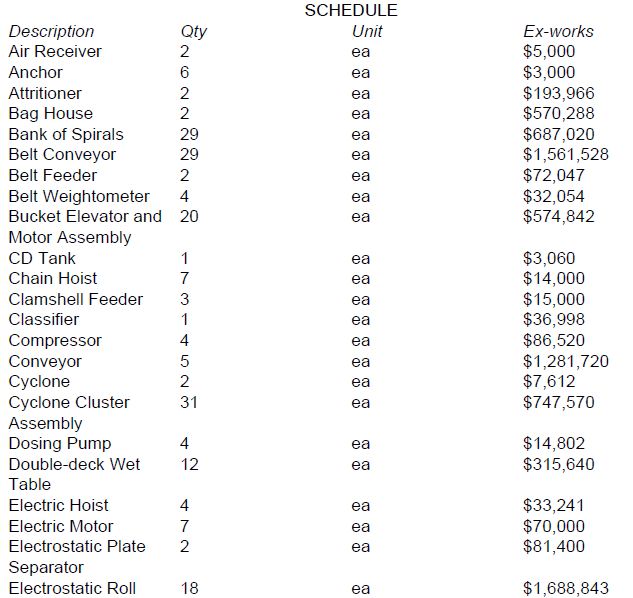
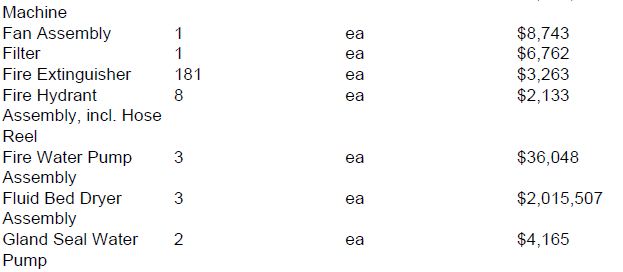
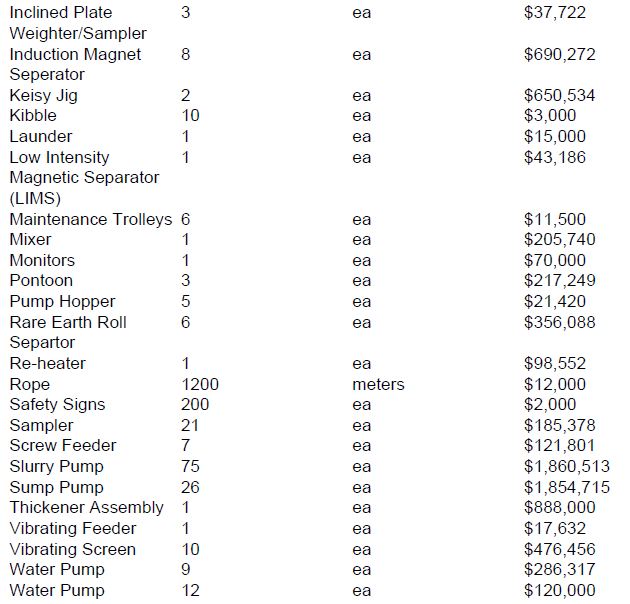
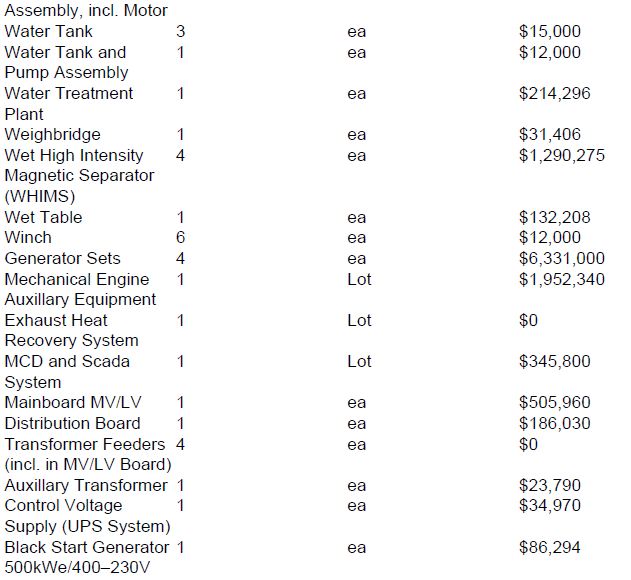
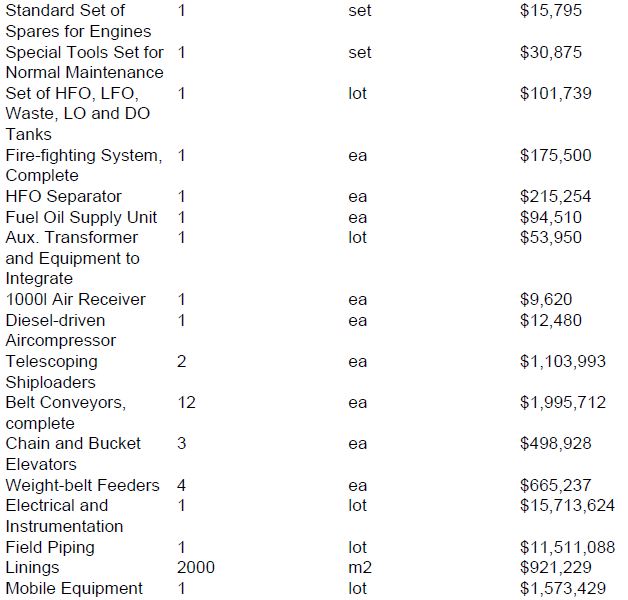
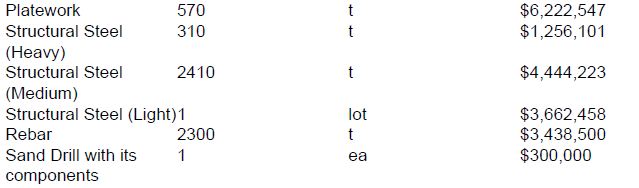
|
THE VALUE ADDED TAX (REMISSION) ORDER
| 1. |
This Order may be cited as the Value Added Tax (Remission) Order.
|
| 2. |
The tax payable on the items listed in the Schedule hereto being imported for the Kwale Titanium Mining project by Tiomin Kenya Limited within the year 2007 be remitted wholly:
Provided that the tax remitted by this Order shall be payable by Tiomin Kenya Limited in the event that the Cabinet Secretary determines that Tiomin Kenya Limited is in breach of any of the terms of the Agreement in relation to a Special Mining Lease granted by the Government of Kenya to Tiomin Resources Inc. et al entered on 2nd February, 2005.
|
SCHEDULE
|
|
Description
|
|
Qty
|
|
Unit
|
|
|
Ex-Works
|
|
Air Receiver
|
|
2
|
|
ea
|
|
|
$5,000
|
|
Anchor
|
|
6
|
|
ea
|
|
|
$3,000
|
|
Attritioner
|
|
2
|
|
ea
|
|
|
$193,966
|
|
Bag House
|
|
2
|
|
ea
|
|
|
$570,288
|
|
Bank of Spirals
|
|
29
|
|
ea
|
|
|
$687,020
|
|
Belt Conveyor
|
|
29
|
|
ea
|
|
|
$1,561,528
|
|
Belt Feeder
|
|
2
|
|
ea
|
|
|
$72,047
|
|
Belt Weightometer
|
|
4
|
|
ea
|
|
|
$32,054
|
|
Bucket Elevator and
|
|
20
|
|
ea
|
|
|
$574,842
|
|
Motor Assembly
|
|
|
|
|
|
|
|
|
CD Tank
|
|
1
|
|
ea
|
|
|
$3,060
|
|
Chain Host
|
|
7
|
|
ea
|
|
|
$14,000
|
|
Clamshell Feeder
|
|
3
|
|
ea
|
|
|
$15,000
|
|
Classifier
|
|
1
|
|
ea
|
|
|
$36,998
|
|
Compressor
|
|
4
|
|
ea
|
|
|
$86,520
|
|
Conveyor
|
|
5
|
|
ea
|
|
|
$1,281,720
|
|
Cyclone
|
|
2
|
|
ea
|
|
|
$7,612
|
|
Cyclone Cluster
|
|
31
|
|
ea
|
|
|
$747,570
|
|
Assembly
|
|
|
|
|
|
|
|
|
Dosing Pump
|
|
4
|
|
ea
|
|
|
$14,802
|
|
Double-deck Wet
|
|
12
|
|
ea
|
|
|
$315,640
|
|
Table
|
|
|
|
|
|
|
|
|
Electric Hoist
|
|
4
|
|
ea
|
|
|
$33,241
|
|
Electric Motor
|
|
7
|
|
ea
|
|
|
$70,000
|
|
Electrostatic Plate
|
|
3
|
|
ea
|
|
|
$81,400
|
|
Separator
|
|
|
|
|
|
|
|
|
Electrostatic Roll
|
|
18
|
|
ea
|
|
|
$1,68,843
|
|
|
|
|
|
|
|
|
|
|
Machine
|
|
|
|
|
|
|
|
|
Fan Assembly
|
|
1
|
|
ea
|
|
|
$8,743
|
|
Filter
|
|
1
|
|
ea
|
|
|
$6,762
|
|
Fire Extingusher
|
|
181
|
|
ea
|
|
|
$3,263
|
|
Fire Hydrant
|
|
8
|
|
ea
|
|
|
$2,133
|
|
Assembly, incl. Hose
|
|
|
|
|
|
|
|
|
Reel
|
|
|
|
|
|
|
|
|
Fire Water Pump
|
|
3
|
|
ea
|
|
|
$36,048
|
|
Assembly
|
|
|
|
|
|
|
|
|
Fluid Bed Dryer
|
|
3
|
|
ea
|
|
|
$2,015,507
|
|
Assembly
|
|
|
|
|
|
|
|
|
Gland Seal Water
|
|
2
|
|
ea
|
|
|
$4,165
|
|
Pump
|
|
|
|
|
|
|
|
|
Inclined Plate
|
|
3
|
|
ea
|
|
|
$37,722
|
|
Weighter/Sampler
|
|
|
|
|
|
|
|
|
Induction Magnet
|
|
8
|
|
ea
|
|
|
$690,272
|
|
Separator
|
|
|
|
|
|
|
|
|
Keisy Jig
|
|
2
|
|
ea
|
|
|
$650,534
|
|
Kibble
|
|
10
|
|
ea
|
|
|
$3,000
|
|
Launder
|
|
1
|
|
ea
|
|
|
$15,000
|
|
Low Intensity
|
|
1
|
|
ea
|
|
|
$43,186
|
|
Magnetic Separator
|
|
|
|
|
|
|
|
|
(LIMS)
|
|
|
|
|
|
|
|
|
Maintenance Trolleys
|
|
6
|
|
ea
|
|
|
$11,500
|
|
Mixer
|
|
1
|
|
ea
|
|
|
$205,740
|
|
Monitors
|
|
1
|
|
ea
|
|
|
$70,000
|
|
Pontoon
|
|
3
|
|
ea
|
|
|
$217,249
|
|
Pump Hopper
|
|
5
|
|
ea
|
|
|
$21,420
|
|
Rare Earth Roll
|
|
6
|
|
ea
|
|
|
$356,088
|
|
Separator
|
|
|
|
|
|
|
|
|
Re-heater
|
|
1
|
|
ea
|
|
|
$98,552
|
|
Rope
|
|
1200
|
|
meters
|
|
|
$12,000
|
|
Safety Signs
|
|
200
|
|
ea
|
|
|
$2,000
|
|
Sampler
|
|
21
|
|
ea
|
|
|
$185,378
|
|
Screw Feeder
|
|
7
|
|
ea
|
|
|
$121,801
|
|
Slurry Pump
|
|
75
|
|
ea
|
|
|
$1,860,513
|
|
Sump Pump
|
|
26
|
|
ea
|
|
|
$1,854,715
|
|
Thickener Assembly
|
|
1
|
|
ea
|
|
|
$888,000
|
|
Vibrating Feeder
|
|
1
|
|
ea
|
|
|
$17,632
|
|
Vibrating Screen
|
|
10
|
|
ea
|
|
|
$476,456
|
|
Water Pump
|
|
9
|
|
ea
|
|
|
$286,317
|
|
Water Pump
|
|
12
|
|
ea
|
|
|
$120,000
|
|
|
|
|
|
|
|
|
|
|
Assembly incl. Motor
|
|
|
|
|
|
|
|
|
Water Tank
|
|
3
|
|
ea
|
|
|
$15,000
|
|
Water Tank and
|
|
1
|
|
ea
|
|
|
$12,000
|
|
Pump Assembly
|
|
|
|
|
|
|
|
|
Water Treatment
|
|
1
|
|
ea
|
|
|
$214,296
|
|
Plant
|
|
|
|
|
|
|
|
|
Weighbridge
|
|
1
|
|
ea
|
|
|
$31,406
|
|
Wet High Intensity
|
|
4
|
|
ea
|
|
|
$1,290,275
|
|
Magnetic Separators
|
|
|
|
|
|
|
|
|
(WHIMS)
|
|
|
|
|
|
|
|
|
Wet Table
|
|
1
|
|
ea
|
|
|
$132,298
|
|
Winch
|
|
6
|
|
ea
|
|
|
$12,000
|
|
Generator Sets
|
|
4
|
|
ea
|
|
|
$6,331,000
|
|
Mechanical Engine
|
|
1
|
|
Lot
|
|
|
$1,952,340
|
|
Auxillary Equipment
|
|
|
|
|
|
|
|
|
Exhaust Heat
|
|
1
|
|
Lot
|
|
|
$0
|
|
Recovery System
|
|
|
|
|
|
|
|
|
MCD and Scada
|
|
1
|
|
Lot
|
|
|
$345,800
|
|
System
|
|
|
|
|
|
|
|
|
Mainboard MV/LV
|
|
1
|
|
ea
|
|
|
$505,960
|
|
Distribution Board
|
|
1
|
|
ea
|
|
|
$186,030
|
|
Transformer Feeders
|
|
4
|
|
ea
|
|
|
$0
|
|
(inc. in ML/LV Board)
|
|
|
|
|
|
|
|
|
Auxillary Transformer
|
|
1
|
|
ea
|
|
|
$23,790
|
|
Control Voltage
|
|
1
|
|
ea
|
|
|
$34,970
|
|
Supply (UPS System)
|
|
|
|
|
|
|
|
|
Black Start Generator
|
|
1
|
|
ea
|
|
|
$86,294
|
|
500kWe/400-230V
|
|
|
|
|
|
|
|
|
Standard Set of
|
|
1
|
|
set
|
|
|
$15,795
|
|
Spares for Engines
|
|
|
|
|
|
|
|
|
Special Tools Set for
|
|
1
|
|
set
|
|
|
$30,875
|
|
Normal Maintenance
|
|
|
|
|
|
|
|
|
Set of HFO, LFO
|
|
1
|
|
lot
|
|
|
$101,739
|
|
waste, LO and DO
|
|
|
|
|
|
|
|
|
Tanks
|
|
|
|
|
|
|
|
|
Fire-fighting System,
|
|
1
|
|
ea
|
|
|
$175,500
|
|
Complete
|
|
|
|
|
|
|
|
|
HFO Separator
|
|
1
|
|
ea
|
|
|
$215,254
|
|
Fuel Oil Supply Unit
|
|
1
|
|
ea
|
|
|
$94,510
|
|
Aux, Transformer
|
|
1
|
|
lot
|
|
|
$53,950
|
|
and Equipment to
|
|
|
|
|
|
|
|
|
Intergrate
|
|
|
|
|
|
|
|
|
1000l Air Receiver
|
|
1
|
|
ea
|
|
|
$9,620
|
|
Dissel-driven
|
|
1
|
|
ea
|
|
|
$12,480
|
|
Aircompressor
|
|
|
|
|
|
|
|
|
Telescoping
|
|
2
|
|
ea
|
|
|
$1,103,993
|
|
Shiploaders
|
|
|
|
|
|
|
|
|
Belt Conveyors
|
|
12
|
|
ea
|
|
|
$1,995,712
|
|
complete
|
|
|
|
|
|
|
|
|
Chain and Bucket
|
|
3
|
|
ea
|
|
|
$498,928
|
|
Elevators
|
|
|
|
|
|
|
|
|
Weight-belt feeders
|
|
4
|
|
ea
|
|
|
$665,237
|
|
Electrical and
|
|
1
|
|
lot
|
|
|
$15,713,624
|
|
Instrumentation
|
|
|
|
|
|
|
|
|
Field Piping
|
|
1
|
|
lot
|
|
|
$11,511,088
|
|
Linings
|
|
2000
|
|
m2
|
|
|
$921,229
|
|
Mobile Equipment
|
|
1
|
|
lot
|
|
|
$1,573,429
|
|
|
|
|
|
|
|
|
|
|
Platework
|
|
570
|
|
t
|
|
|
$6,222,547
|
|
Structural Steel
|
|
310
|
|
t
|
|
|
$1,256,101
|
|
(Heavy)
|
|
|
|
|
|
|
|
|
Structural Steel
|
|
2410
|
|
t
|
|
|
$4,444,223
|
|
(Medium)
|
|
|
|
|
|
|
|
|
Structural Steel (Light)
|
|
1
|
|
lot
|
|
|
$3,662,458
|
|
Rebar
|
|
2300
|
|
t
|
|
|
$3,438,500
|
|
Sand Drill with its
|
|
1
|
|
ea
|
|
|
$300,000
|
|
components
|
|
|
|
|
|
|
|
|
THE VALUE ADDED TAX (REMISSION) (LOW INCOME HOUSING PROJECTS) ORDER, 2008
| 1. |
This Order may be cited as the Value Added Tax (Remission) (Low Income Housing Projects) Order, 2008.
|
| 2. |
In this Order, unless the context otherwise requires—
"applicant" means a person making an application under paragraph 3 of this Order;
"low income earner" means a person whose monthly gross earning amounts to thirty five thousand shillings or less;
"low income house" means a house put up at a construction cost of not more than one million six hundred thousand shillings and of plinth area of not less than thirty square meters;
"low income housing project" means a project of not less than twenty housing units intended for low income earners;
"Minister" means the Minister for the time being responsible for Finance.
|
| 3. |
| (1) |
An application for tax remission under section 23(3)(i) of the Act shall be made in writing to the Minister through the Minister for the time being responsible for Housing.
|
| (2) |
An application under this paragraph shall—
| (a) |
be submitted together with the detailed certified list of goods and services to be rendered in respect of which the application is made;
|
| (b) |
include the following—
| (i) |
the location of the project;
|
| (ii) |
evidence of construction cost;
|
| (iii) |
approved designs of the project;
|
| (iv) |
the number of units to be constructed;
|
| (v) |
the approval of the development by relevant authorities;
|
| (vi) |
the Personal Identification Number (PIN) of the applicant; and
|
| (vii) |
tax compliance certificate.
|
|
|
|
| 4. |
The Commissioner may require an applicant to—
| (a) |
furnish such further information as the Commissioner may consider necessary; and
|
| (b) |
allow and facilitate the inspection of the goods or services rendered to which the application relates by a person authorized by the Commissioner.
|
|
| 5. |
(1) Except as provided in sub-paragraph (2) below, only one application shall be made with respect to a given project.
|
| (2) |
A second application in respect of the same project may be made if the applicant demonstrates that the additional application relates to a separate phase of the project or an expansion thereof.
|
| 6. |
A person granted tax remission under this Order shall—
| (a) |
construct low income houses;
|
| (b) |
allow and facilitate the Minister for the time being responsible for Housing or the Commissioner to inspect the projects, including the goods and services rendered;
|
| (c) |
avail the records of such goods and services rendered for purposes of inspection and audit to the Minister for the time being responsible for Housing or the Commissioner;
|
| (d) |
sell, rent or lease the houses to low income earners;
|
| (e) |
sell the housing units at a price which is not more than thirty per cent above the construction cost;
|
| (f) |
ensure the rent charged for the houses constructed under the scheme reflect the reduced cost of construction as a result of tax remission.
|
|
| 7. |
Where the Commissioner and the Minister for the time being responsible for Housing is satisfied that an applicant granted tax remission under this Order has failed to comply with the provisions of paragraph 6 above, the Commissioner shall require the applicant to refund the tax remitted.
|
| 8. |
An applicant shall, if he sells, leases, rents or converts a house for uses other than as provided under paragraph 6(d), before the expiry of five years from the date the construction was completed, be required to refund the tax remitted or such portion thereof as the Minister may determine relating to the construction of the part so converted.
|
THE VALUE ADDED TAX (REMISSION) (LOW INCOME HOUSING PROJECTS) ORDER, 2008
| 1. |
This Order may be cited as the Value Added Tax (Remission) (Low Income Housing Projects) Order, 2008.
|
| 2. |
In this Order, unless the context otherwise requires—
"applicant" means a person making an application under paragraph 3 of this Order;
"low income earner" means a person whose monthly gross earning amounts to thirty five thousand shillings or less;
"low income house" means a house put up at a construction cost of not more than one million six hundred thousand shillings and of plinth area of not less than thirty square meters;
"low income housing project" means a project of not less than twenty housing units intended for low income earners;
"Minister" means the Minister for the time being responsible for Finance.
|
| 3. |
| (1) |
An application for tax remission under section 23(3)(i) of the Act shall be made in writing to the Minister through the Minister for the time being responsible for Housing.
|
| (2) |
An application under this paragraph shall—
| (a) |
be submitted together with the detailed certified list of goods and services to be rendered in respect of which the application is made;
|
| (b) |
include the following—
| (i) |
the location of the project;
|
| (ii) |
evidence of construction cost;
|
| (iii) |
approved designs of the project;
|
| (iv) |
the number of units to be constructed;
|
| (v) |
the approval of the development by relevant authorities;
|
| (vi) |
the Personal Identification Number (PIN) of the applicant; and
|
| (vii) |
tax compliance certificate.
|
|
|
|
| 4. |
The Commissioner may require an applicant to—
| (a) |
furnish such further information as the Commissioner may consider necessary; and
|
| (b) |
allow and facilitate the inspection of the goods or services rendered to which the application relates by a person authorized by the Commissioner.
|
|
| 5. |
| (1) |
Except as provided in sub-paragraph (2) below, only one application shall be made with respect to a given project.
|
| (2) |
A second application in respect of the same project may be made if the applicant demonstrates that the additional application relates to a separate phase of the project or an expansion thereof.
|
|
| 6. |
A person granted tax remission under this Order shall—
| (a) |
construct low income houses;
|
| (b) |
allow and facilitate the Minister for the time being responsible for Housing or the Commissioner to inspect the projects, including the goods and services rendered;
|
| (c) |
avail the records of such goods and services rendered for purposes of inspection and audit to the Minister for the time being responsible for Housing or the Commissioner;
|
| (d) |
sell, rent or lease the houses to low income earners;
|
| (e) |
sell the housing units at a price which is not more than thirty per cent of the construction cost;
|
| (f) |
ensure the rent charged for the houses constructed under the scheme reflect the reduced cost of construction as a result of tax remission.
|
|
| 7. |
Where the Commissioner and the Minister for the time being responsible for Housing is satisfied that an applicant granted tax remission under this Order has failed to comply with the provisions of paragraph 6 above, the Commissioner shall require the applicant to refund the tax remitted.
|
| 8. |
An applicant shall, if he sells, leases, rents or converts a house for uses other than as provided under paragraph 6(d), before the expiry of five years from the date the construction was completed, be required to refund the tax remitted or such portion thereof as the Minister may determine relating to the construction of the part so converted.
|
THE VALUE ADDED TAX REGULATIONS
ARRANGEMENT OF REGULATIONS
| 4. |
Place of supply of telecommunications services
|
| 5. |
Taxable value of supply
|
| 6. |
Taxable importation by a registered person for use outside the person's business
|
| 7. |
Deduction of input tax on registration or change in use
|
| 9. |
[Deleted by Legal Notice 188 of 2020, r. 2]
|
| 10. |
Tax invoice for supplies of imported services
|
| 13. |
Exportation of goods or services
|
| 14. |
Documents relating to supply to an Export Processing Zone business or Special Economic Zone
|
| 15. |
Tax-inclusive pricing of taxable supplies to unregistered persons
|
| 16. |
Manner of submitting documents
|
| 17. |
Application of increased or reduced tax rate to successive suppliers
|
THE VALUE ADDED TAX REGULATIONS, 2017
| 1. |
Citation
These Regulations may be cited as the Value Added Tax Regulations, 2017.
|
| 2. |
Interpretation
In these Regulations, unless the context otherwise requires—
"Act" means the Value Added Tax Act, 2013;
"arm's length transaction" means a transaction between persons dealing with each other at arm's length;
"member", in relation to a registered group, includes the member of the group appointed, from time to time, as the representative member of the group;
"recipient", in relation to a supply, means the person to whom the supply is made;
"supplier", in relation to a supply, means the person making the supply;
"tax fraction", in relation to a supply, means the fraction computed in accordance with the following formula—
t/(I+t)
where t is the rate of tax applicable to the supply as determined under section 5 of the Act;
"telecommunications services" means the transmission, emission, or reception of signals, writing, images, sounds, or information of any kind by wire, radio, optical, or other electromagnetic systems, and includes—
| (a) |
the related transfer or assignment of the right to use capacity for such transmission, emission, or reception; or
|
| (b) |
the provision of access to global or local information networks,
but does not include the supply of the underlying writing, images, sounds, or information;
|
"telecommunications supplier" means a person who supplies telecommunications services; and
"trading stock" includes anything produced, manufactured, purchased, or otherwise acquired for sale or exchange, and any raw materials used in the production or manufacturing process.
|
| 3. |
Open market value
| (1) |
The open market value of a supply shall be the consideration that the supply would reasonably be expected to fetch in an arm's length transaction made at the time of supply.
|
| (2) |
Where the open market value of a supply cannot be determined in accordance with paragraph (1), the open market value shall be an objective approximation of the consideration the supply would fetch in an arm's length transaction made at the time of supply as determined by the Commissioner based on generally accepted principles of valuation.
|
| (3) |
Where there is need to determine the open market value for particular goods or services held by a person, at a particular time, the value shall be determined in accordance with paragraph (2), or be the value of similar goods or services, at that time.
|
|
| 4. |
Place of supply of telecommunications services
| (1) |
A supply of telecommunications services shall be treated as made in Kenya when the person who initiated the supply is in Kenya at the time of supply where—
| (a) |
the supply is made from a place of business outside Kenya;
|
| (b) |
the supply is not initiated by—
| (i) |
a telecommunications supplier; or |
| (ii) |
a person who is global roaming while temporarily in Kenya; and |
|
| (c) |
the recipient of the supply is not a registered person.
|
|
| (2) |
The person who initiates a supply of telecommunications services shall be the person —
| (a) |
who controls the commencement of the supply;
|
| (c) |
who contracts for the supply; or
|
| (d) |
to whom the invoice for the supply is sent.
|
|
|
| 5. |
Taxable value of supply
| (1) |
Unless the Act otherwise provides, where a registered person makes a taxable supply without a separate amount being identified as tax, the taxable value of the supply shall be computed in accordance with the following formula—
B=A /(1+t)
Where —
A is the total amount charged for the supply inclusive of VAT;
B is the taxable value; and
t
tax rate.
|
|
| 6. |
Taxable importation by a registered person for use outside the person's business
| (1) |
An application of taxable supplies by a registered person for use outside his business shall not be treated as a taxable supply made by the person unless the registered person has been allowed a deduction for input tax in respect of the taxable supply made to, or taxable importation made by the person for use outside the person's business.
|
| (2) |
The taxable value of a taxable supply by a person for use outside his business shall be—
| (a) |
for goods that are trading stock acquired in a taxable supply, the consideration paid or payable in respect of the acquisition of the trading stock;
|
| (b) |
for goods that are trading stock acquired in a taxable importation, the taxable value of the importation; or
|
| (c) |
for any other case, the higher of—
| (i) |
the consideration paid or payable on acquisition of the goods or services; or |
| (ii) |
the open market value of the goods or services on the date the supply is first used outside the business. |
|
|
| (3) |
The taxable value determined under paragraph (2) shall be reduced by—
| (a) |
if part of the input tax paid by the registered person on acquisition was allowed as a deduction, an amount reflecting the extent to which no deduction was allowed; or
|
| (b) |
if part of the goods or services were applied to a use outside the person's business, an amount reflecting the extent to which the goods or services were not so applied.
|
|
|
| 7. |
Deduction of input tax on registration or change in use
| (1) |
A person shall be entitled to a deduction of input tax incurred for trading stock on hand at the date that the person becomes registered.
|
| (2) |
A deduction of Input Tax shall not be allowed unless —
| (a) |
the input tax to which the deduction relates is deductible under section 17 of the Act;
|
| (b) |
the registered person has provided the Commissioner with satisfactory evidence—
| (i) |
that input tax was paid on acquisition of the goods; |
| (ii) |
of the quantities, descriptions, and values of the goods on hand at the time of registration. |
|
|
| (3) |
A person shall when applying for the authorisation of deduction, submit to the Commissioner a list of goods on hand at the date of registration in respect of which the person seeks relief within three months of becoming registered in the approved form.
|
| (4) |
The Commissioner may require a person who has submitted a list under paragraph (3) to produce further evidence of—
| (a) |
the quantities, descriptions, or values of goods on hand at the time of registration; or
|
| (b) |
the use or intended disposal of the goods after the date of registration.
|
|
| (5) |
The Commissioner shall not allow an appropriate deduction—
| (a) |
for goods that are trading stock, the tax paid on acquisition or importation of the goods; or
|
| (b) |
for any other case, the lesser of—
| (i) |
the tax paid on acquisition or importation of the goods or services; or |
| (ii) |
the tax fraction of the open market value of the goods or services at the time of change in use. |
|
|
|
| 8. |
Refund
| (1) |
A registered person who makes taxable supplies at both the general rate and zero rate, shall only be entitled to a refund arising from making zero rated supplies.
|
| (2) |
In determining the amount due as a refund to a registered person who makes taxable supplies at both the general rate and zero rate, the Commissioner shall use the following formula—
R = Z/T x e
Where—
R is the amount to be refunded
Z is the total value of the zero rated supplies
T is the total value of the taxable supplies
e
is excess input tax for the month of the supply.
|
| (3) |
A refund payable under section 30 or 31 of the Act shall be applied in accordance with section 47(4) of the Tax procedures Act (No. 28 of 2015).
|
| (4) |
When the recipient of a taxable supply to which section 31(1) of the Act applies is a registered person that is still in existence at the time the supplier applies for a refund under section 31(1), the refund shall be allowed unless the supplier had issued a credit note to the recipient of the supply specifying the amount of the unpaid tax claimed computed in accordance with section 31(1).
|
| (5) |
The recipient of a taxable supply issued with a credit note under paragraph (4) shall reduce the amount of their deductible input tax in the tax period in which the credit note was received by the amount of tax specified in the note.
|
| (6) |
When section 31(3) applies and the recipient of the taxable supply is a registered person who has previously been issued with a credit note in relation to the supply, the registered person refunding the tax to the Commissioner shall issue the recipient of the taxable supply with a debit note specifying the amount of tax refunded to the Commissioner.
|
| (7) |
The recipient of a taxable supply issued with a debit note under paragraph (6) shall be allowed to reduce the amount of their deductible input tax in the tax period in which the debit note is received by the amount of tax specified in the note.
|
|
| 9. |
Tax invoice
| (1) |
A registered person who makes a taxable supply shall, at the time of supply, furnish the purchaser with a tax invoice containing—
| (a) |
the words "TAX INVOICE" in a prominent place;
|
| (b) |
the name, address, and PIN of the supplier;
|
| (c) |
the name, address, and PIN, if any, of the recipient;
|
| (d) |
the individualised serial number of the tax invoice;
|
| (e) |
the date on which the tax invoice is issued and the date on which the supply was made, if different from the date of issue of the tax invoice;
|
| (f) |
the description of the goods supplied including quantity or volume or services provided;
|
| (g) |
the details of any discount allowed at the time of supply; and
|
| (h) |
the consideration for the supply and the amount of tax charged.
|
|
| (2) |
Notwithstanding paragraph (1), a registered person may provide an electronically generated fiscal receipt as a simplified tax invoice for cash sales made from retail premises containing—
| (a) |
the name, address, and PIN of the supplier;
|
| (b) |
the serial number of the receipt;
|
| (c) |
the date and time of issue of the receipt;
|
| (d) |
a brief description of the goods supplied (including quantity or volume);
|
| (f) |
the total amount payable for the supply inclusive of tax.
|
|
|
| 10. |
Tax invoice for supplies of imported services
| (1) |
A registered person liable for tax under section 5(1)(c) and (6) of the Act and who is entitled to a credit for part of the amount of input tax payable shall, in respect of a supply of imported services, prepare a tax invoice in respect of the supply containing—
| (a) |
the name, address, and PIN of the recipient;
|
| (b) |
the name and address of the supplier;
|
| (c) |
the individualised serial number of the tax invoice and the date on which the tax invoice is prepared;
|
| (d) |
a description of the services supplied and the date of the supply;
|
| (e) |
the extent to which the supply has been applied other than to make taxable supplies;
|
| (f) |
the consideration for the supply and the amount of tax charged.
|
|
|
| 11. |
Credit notes
| (1) |
A registered person for good and valid business reasons, decides to reduce the value of a supply after the issue of a tax invoice after goods are returned to the registered person shall issue a credit note to a person after the registered person has refunded the excess tax to the recipient of the supply, whether in cash or as a credit against any amount owing to the supplier by the recipient.
|
| (2) |
A credit note shall contain—
| (a) |
the words "CREDIT NOTE" in a prominent place;
|
| (b) |
the name, address, and PIN of the supplier;
|
| (c) |
the name, address, and PIN of the recipient;
|
| (d) |
the individualised serial number of the credit note and the date on which the credit note is issued;
|
| (e) |
a brief description of the circumstances giving rise to the issuing of the credit note, including the invoice details to which the credit note relates;
|
| (f) |
the consideration shown on the tax invoice for the supply, the correct amount of the consideration, the difference between those two amounts, and the amount of tax that relates to the difference.
|
|
|
| 12. |
Debit notes
| (1) |
A registered person who issues a debit note in respect of further charge made in respect of a supply, or any transaction associated with that supply shall include the amount of tax specified in the debit note as output tax of the person in the tax period in which the debit note is issued.
|
| (2) |
A debit note issued under paragraph (1) shall contains—
| (a) |
the words "DEBIT NOTE" in a prominent place;
|
| (b) |
the name, address, and PIN of the supplier;
|
| (c) |
the name, address, and PIN of the recipient;
|
| (d) |
the individualised serial number of the debit note and the date on which the debit note is issued;
|
| (e) |
a brief description of the circumstances giving rise to the issuing of the debit note, including the invoice details to which the debit note relates;
|
| (f) |
the consideration shown on the tax invoice for the supply, the correct amount of the consideration, the difference between those two amounts, and the amount of tax that relates to the difference.
|
|
|
| 13. |
Exportation of goods or services
| (1) |
An exportation shall be a taxable supply—
| (a) |
in the case of goods, when the taxable supply involves the goods being entered for export under the East African Community Customs Management Act and delivered to a recipient outside Kenya at an address outside Kenya; or
|
| (b) |
in the case of services, when the taxable supply involves the services being provided to a recipient outside Kenya for use, consumption, or enjoyment outside Kenya:
Provided that the exportation of services shall not include—
| (a) |
taxable services consumed on exportation of goods unless the services are in relation to transportation of goods which terminates outside Kenya;
|
| (b) |
taxable services provided in Kenya but paid for by a person who is not a resident in Kenya.
|
|
|
| (2) |
The documentation relating to a supply required as the proof of an exportation of goods or services shall be—
| (a) |
a copy of the invoice showing the recipient of the supply to be a person outside Kenya;
|
| (b) |
proof of payment for the supply;
|
| (c) |
| (i) |
the bill of lading, road manifest, or airway bill, as the case may be; |
| (ii) |
the export or transfer entry certified by a proper officer of Customs at the port of exit; |
| (iii) |
for excisable goods, the documents shall be in accordance with the provisions of the Excise Duty Act (No. 35 of 2015). |
|
| (d) |
for services, such other documents as the Commissioner may require as proof that the services had been used or consumed outside Kenya.
|
|
| (3) |
Where the Commissioner has reasonable grounds to believe that goods treated by a registered person as exported may not have been exported —
| (a) |
the Commissioner may, by notice in writing, require the registered person to produce, within the time specified in the notice, a certificate signed and stamped by a competent authority outside Kenya stating that the goods were duly landed and entered for home consumption at a place outside Kenya;
|
| (b) |
the supply shall not be treated as an exportation until the certificate referred to in paragraph (a) has been provided to, and accepted by, the Commissioner.
|
|
|
| 14. |
Documents relating to supply to an Export Processing Zone business or Special Economic Zone
| (1) |
The documents relating to a supply required as proof of a supply of goods or services to an Export Processing Zone business or Special Economic Zone shall be—
| (a) |
a copy of the recipient's export processing zone licence; or Special Economic Zone licence;
|
| (b) |
a certificate signed by the recipient of the supply stating that the goods have been received and are for use in the approved operations of an export processing zone enterprise; and
|
| (c) |
for goods, the export entry duly certified by the proper officer of customs.
|
|
|
| 15. |
Tax-inclusive pricing of taxable supplies to unregistered persons
| (1) |
A registered person who is a retailer or who otherwise primarily makes taxable supplies to persons who are not registered shall—
| (a) |
state prominently on its invoices that taxable supplies are made inclusive of tax; and
|
| (b) |
disclose prominently on its invoice that the supply is a taxable or exempt supply and, if a taxable supply, the rate of tax charged.
|
|
| (2) |
In determining the tax payable in respect of a taxable supply for which the price is quoted as inclusive of tax the following formula shall apply—
|
where—
A is the total amount charged for the supply inclusive of VAT; and
t tax rate.
| (3) |
A registered person who fails to comply with paragraph (1) commits an offence.
|
|
| 16. |
Manner of submitting documents
A return, application, notice, or other document to be lodged or submitted under the Act shall be lodged or submitted in accordance with the Tax Procedures Act, 2015 (No. 23 of 2015).
|
| 17. |
Application of increased or reduced tax rate to successive suppliers
| (1) |
Where a supply of goods or services is treated as a successive supply under section 12(3) of the Act for a period beginning and ending before the date on which a change in the rate of tax levied becomes effective in respect of the supply, or the date on which tax is imposed or withdrawn in respect of the supply, and the supply is treated under section 12 as having been made on or after that date, then—
| (a) |
in the case of a change in the rate of tax on the change date, the rate of tax applicable to the supply shall be the rate applicable immediately before the change date;
|
| (b) |
in the case of the imposition of tax on the change date, the supply shall be treated as not being subject to tax; or
|
| (c) |
in the case of withdrawal of the tax on the change date, the supply shall be treated as being subject to tax as if the tax had not been withdrawn.
|
|
| (2) |
When a supply of goods or services is treated as a successive supply under sectio 12(3) of the Act during a period beginning before and ending on or after the date on which a change in the rate of tax levied becomes effective in respect of the supply, or the date on which tax is imposed or withdrawn in respect of the supply, and the supply is treated under section 12 as having been made on or after the change date, the consideration for the supply shall, on the basis of a fair and reasonable apportionment, be treated as consisting of a part relating to the supply of the goods or services before the change date and a part relating to the supply of goods or services on or after the change date and—
| (a) |
in the case of a change in the rate of tax on the change date, the tax payable in respect of the first part is determined at the rate applicable before the change date and the tax payable in respect of the second part is determined at the rate applicable on the change date;
|
| (b) |
in the case of the imposition of tax on the change date, the first part is not subject to tax; and
|
| (c) |
in the case of the withdrawal of the tax, the first part is subject to tax as if the tax had not been withdrawn.
|
|
|
| 18. |
Revocation
Subject to section 68 of the Act, the following are revoked:
| (a) |
The Value Added Tax Regulations, 1994 (L.N. 195/1994);
|
| (b) |
The Value Added Tax (Appeals) Rules, 1990 (L.N. 229/1990);
|
| (c) |
The Value Added Tax (Distraint) Regulations, 1990 (L.N. 227/1990);
|
| (d) |
The Value Added Tax Order, 2002 (L.N. 95/2002);
|
| (e) |
The Value Added Tax (Tax Withholding) Regulations, 2004 (L.N. 53/2004);
|
| (f) |
The Value Added Tax (Electronic Tax Registers) Regulations, 2004 (L.N. 110/2004).
|
| (2) |
The Value Added Tax (Remission) (Official Aid Funded Projects) Order, 2003 (L.N. 67/2003) shall continue to apply until another Regulation relating to official aid funded project is put in place.
|
| (3) |
The Value Added Tax (Remission) (Low Income Housing Projects), Order 2008 (L.N. 115/2008) shall continue to apply to a remission granted before the commencement date while the remission remains in force.
|
|
THE VALUE ADDED TAX REGULATIONS, 2017
| 1. |
Citation
These Regulations may be cited as the Value Added Tax Regulations, 2017.
|
| 2. |
Interpretation
In these Regulations, unless the context otherwise requires—
"Act" means the Value Added Tax Act, 2013;
"arm's length transaction" means a transaction between persons dealing with each other at arm's length;
"member", in relation to a registered group, includes the member of the group appointed, from time to time, as the representative member of the group;
"recipient", in relation to a supply, means the person to whom the supply is made;
"supplier", in relation to a supply, means the person making the supply;
"tax fraction", in relation to a supply, means the fraction computed in accordance with the following formula—
t/(I+t)
where t is the rate of tax applicable to the supply as determined under section 5 of the Act;
"telecommunications services" means the transmission, emission, or reception of signals, writing, images, sounds, or information of any kind by wire, radio, optical, or other electromagnetic systems, and includes—
| (a) |
the related transfer or assignment of the right to use capacity for such transmission, emission, or reception; or
|
| (b) |
the provision of access to global or local information networks,
but does not include the supply of the underlying writing, images, sounds, or information;
|
"telecommunications supplier" means a person who supplies telecommunications services; and
"trading stock" includes anything produced, manufactured, purchased, or otherwise acquired for sale or exchange, and any raw materials used in the production or manufacturing process.
|
| 3. |
Open market value
| (1) |
The open market value of a supply shall be the consideration that the supply would reasonably be expected to fetch in an arm's length transaction made at the time of supply.
|
| (2) |
Where the open market value of a supply cannot be determined in accordance with paragraph (1), the open market value shall be an objective approximation of the consideration the supply would fetch in an arm's length transaction made at the time of supply as determined by the Commissioner based on generally accepted principles of valuation.
|
| (3) |
Where there is need to determine the open market value for particular goods or services held by a person, at a particular time, the value shall be determined in accordance with paragraph (2), or be the value of similar goods or services, at that time.
|
|
| 4. |
Place of supply of telecommunications services
| (1) |
A supply of telecommunications services shall be treated as made in Kenya when the person who initiated the supply is in Kenya at the time of supply where—
| (a) |
the supply is made from a place of business outside Kenya;
|
| (b) |
the supply is not initiated by—
| (i) |
a telecommunications supplier; or |
| (ii) |
a person who is global roaming while temporarily in Kenya; and |
|
| (c) |
the recipient of the supply is not a registered person.
|
|
| (2) |
The person who initiates a supply of telecommunications services shall be the person —
| (a) |
who controls the commencement of the supply;
|
| (c) |
who contracts for the supply; or
|
| (d) |
to whom the invoice for the supply is sent.
|
|
|
| 5. |
Taxable value of supply
| (1) |
Unless the Act otherwise provides, where a registered person makes a taxable supply without a separate amount being identified as tax, the taxable value of the supply shall be computed in accordance with the following formula—
B=A /(1+t)
Where —
A is the total amount charged for the supply inclusive of VAT;
B is the taxable value; and
t
tax rate.
|
|
| 6. |
Taxable importation by a registered person for use outside the person's business
| (1) |
An application of taxable supplies by a registered person for use outside his business shall not be treated as a taxable supply made by the person unless the registered person has been allowed a deduction for input tax in respect of the taxable supply made to, or taxable importation made by the person for use outside the person's business.
|
| (2) |
The taxable value of a taxable supply by a person for use outside his business shall be—
| (a) |
for goods that are trading stock acquired in a taxable supply, the consideration paid or payable in respect of the acquisition of the trading stock;
|
| (b) |
for goods that are trading stock acquired in a taxable importation, the taxable value of the importation; or
|
| (c) |
for any other case, the higher of—
| (i) |
the consideration paid or payable on acquisition of the goods or services; or |
| (ii) |
the open market value of the goods or services on the date the supply is first used outside the business. |
|
|
| (3) |
The taxable value determined under paragraph (2) shall be reduced by—
| (a) |
if part of the input tax paid by the registered person on acquisition was allowed as a deduction, an amount reflecting the extent to which no deduction was allowed; or
|
| (b) |
if part of the goods or services were applied to a use outside the person's business, an amount reflecting the extent to which the goods or services were not so applied.
|
|
|
| 7. |
Deduction of input tax on registration or change in use
| (1) |
A person shall be entitled to a deduction of input tax incurred for trading stock on hand at the date that the person becomes registered.
|
| (2) |
A deduction of Input Tax shall not be allowed unless —
| (a) |
the input tax to which the deduction relates is deductible under section 17 of the Act;
|
| (b) |
the registered person has provided the Commissioner with satisfactory evidence—
| (i) |
that input tax was paid on acquisition of the goods; |
| (ii) |
of the quantities, descriptions, and values of the goods on hand at the time of registration. |
|
|
| (3) |
A person shall when applying for the authorisation of deduction, submit to the Commissioner a list of goods on hand at the date of registration in respect of which the person seeks relief within three months of becoming registered in the approved form.
|
| (4) |
The Commissioner may require a person who has submitted a list under paragraph (3) to produce further evidence of—
| (a) |
the quantities, descriptions, or values of goods on hand at the time of registration; or
|
| (b) |
the use or intended disposal of the goods after the date of registration.
|
|
| (5) |
The Commissioner shall not allow an appropriate deduction—
| (a) |
for goods that are trading stock, the tax paid on acquisition or importation of the goods; or
|
| (b) |
for any other case, the lesser of—
| (i) |
the tax paid on acquisition or importation of the goods or services; or |
| (ii) |
the tax fraction of the open market value of the goods or services at the time of change in use. |
|
|
|
| 8. |
Refund
| (1) |
A registered person who makes taxable supplies at both the general rate and zero rate, shall only be entitled to a refund arising from making zero rated supplies.
|
| (2) |
In determining the amount due as a refund to a registered person who makes taxable supplies at both the general rate and zero rate, the Commissioner shall use the following formula—

Where—
R, is the value of input tax relating to zero rated supplies,
Z, is the total value of the zero-rated supplies,
T, is the total value of the taxable supplies; and
i, is the deductible input tax for the month of supply.
|
| (3) |
A refund payable under section 30 or 31 of the Act shall be applied in accordance with section 47(4) of the Tax procedures Act (No. 28 of 2015).
|
| (4) |
When the recipient of a taxable supply to which section 31(1) of the Act applies is a registered person that is still in existence at the time the supplier applies for a refund under section 31(1), the refund shall be allowed unless the supplier had issued a credit note to the recipient of the supply specifying the amount of the unpaid tax claimed computed in accordance with section 31(1).
|
| (5) |
The recipient of a taxable supply issued with a credit note under paragraph (4) shall reduce the amount of their deductible input tax in the tax period in which the credit note was received by the amount of tax specified in the note.
|
| (6) |
When section 31(3) applies and the recipient of the taxable supply is a registered person who has previously been issued with a credit note in relation to the supply, the registered person refunding the tax to the Commissioner shall issue the recipient of the taxable supply with a debit note specifying the amount of tax refunded to the Commissioner.
|
| (7) |
The recipient of a taxable supply issued with a debit note under paragraph (6) shall be allowed to reduce the amount of their deductible input tax in the tax period in which the debit note is received by the amount of tax specified in the note.
[L.N. 86/2019, r. 2.]
|
|
| 9. |
Tax invoice
| (1) |
A registered person who makes a taxable supply shall, at the time of supply, furnish the purchaser with a tax invoice containing—
| (a) |
the words "TAX INVOICE" in a prominent place;
|
| (b) |
the name, address, and PIN of the supplier;
|
| (c) |
the name, address, and PIN, if any, of the recipient;
|
| (d) |
the individualised serial number of the tax invoice;
|
| (e) |
the date on which the tax invoice is issued and the date on which the supply was made, if different from the date of issue of the tax invoice;
|
| (f) |
the description of the goods supplied including quantity or volume or services provided;
|
| (g) |
the details of any discount allowed at the time of supply; and
|
| (h) |
the consideration for the supply and the amount of tax charged.
|
|
| (2) |
Notwithstanding paragraph (1), a registered person may provide an electronically generated fiscal receipt as a simplified tax invoice for cash sales made from retail premises containing—
| (a) |
the name, address, and PIN of the supplier;
|
| (b) |
the serial number of the receipt;
|
| (c) |
the date and time of issue of the receipt;
|
| (d) |
a brief description of the goods supplied (including quantity or volume);
|
| (f) |
the total amount payable for the supply inclusive of tax.
|
|
|
| 10. |
Tax invoice for supplies of imported services
| (1) |
A registered person liable for tax under section 5(1)(c) and (6) of the Act and who is entitled to a credit for part of the amount of input tax payable shall, in respect of a supply of imported services, prepare a tax invoice in respect of the supply containing—
| (a) |
the name, address, and PIN of the recipient;
|
| (b) |
the name and address of the supplier;
|
| (c) |
the individualised serial number of the tax invoice and the date on which the tax invoice is prepared;
|
| (d) |
a description of the services supplied and the date of the supply;
|
| (e) |
the extent to which the supply has been applied other than to make taxable supplies;
|
| (f) |
the consideration for the supply and the amount of tax charged.
|
|
|
| 11. |
Credit notes
| (1) |
A registered person for good and valid business reasons, decides to reduce the value of a supply after the issue of a tax invoice after goods are returned to the registered person shall issue a credit note to a person after the registered person has refunded the excess tax to the recipient of the supply, whether in cash or as a credit against any amount owing to the supplier by the recipient.
|
| (2) |
A credit note shall contain—
| (a) |
the words "CREDIT NOTE" in a prominent place;
|
| (b) |
the name, address, and PIN of the supplier;
|
| (c) |
the name, address, and PIN of the recipient;
|
| (d) |
the individualised serial number of the credit note and the date on which the credit note is issued;
|
| (e) |
a brief description of the circumstances giving rise to the issuing of the credit note, including the invoice details to which the credit note relates;
|
| (f) |
the consideration shown on the tax invoice for the supply, the correct amount of the consideration, the difference between those two amounts, and the amount of tax that relates to the difference.
|
|
|
| 12. |
Debit notes
| (1) |
A registered person who issues a debit note in respect of further charge made in respect of a supply, or any transaction associated with that supply shall include the amount of tax specified in the debit note as output tax of the person in the tax period in which the debit note is issued.
|
| (2) |
A debit note issued under paragraph (1) shall contains—
| (a) |
the words "DEBIT NOTE" in a prominent place;
|
| (b) |
the name, address, and PIN of the supplier;
|
| (c) |
the name, address, and PIN of the recipient;
|
| (d) |
the individualised serial number of the debit note and the date on which the debit note is issued;
|
| (e) |
a brief description of the circumstances giving rise to the issuing of the debit note, including the invoice details to which the debit note relates;
|
| (f) |
the consideration shown on the tax invoice for the supply, the correct amount of the consideration, the difference between those two amounts, and the amount of tax that relates to the difference.
|
|
|
| 13. |
Exportation of goods or services
| (1) |
An exportation shall be a taxable supply—
| (a) |
in the case of goods, when the taxable supply involves the goods being entered for export under the East African Community Customs Management Act and delivered to a recipient outside Kenya at an address outside Kenya; or
|
| (b) |
in the case of services, when the taxable supply involves the services being provided to a recipient outside Kenya for use, consumption, or enjoyment outside Kenya irrespective of where the payment is made from:
Provided that the exportation of services shall not include—
| (a) |
taxable services consumed on exportation of goods unless the services are in relation to transportation of goods which terminates outside Kenya;
|
| (b) |
deleted by L.N. 86/2019, r. 3(b).
|
|
|
| (2) |
The documentation relating to a supply required as the proof of an exportation of goods or services shall be—
| (a) |
a copy of the invoice showing the recipient of the supply to be a person outside Kenya;
|
| (b) |
proof of payment for the supply;
|
| (c) |
| (i) |
the bill of lading, road manifest, or airway bill, as the case may be; |
| (ii) |
the export or transfer entry certified by a proper officer of Customs at the port of exit; |
| (iii) |
for excisable goods, the documents shall be in accordance with the provisions of the Excise Duty Act (No. 35 of 2015). |
|
| (d) |
for services, such other documents as the Commissioner may require as proof that the services had been used or consumed outside Kenya.
|
|
| (3) |
Where the Commissioner has reasonable grounds to believe that goods treated by a registered person as exported may not have been exported —
| (a) |
the Commissioner may, by notice in writing, require the registered person to produce, within the time specified in the notice, a certificate signed and stamped by a competent authority outside Kenya stating that the goods were duly landed and entered for home consumption at a place outside Kenya;
|
| (b) |
the supply shall not be treated as an exportation until the certificate referred to in paragraph (a) has been provided to, and accepted by, the Commissioner.
|
|
|
| 14. |
Documents relating to supply to an Export Processing Zone business or Special Economic Zone
| (1) |
The documents relating to a supply required as proof of a supply of goods or services to an Export Processing Zone business or Special Economic Zone shall be—
| (a) |
a copy of the recipient's export processing zone licence; or Special Economic Zone licence;
|
| (b) |
a certificate signed by the recipient of the supply stating that the goods have been received and are for use in the approved operations of an export processing zone enterprise; and
|
| (c) |
for goods, the export entry duly certified by the proper officer of customs.
|
|
|
| 15. |
Tax-inclusive pricing of taxable supplies to unregistered persons
| (1) |
A registered person who is a retailer or who otherwise primarily makes taxable supplies to persons who are not registered shall—
| (a) |
state prominently on its invoices that taxable supplies are made inclusive of tax; and
|
| (b) |
disclose prominently on its invoice that the supply is a taxable or exempt supply and, if a taxable supply, the rate of tax charged.
|
|
| (2) |
In determining the tax payable in respect of a taxable supply for which the price is quoted as inclusive of tax the following formula shall apply—
t x[A/((1+t))]
where—
A is the total amount charged for the supply inclusive of VAT; and
t tax rate.
|
| (3) |
A registered person who fails to comply with paragraph (1) commits an offence.
|
|
| 16. |
Manner of submitting documents
A return, application, notice, or other document to be lodged or submitted under the Act shall be lodged or submitted in accordance with the Tax Procedures Act, 2015 (No. 23 of 2015).
|
| 17. |
Application of increased or reduced tax rate to successive suppliers
| (1) |
Where a supply of goods or services is treated as a successive supply under section 12(3) of the Act for a period beginning and ending before the date on which a change in the rate of tax levied becomes effective in respect of the supply, or the date on which tax is imposed or withdrawn in respect of the supply, and the supply is treated under section 12 as having been made on or after that date, then—
| (a) |
in the case of a change in the rate of tax on the change date, the rate of tax applicable to the supply shall be the rate applicable immediately before the change date;
|
| (b) |
in the case of the imposition of tax on the change date, the supply shall be treated as not being subject to tax; or
|
| (c) |
in the case of withdrawal of the tax on the change date, the supply shall be treated as being subject to tax as if the tax had not been withdrawn.
|
|
| (2) |
When a supply of goods or services is treated as a successive supply under sectio 12(3) of the Act during a period beginning before and ending on or after the date on which a change in the rate of tax levied becomes effective in respect of the supply, or the date on which tax is imposed or withdrawn in respect of the supply, and the supply is treated under section 12 as having been made on or after the change date, the consideration for the supply shall, on the basis of a fair and reasonable apportionment, be treated as consisting of a part relating to the supply of the goods or services before the change date and a part relating to the supply of goods or services on or after the change date and—
| (a) |
in the case of a change in the rate of tax on the change date, the tax payable in respect of the first part is determined at the rate applicable before the change date and the tax payable in respect of the second part is determined at the rate applicable on the change date;
|
| (b) |
in the case of the imposition of tax on the change date, the first part is not subject to tax; and
|
| (c) |
in the case of the withdrawal of the tax, the first part is subject to tax as if the tax had not been withdrawn.
|
|
|
| 18. |
Revocation
Subject to section 68 of the Act, the following are revoked:
| (a) |
The Value Added Tax Regulations, 1994 (L.N. 195/1994);
|
| (b) |
The Value Added Tax (Appeals) Rules, 1990 (L.N. 229/1990);
|
| (c) |
The Value Added Tax (Distraint) Regulations, 1990 (L.N. 227/1990);
|
| (d) |
The Value Added Tax Order, 2002 (L.N. 95/2002);
|
| (e) |
The Value Added Tax (Tax Withholding) Regulations, 2004 (L.N. 53/2004);
|
| (f) |
The Value Added Tax (Electronic Tax Registers) Regulations, 2004 (L.N. 110/2004).
|
| (2) |
The Value Added Tax (Remission) (Official Aid Funded Projects) Order, 2003 (L.N. 67/2003) shall continue to apply until another Regulation relating to official aid funded project is put in place.
|
| (3) |
The Value Added Tax (Remission) (Low Income Housing Projects), Order 2008 (L.N. 115/2008) shall continue to apply to a remission granted before the commencement date while the remission remains in force.
|
|
THE VALUE ADDED TAX REGULATIONS, 2017
| 1. |
Citation
These Regulations may be cited as the Value Added Tax Regulations, 2017.
|
| 2. |
Interpretation
In these Regulations, unless the context otherwise requires—
"Act" means the Value Added Tax Act, 2013;
"arm's length transaction" means a transaction between persons dealing with each other at arm's length;
"member", in relation to a registered group, includes the member of the group appointed, from time to time, as the representative member of the group;
"recipient", in relation to a supply, means the person to whom the supply is made;
"supplier", in relation to a supply, means the person making the supply;
"tax fraction", in relation to a supply, means the fraction computed in accordance with the following formula—
t/(I+t)
where t is the rate of tax applicable to the supply as determined under section 5 of the Act;
"telecommunications services" means the transmission, emission, or reception of signals, writing, images, sounds, or information of any kind by wire, radio, optical, or other electromagnetic systems, and includes—
| (a) |
the related transfer or assignment of the right to use capacity for such transmission, emission, or reception; or
|
| (b) |
the provision of access to global or local information networks,
but does not include the supply of the underlying writing, images, sounds, or information;
|
"telecommunications supplier" means a person who supplies telecommunications services; and
"trading stock" includes anything produced, manufactured, purchased, or otherwise acquired for sale or exchange, and any raw materials used in the production or manufacturing process.
|
| 3. |
Open market value
| (1) |
The open market value of a supply shall be the consideration that the supply would reasonably be expected to fetch in an arm's length transaction made at the time of supply.
|
| (2) |
Where the open market value of a supply cannot be determined in accordance with paragraph (1), the open market value shall be an objective approximation of the consideration the supply would fetch in an arm's length transaction made at the time of supply as determined by the Commissioner based on generally accepted principles of valuation.
|
| (3) |
Where there is need to determine the open market value for particular goods or services held by a person, at a particular time, the value shall be determined in accordance with paragraph (2), or be the value of similar goods or services, at that time.
|
|
| 4. |
Place of supply of telecommunications services
| (1) |
A supply of telecommunications services shall be treated as made in Kenya when the person who initiated the supply is in Kenya at the time of supply where—
| (a) |
the supply is made from a place of business outside Kenya;
|
| (b) |
the supply is not initiated by—
| (i) |
a telecommunications supplier; or |
| (ii) |
a person who is global roaming while temporarily in Kenya; and |
|
| (c) |
the recipient of the supply is not a registered person.
|
|
| (2) |
The person who initiates a supply of telecommunications services shall be the person —
| (a) |
who controls the commencement of the supply;
|
| (c) |
who contracts for the supply; or
|
| (d) |
to whom the invoice for the supply is sent.
|
|
|
| 5. |
Taxable value of supply
| (1) |
Unless the Act otherwise provides, where a registered person makes a taxable supply without a separate amount being identified as tax, the taxable value of the supply shall be computed in accordance with the following formula—
B=A /(1+ t )
Where —
A is the total amount charged for the supply inclusive of VAT;
B is the taxable value; and
t
tax rate.
|
|
| 6. |
Taxable importation by a registered person for use outside the person's business
| (1) |
An application of taxable supplies by a registered person for use outside his business shall not be treated as a taxable supply made by the person unless the registered person has been allowed a deduction for input tax in respect of the taxable supply made to, or taxable importation made by the person for use outside the person's business.
|
| (2) |
The taxable value of a taxable supply by a person for use outside his business shall be—
| (a) |
for goods that are trading stock acquired in a taxable supply, the consideration paid or payable in respect of the acquisition of the trading stock;
|
| (b) |
for goods that are trading stock acquired in a taxable importation, the taxable value of the importation; or
|
| (c) |
for any other case, the higher of—
| (i) |
the consideration paid or payable on acquisition of the goods or services; or |
| (ii) |
the open market value of the goods or services on the date the supply is first used outside the business. |
|
|
| (3) |
The taxable value determined under paragraph (2) shall be reduced by—
| (a) |
if part of the input tax paid by the registered person on acquisition was allowed as a deduction, an amount reflecting the extent to which no deduction was allowed; or
|
| (b) |
if part of the goods or services were applied to a use outside the person's business, an amount reflecting the extent to which the goods or services were not so applied.
|
|
|
| 7. |
Deduction of input tax on registration or change in use
| (1) |
A person shall be entitled to a deduction of input tax incurred for trading stock on hand at the date that the person becomes registered.
|
| (2) |
A deduction of Input Tax shall not be allowed unless —
| (a) |
the input tax to which the deduction relates is deductible under section 17 of the Act;
|
| (b) |
the registered person has provided the Commissioner with satisfactory evidence—
| (i) |
that input tax was paid on acquisition of the goods; |
| (ii) |
of the quantities, descriptions, and values of the goods on hand at the time of registration. |
|
|
| (3) |
A person shall when applying for the authorisation of deduction, submit to the Commissioner a list of goods on hand at the date of registration in respect of which the person seeks relief within three months of becoming registered in the approved form.
|
| (4) |
The Commissioner may require a person who has submitted a list under paragraph (3) to produce further evidence of—
| (a) |
the quantities, descriptions, or values of goods on hand at the time of registration; or
|
| (b) |
the use or intended disposal of the goods after the date of registration.
|
|
| (5) |
The Commissioner shall not allow an appropriate deduction—
| (a) |
for goods that are trading stock, the tax paid on acquisition or importation of the goods; or
|
| (b) |
for any other case, the lesser of—
| (i) |
the tax paid on acquisition or importation of the goods or services; or |
| (ii) |
the tax fraction of the open market value of the goods or services at the time of change in use. |
|
|
|
| 8. |
Refund
| (1) |
A registered person who makes taxable supplies at both the general rate and zero rate, shall only be entitled to a refund arising from making zero rated supplies.
|
| (2) |
In determining the amount due as a refund to a registered person who makes taxable supplies at both the general rate and zero rate, the Commissioner shall use the following formula—
Where—
R, is the value of input tax relating to zero rated supplies,
Z, is the total value of the zero-rated supplies,
T, is the total value of the taxable supplies; and
i, is the deductible input tax for the month of supply.
|
| (3) |
A refund payable under section 30 or 31 of the Act shall be applied in accordance with section 47(4) of the Tax procedures Act (No. 28 of 2015).
|
| (4) |
When the recipient of a taxable supply to which section 31(1) of the Act applies is a registered person that is still in existence at the time the supplier applies for a refund under section 31(1), the refund shall be allowed unless the supplier had issued a credit note to the recipient of the supply specifying the amount of the unpaid tax claimed computed in accordance with section 31(1).
|
| (5) |
The recipient of a taxable supply issued with a credit note under paragraph (4) shall reduce the amount of their deductible input tax in the tax period in which the credit note was received by the amount of tax specified in the note.
|
| (6) |
When section 31(3) applies and the recipient of the taxable supply is a registered person who has previously been issued with a credit note in relation to the supply, the registered person refunding the tax to the Commissioner shall issue the recipient of the taxable supply with a debit note specifying the amount of tax refunded to the Commissioner.
|
| (7) |
The recipient of a taxable supply issued with a debit note under paragraph (6) shall be allowed to reduce the amount of their deductible input tax in the tax period in which the debit note is received by the amount of tax specified in the note.
[L.N. 86/2019, r. 2.]
|
|
| 9. |
Deleted
Deleted by Legal Notice 188 of 2020, r. 2
|
| 10. |
Tax invoice for supplies of imported services
| (1) |
A registered person liable for tax under section 5(1)(c) and (6) of the Act and who is entitled to a credit for part of the amount of input tax payable shall, in respect of a supply of imported services, prepare a tax invoice in respect of the supply containing—
| (a) |
the name, address, and PIN of the recipient;
|
| (b) |
the name and address of the supplier;
|
| (c) |
the individualised serial number of the tax invoice and the date on which the tax invoice is prepared;
|
| (d) |
a description of the services supplied and the date of the supply;
|
| (e) |
the extent to which the supply has been applied other than to make taxable supplies;
|
| (f) |
the consideration for the supply and the amount of tax charged.
|
|
|
| 11. |
Credit notes
| (1) |
A registered person for good and valid business reasons, decides to reduce the value of a supply after the issue of a tax invoice after goods are returned to the registered person shall issue a credit note to a person after the registered person has refunded the excess tax to the recipient of the supply, whether in cash or as a credit against any amount owing to the supplier by the recipient.
|
| (2) |
A credit note shall contain—
| (a) |
the words "CREDIT NOTE" in a prominent place;
|
| (b) |
the name, address, and PIN of the supplier;
|
| (c) |
the name, address, and PIN of the recipient;
|
| (d) |
the individualised serial number of the credit note and the date on which the credit note is issued;
|
| (e) |
a brief description of the circumstances giving rise to the issuing of the credit note, including the invoice details to which the credit note relates;
|
| (f) |
the consideration shown on the tax invoice for the supply, the correct amount of the consideration, the difference between those two amounts, and the amount of tax that relates to the difference.
|
|
|
| 12. |
Debit notes
| (1) |
A registered person who issues a debit note in respect of further charge made in respect of a supply, or any transaction associated with that supply shall include the amount of tax specified in the debit note as output tax of the person in the tax period in which the debit note is issued.
|
| (2) |
A debit note issued under paragraph (1) shall contains—
| (a) |
the words "DEBIT NOTE" in a prominent place;
|
| (b) |
the name, address, and PIN of the supplier;
|
| (c) |
the name, address, and PIN of the recipient;
|
| (d) |
the individualised serial number of the debit note and the date on which the debit note is issued;
|
| (e) |
a brief description of the circumstances giving rise to the issuing of the debit note, including the invoice details to which the debit note relates;
|
| (f) |
the consideration shown on the tax invoice for the supply, the correct amount of the consideration, the difference between those two amounts, and the amount of tax that relates to the difference.
|
|
|
| 13. |
Exportation of goods or services
| (1) |
An exportation shall be a taxable supply—
| (a) |
in the case of goods, when the taxable supply involves the goods being entered for export under the East African Community Customs Management Act and delivered to a recipient outside Kenya at an address outside Kenya; or
|
| (b) |
in the case of services, when the taxable supply involves the services being provided to a recipient outside Kenya for use, consumption, or enjoyment outside Kenya irrespective of where the payment is made from:
Provided that the exportation of services shall not include—
| (a) |
taxable services consumed on exportation of goods unless the services are in relation to transportation of goods which terminates outside Kenya;
|
| (b) |
deleted by L.N. 86/2019, r. 3(b).
|
|
|
| (2) |
The documentation relating to a supply required as the proof of an exportation of goods or services shall be—
| (a) |
a copy of the invoice showing the recipient of the supply to be a person outside Kenya;
|
| (b) |
proof of payment for the supply;
|
| (c) |
| (i) |
the bill of lading, road manifest, or airway bill, as the case may be; |
| (ii) |
the export or transfer entry certified by a proper officer of Customs at the port of exit; |
| (iii) |
for excisable goods, the documents shall be in accordance with the provisions of the Excise Duty Act (No. 23 of 2015). |
|
| (d) |
for services, such other documents as the Commissioner may require as proof that the services had been used or consumed outside Kenya.
|
|
| (3) |
Where the Commissioner has reasonable grounds to believe that goods treated by a registered person as exported may not have been exported —
| (a) |
the Commissioner may, by notice in writing, require the registered person to produce, within the time specified in the notice, a certificate signed and stamped by a competent authority outside Kenya stating that the goods were duly landed and entered for home consumption at a place outside Kenya;
|
| (b) |
the supply shall not be treated as an exportation until the certificate referred to in paragraph (a) has been provided to, and accepted by, the Commissioner.
|
|
|
| 14. |
Documents relating to supply to an Export Processing Zone business or Special Economic Zone
| (1) |
The documents relating to a supply required as proof of a supply of goods or services to an Export Processing Zone business or Special Economic Zone shall be—
| (a) |
a copy of the recipient's export processing zone licence; or Special Economic Zone licence;
|
| (b) |
a certificate signed by the recipient of the supply stating that the goods have been received and are for use in the approved operations of an export processing zone enterprise; and
|
| (c) |
for goods, the export entry duly certified by the proper officer of customs.
|
|
|
| 15. |
Tax-inclusive pricing of taxable supplies to unregistered persons
| (1) |
A registered person who is a retailer or who otherwise primarily makes taxable supplies to persons who are not registered shall—
| (a) |
state prominently on its invoices that taxable supplies are made inclusive of tax; and
|
| (b) |
disclose prominently on its invoice that the supply is a taxable or exempt supply and, if a taxable supply, the rate of tax charged.
|
|
| (2) |
In determining the tax payable in respect of a taxable supply for which the price is quoted as inclusive of tax the following formula shall apply—
t x[A/((1+t))]
where—
A is the total amount charged for the supply inclusive of VAT; and
t tax rate.
|
| (3) |
A registered person who fails to comply with paragraph (1) commits an offence.
|
|
| 16. |
Manner of submitting documents
A return, application, notice, or other document to be lodged or submitted under the Act shall be lodged or submitted in accordance with the Tax Procedures Act, 2015 (No. 29 of 2015).
|
| 17. |
Application of increased or reduced tax rate to successive suppliers
| (1) |
Where a supply of goods or services is treated as a successive supply under section 12(3) of the Act for a period beginning and ending before the date on which a change in the rate of tax levied becomes effective in respect of the supply, or the date on which tax is imposed or withdrawn in respect of the supply, and the supply is treated under section 12 as having been made on or after that date, the—
| (a) |
in the case of a change in the rate of tax on the change date, the rate of tax applicable to the supply shall be the rate applicable immediately before the change date;
|
| (b) |
in the case of the imposition of tax on the change date, the supply shall be treated as not being subject to tax; or
|
| (c) |
in the case of withdrawal of the tax on the change date, the supply shall be treated as being subject to tax as if the tax had not been withdrawn.
|
|
| (2) |
When a supply of goods or services is treated as a successive supply under section 12(3) of the Act during a period beginning before and ending on or after the date on which a change in the rate of tax levied becomes effective in respect of the supply, or the date on which tax is imposed or withdrawn in respect of the supply, and the supply is treated under section 12 as having been made on or after the change date, the consideration for the supply shall, on the basis of a fair and reasonable apportionment, be treated as consisting of a part relating to the supply of the goods or services before the change date and a part relating to the supply of goods or services on or after the change date and—
| (a) |
in the case of a change in the rate of tax on the change date, the tax payable in respect of the first part is determined at the rate applicable before the change date and the tax payable in respect of the second part is determined at the rate applicable on the change date;
|
| (b) |
in the case of the imposition of tax on the change date, the first part is not subject to tax; and
|
| (c) |
in the case of the withdrawal of the tax, the first part is subject to tax as if the tax had not been withdrawn.
|
|
|
| 18. |
Revocation
Subject to section 68 of the Act, the following are revoked:
| (a) |
The Value Added Tax Regulations, 1994 (L.N. 195/1994);
|
| (b) |
The Value Added Tax (Appeals) Rules, 1990 (L.N. 229/1990);
|
| (c) |
The Value Added Tax (Distraint) Regulations, 1990 (L.N. 227/1990);
|
| (d) |
The Value Added Tax Order, 2002 (L.N. 95/2002);
|
| (e) |
The Value Added Tax (Tax Withholding) Regulations, 2004 (L.N. 53/2004);
|
| (f) |
The Value Added Tax (Electronic Tax Registers) Regulations, 2004 (L.N. 110/2004).
|
| (2) |
The Value Added Tax (Remission) (Official Aid Funded Projects) Order, 2003 (L.N. 67/2003) shall continue to apply until another Regulation relating to official aid funded project is put in place.
|
| (3) |
The Value Added Tax (Remission) (Low Income Housing Projects), Order 2008 (L.N. 115/2008) shall continue to apply to a remission granted before the commencement date while the remission remains in force.
|
|
THE VALUE ADDED TAX REGULATIONS
| 1. |
Citation
These Regulations may be cited as the Value Added Tax Regulations.
|
| 2. |
Interpretation
In these Regulations, unless the context otherwise requires—
"Act" means the Value Added Tax Act (Cap. 476);
"arm's length transaction" means a transaction between persons dealing with each other at arm's length;
"member", in relation to a registered group, includes the member of the group appointed, from time to time, as the representative member of the group;
"recipient", in relation to a supply, means the person to whom the supply is made;
"supplier", in relation to a supply, means the person making the supply;
"tax fraction", in relation to a supply, means the fraction computed in accordance with the following formula—
where t is the rate of tax applicable to the supply as determined under section 5 of the Act;
"telecommunications services" means the transmission, emission, or reception of signals, writing, images, sounds, or information of any kind by wire, radio, optical, or other electromagnetic systems, and includes—
| (a) |
the related transfer or assignment of the right to use capacity for such transmission, emission, or reception; or
|
| (b) |
the provision of access to global or local information networks,
but does not include the supply of the underlying writing, images, sounds, or information;
|
"telecommunications supplier" means a person who supplies telecommunications services; and
"trading stock" includes anything produced, manufactured, purchased, or otherwise acquired for sale or exchange, and any raw materials used in the production or manufacturing process.
|
| 3. |
Open market value
| (1) |
The open market value of a supply shall be the consideration that the supply would reasonably be expected to fetch in an arm's length transaction made at the time of supply.
|
| (2) |
Where the open market value of a supply cannot be determined in accordance with paragraph (1), the open market value shall be an objective approximation of the consideration the supply would fetch in an arm's length transaction made at the time of supply as determined by the Commissioner based on generally accepted principles of valuation.
|
| (3) |
Where there is need to determine the open market value for particular goods or services held by a person, at a particular time, the value shall be determined in accordance with paragraph (2), or be the value of similar goods or services, at that time.
|
|
| 4. |
Place of supply of telecommunications services
| (1) |
A supply of telecommunications services shall be treated as made in Kenya when the person who initiated the supply is in Kenya at the time of supply where—
| (a) |
the supply is made from a place of business outside Kenya;
|
| (b) |
the supply is not initiated by—
| (i) |
a telecommunications supplier; or |
| (ii) |
a person who is global roaming while temporarily in Kenya; and |
|
| (c) |
the recipient of the supply is not a registered person.
|
|
| (2) |
The person who initiates a supply of telecommunications services shall be the person —
| (a) |
who controls the commencement of the supply;
|
| (c) |
who contracts for the supply; or
|
| (d) |
to whom the invoice for the supply is sent.
|
|
|
| 5. |
Taxable value of supply
Unless the Act otherwise provides, where a registered person makes a taxable supply without a separate amount being identified as tax, the taxable value of the supply shall be computed in accordance with the following formula—
Where —
A is the total amount charged for the supply inclusive of VAT;
B is the taxable value; and
t tax rate.
|
| 6. |
Taxable importation by a registered person for use outside the person's business
| (1) |
An application of taxable supplies by a registered person for use outside his business shall not be treated as a taxable supply made by the person unless the registered person has been allowed a deduction for input tax in respect of the taxable supply made to, or taxable importation made by the person for use outside the person's business.
|
| (2) |
The taxable value of a taxable supply by a person for use outside his business shall be—
| (a) |
for goods that are trading stock acquired in a taxable supply, the consideration paid or payable in respect of the acquisition of the trading stock;
|
| (b) |
for goods that are trading stock acquired in a taxable importation, the taxable value of the importation; or
|
| (c) |
for any other case, the higher of—
| (i) |
the consideration paid or payable on acquisition of the goods or services; or |
| (ii) |
the open market value of the goods or services on the date the supply is first used outside the business. |
|
|
| (3) |
The taxable value determined under paragraph (2) shall be reduced by—
| (a) |
if part of the input tax paid by the registered person on acquisition was allowed as a deduction, an amount reflecting the extent to which no deduction was allowed; or
|
| (b) |
if part of the goods or services were applied to a use outside the person's business, an amount reflecting the extent to which the goods or services were not so applied.
|
|
|
| 7. |
Deduction of input tax on registration or change in use
| (1) |
A person shall be entitled to a deduction of input tax incurred for trading stock on hand at the date that the person becomes registered.
|
| (2) |
A deduction of Input Tax shall not be allowed unless —
| (a) |
the input tax to which the deduction relates is deductible under section 17 of the Act;
|
| (b) |
the registered person has provided the Commissioner with satisfactory evidence—
| (i) |
that input tax was paid on acquisition of the goods; |
| (ii) |
of the quantities, descriptions, and values of the goods on hand at the time of registration. |
|
|
| (3) |
A person shall when applying for the authorisation of deduction, submit to the Commissioner a list of goods on hand at the date of registration in respect of which the person seeks relief within three months of becoming registered in the approved form.
|
| (4) |
The Commissioner may require a person who has submitted a list under paragraph (3) to produce further evidence of—
| (a) |
the quantities, descriptions, or values of goods on hand at the time of registration; or
|
| (b) |
the use or intended disposal of the goods after the date of registration.
|
|
| (5) |
The Commissioner shall not allow an appropriate deduction—
| (a) |
for goods that are trading stock, the tax paid on acquisition or importation of the goods; or
|
| (b) |
for any other case, the lesser of—
| (i) |
the tax paid on acquisition or importation of the goods or services; or |
| (ii) |
the tax fraction of the open market value of the goods or services at the time of change in use. |
|
|
|
| 8. |
Refund
| (1) |
A registered person who makes taxable supplies at both the general rate and zero rate, shall only be entitled to a refund arising from making zero rated supplies.
|
| (2) |
In determining the amount due as a refund to a registered person who makes taxable supplies at both the general rate and zero rate, the Commissioner shall use the following formula—
Where—
R, is the value of input tax relating to zero rated supplies,
Z, is the total value of the zero-rated supplies,
T, is the total value of the taxable supplies; and
i, is the deductible input tax for the month of supply.
|
| (3) |
A refund payable under section 30 or 31 of the Act shall be applied in accordance with section 47(4) of the Tax Procedures Act (Cap. 469B).
|
| (4) |
When the recipient of a taxable supply to which section 31(1) of the Act applies is a registered person that is still in existence at the time the supplier applies for a refund under section 31(1), the refund shall be allowed unless the supplier had issued a credit note to the recipient of the supply specifying the amount of the unpaid tax claimed computed in accordance with section 31(1).
|
| (5) |
The recipient of a taxable supply issued with a credit note under paragraph (4) shall reduce the amount of their deductible input tax in the tax period in which the credit note was received by the amount of tax specified in the note.
|
| (6) |
When section 31(3) applies and the recipient of the taxable supply is a registered person who has previously been issued with a credit note in relation to the supply, the registered person refunding the tax to the Commissioner shall issue the recipient of the taxable supply with a debit note specifying the amount of tax refunded to the Commissioner.
|
| (7) |
The recipient of a taxable supply issued with a debit note under paragraph (6) shall be allowed to reduce the amount of their deductible input tax in the tax period in which the debit note is received by the amount of tax specified in the note.
[L.N. 86/2019, r. 2.]
|
|
| 9. |
[Deleted by Legal Notice 188 of 2020, r. 2]
|
| 10. |
Tax invoice for supplies of imported services
A registered person liable for tax under section 5(1)(c) and (6) of the Act and who is entitled to a credit for part of the amount of input tax payable shall, in respect of a supply of imported services, prepare a tax invoice in respect of the supply containing—
| (a) |
the name, address, and PIN of the recipient;
|
| (b) |
the name and address of the supplier;
|
| (c) |
the individualised serial number of the tax invoice and the date on which the tax invoice is prepared;
|
| (d) |
a description of the services supplied and the date of the supply;
|
| (e) |
the extent to which the supply has been applied other than to make taxable supplies;
|
| (f) |
the consideration for the supply and the amount of tax charged.
|
|
| 11. |
Credit notes
| (1) |
A registered person for good and valid business reasons, decides to reduce the value of a supply after the issue of a tax invoice after goods are returned to the registered person shall issue a credit note to a person after the registered person has refunded the excess tax to the recipient of the supply, whether in cash or as a credit against any amount owing to the supplier by the recipient.
|
| (2) |
A credit note shall contain—
| (a) |
the words "CREDIT NOTE" in a prominent place;
|
| (b) |
the name, address, and PIN of the supplier;
|
| (c) |
the name, address, and PIN of the recipient;
|
| (d) |
the individualised serial number of the credit note and the date on which the credit note is issued;
|
| (e) |
a brief description of the circumstances giving rise to the issuing of the credit note, including the invoice details to which the credit note relates;
|
| (f) |
the consideration shown on the tax invoice for the supply, the correct amount of the consideration, the difference between those two amounts, and the amount of tax that relates to the difference.
|
|
|
| 12. |
Debit notes
| (1) |
A registered person who issues a debit note in respect of further charge made in respect of a supply, or any transaction associated with that supply shall include the amount of tax specified in the debit note as output tax of the person in the tax period in which the debit note is issued.
|
| (2) |
A debit note issued under paragraph (1) shall contains—
| (a) |
the words "DEBIT NOTE" in a prominent place;
|
| (b) |
the name, address, and PIN of the supplier;
|
| (c) |
the name, address, and PIN of the recipient;
|
| (d) |
the individualised serial number of the debit note and the date on which the debit note is issued;
|
| (e) |
a brief description of the circumstances giving rise to the issuing of the debit note, including the invoice details to which the debit note relates;
|
| (f) |
the consideration shown on the tax invoice for the supply, the correct amount of the consideration, the difference between those two amounts, and the amount of tax that relates to the difference.
|
|
|
| 13. |
Exportation of goods or services
| (1) |
An exportation shall be a taxable supply—
| (a) |
in the case of goods, when the taxable supply involves the goods being entered for export under the East African Community Customs Management Act and delivered to a recipient outside Kenya at an address outside Kenya; or
|
| (b) |
in the case of services, when the taxable supply involves the services being provided to a recipient outside Kenya for use, consumption, or enjoyment outside Kenya irrespective of where the payment is made from:
Provided that the exportation of services shall not include—
| (a) |
taxable services consumed on exportation of goods unless the services are in relation to transportation of goods which terminates outside Kenya;
|
| (b) |
deleted by L.N. 86/2019, r. 3(b).
|
|
|
| (2) |
The documentation relating to a supply required as the proof of an exportation of goods or services shall be—
| (a) |
a copy of the invoice showing the recipient of the supply to be a person outside Kenya;
|
| (b) |
proof of payment for the supply;
|
| (c) |
| (i) |
the bill of lading, road manifest, or airway bill, as the case may be; |
| (ii) |
the export or transfer entry certified by a proper officer of Customs at the port of exit; |
| (iii) |
for excisable goods, the documents shall be in accordance with the provisions of the Excise Duty Act (Cap. 472). |
|
| (d) |
for services, such other documents as the Commissioner may require as proof that the services had been used or consumed outside Kenya.
|
|
| (3) |
Where the Commissioner has reasonable grounds to believe that goods treated by a registered person as exported may not have been exported —
| (a) |
the Commissioner may, by notice in writing, require the registered person to produce, within the time specified in the notice, a certificate signed and stamped by a competent authority outside Kenya stating that the goods were duly landed and entered for home consumption at a place outside Kenya;
|
| (b) |
the supply shall not be treated as an exportation until the certificate referred to in paragraph (a) has been provided to, and accepted by, the Commissioner.
|
|
|
| 14. |
Documents relating to supply to an Export Processing Zone business or Special Economic Zone
The documents relating to a supply required as proof of a supply of goods or services to an Export Processing Zone business or Special Economic Zone shall be—
| (a) |
a copy of the recipient's export processing zone licence; or Special Economic Zone licence;
|
| (b) |
a certificate signed by the recipient of the supply stating that the goods have been received and are for use in the approved operations of an export processing zone enterprise; and
|
| (c) |
for goods, the export entry duly certified by the proper officer of customs.
|
|
| 15. |
Tax-inclusive pricing of taxable supplies to unregistered persons
| (1) |
A registered person who is a retailer or who otherwise primarily makes taxable supplies to persons who are not registered shall—
| (a) |
state prominently on its invoices that taxable supplies are made inclusive of tax; and
|
| (b) |
disclose prominently on its invoice that the supply is a taxable or exempt supply and, if a taxable supply, the rate of tax charged.
|
|
| (2) |
In determining the tax payable in respect of a taxable supply for which the price is quoted as inclusive of tax the following formula shall apply—
where—
A is the total amount charged for the supply inclusive of VAT; and
t is the tax rate.
|
| (3) |
A registered person who fails to comply with paragraph (1) commits an offence.
|
|
| 16. |
Manner of submitting documents
A return, application, notice, or other document to be lodged or submitted under the Act shall be lodged or submitted in accordance with the Tax Procedures Act (Cap. 469B).
|
| 17. |
Application of increased or reduced tax rate to successive suppliers
| (1) |
Where a supply of goods or services is treated as a successive supply under section 12(3) of the Act for a period beginning and ending before the date on which a change in the rate of tax levied becomes effective in respect of the supply, or the date on which tax is imposed or withdrawn in respect of the supply, and the supply is treated under section 12 as having been made on or after that date, the—
| (a) |
in the case of a change in the rate of tax on the change date, the rate of tax applicable to the supply shall be the rate applicable immediately before the change date;
|
| (b) |
in the case of the imposition of tax on the change date, the supply shall be treated as not being subject to tax; or
|
| (c) |
in the case of withdrawal of the tax on the change date, the supply shall be treated as being subject to tax as if the tax had not been withdrawn.
|
|
| (2) |
When a supply of goods or services is treated as a successive supply under section 12(3) of the Act during a period beginning before and ending on or after the date on which a change in the rate of tax levied becomes effective in respect of the supply, or the date on which tax is imposed or withdrawn in respect of the supply, and the supply is treated under section 12 as having been made on or after the change date, the consideration for the supply shall, on the basis of a fair and reasonable apportionment, be treated as consisting of a part relating to the supply of the goods or services before the change date and a part relating to the supply of goods or services on or after the change date and—
| (a) |
in the case of a change in the rate of tax on the change date, the tax payable in respect of the first part is determined at the rate applicable before the change date and the tax payable in respect of the second part is determined at the rate applicable on the change date;
|
| (b) |
in the case of the imposition of tax on the change date, the first part is not subject to tax; and
|
| (c) |
in the case of the withdrawal of the tax, the first part is subject to tax as if the tax had not been withdrawn.
|
|
|
| 18. |
Revocation
Subject to section 68 of the Act, the following are revoked:
| (a) |
The Value Added Tax Regulations, 1994 (L.N. 195/1994);
|
| (b) |
The Value Added Tax (Appeals) Rules, 1990 (L.N. 229/1990);
|
| (c) |
The Value Added Tax (Distraint) Regulations, 1990 (L.N. 227/1990);
|
| (d) |
The Value Added Tax Order, 2002 (L.N. 95/2002);
|
| (e) |
The Value Added Tax (Tax Withholding) Regulations, 2004 (L.N. 53/2004);
|
| (f) |
The Value Added Tax (Electronic Tax Registers) Regulations, 2004 (L.N. 110/2004).
|
| (2) |
The Value Added Tax (Remission) (Official Aid Funded Projects) Order, 2003 (L.N. 67/2003) shall continue to apply until another Regulation relating to official aid funded project is put in place.
|
| (3) |
The Value Added Tax (Remission) (Low Income Housing Projects), Order 2008 (L.N. 115/2008) shall continue to apply to a remission granted before the commencement date while the remission remains in force.
|
|
THE VALUE ADDED TAX (DIGITAL MARKETPLACE SUPPLY) REGULATIONS
ARRANGEMENT OF REGULATIONS
| 3. |
Scope of taxable supply through a digital marketplace
|
| 6. |
Appointment of tax representatives
|
| 7. |
Simplified tax registration framework
|
| 10. |
Exemption from issuing an electronic tax invoice
|
| 12. |
Accounting for and payment of tax
|
| 15. |
Transitional provisions
|
THE VALUE ADDED TAX (DIGITAL MARKETPLACE SUPPLY) REGULATIONS, 2020
| 1. |
Citation
These Regulations may be cited as the Value Added Tax (Digital Marketplace Supply) Regulations, 2020.
|
| 2. |
Interpretation
In these Regulations, unless the context otherwise requires—
"business-to-business transaction" means a transaction between a supplier from an export country to a tax registered or non-registered business entity in Kenya that is required to account for tax on imported services under section 10;
"business-to-consumer transaction" means a transaction between a supplier from an export country and a consumer in Kenya;
"digital marketplace supply" means the supply of a service made on a digital marketplace;
"digital marketplace" has the meaning assigned to it in section 5(9);
"export country" means any country other than Kenya and includes any place which is not situated in Kenya;
"intermediary" means any person who facilitates the supply of services through the digital marketplace and is responsible for issuing invoices or collecting payments for the supply;
"Personal Identification Number" or "PIN" has the meaning assigned to it in section 2 of the Tax Procedures Act, 2015;
"recipient", in relation to any supply of services, means the person to whom the supply is made;
"tax" has the meaning assigned to it under section 2(1); and
"tax period" means a calendar month.
|
| 3. |
Scope of taxable supply through a digital marketplace
Taxable supplies made through a digital marketplace include—
| (a) |
downloadable digital content including downloadable mobile applications, e-books and films;
|
| (b) |
subscription-based media including news, magazines and journals;
|
| (c) |
over-the-top services including streaming television shows, films, music, podcasts and any form of digital content;
|
| (d) |
software programmes including software, drivers, website filters and firewalls;
|
| (e) |
electronic data management including website hosting, online data warehousing, file-sharing and cloud storage services;
|
| (g) |
search engine and automated helpdesk services including customisable search engine services;
|
| (h) |
tickets for live events, theatres or restaurants;
|
| (i) |
distance teaching through pre-recorded media or e-learning including online courses and training;
|
| (j) |
digital content for listening, viewing or playing on any audio, visual or digital media;
|
| (k) |
services that links the supplier to the recipient including transport hailing services or platforms;
|
| (l) |
electronic services under section 8(3); and
|
| (m) |
any other service provided through a digital marketplace that is not exempt under the Act.
|
|
| 4. |
Application of tax
| (1) |
Tax shall apply to taxable supplies specified under regulation 3 when supplied in Kenya.
|
| (2) |
Where the supply under regulation 3 is made in a business-to-business transaction, the provisions of section 10 shall apply.
|
| (3) |
A business entity that is required to account for the value added tax on taxable supplies made on a digital marketplace under section 10 shall notify the supplier from the export country that the supplier is not required to account for the tax in Kenya for the supply.
|
| (4) |
Where the supplier from an export country is notified as provided under paragraph (3), the supplier shall not be required to charge the tax on the supply to the business entity.
|
| (5) |
Where a business entity fails to notify the supplier under paragraph (3) and the supplier charges tax, the business entity shall not be allowed to deduct the tax charged.
|
|
| 5. |
Registration
| (1) |
A person supplying the taxable services specified in regulation 3 shall register for tax in Kenya if—
| (a) |
the supplies are made by a person from an export country to a recipient in Kenya in a business-to-consumer transaction; and
|
| (b) |
the person is conducting business in Kenya in accordance with section 8 (2) and any of the following circumstances apply—
| (i) |
the recipient of the supply is in Kenya; |
| (ii) |
the payment for the services is made to the supplier in the export country from a bank registered under the Banking Act; or |
| (iii) |
the payment for the services that is made to the supplier in the export country is authorised in Kenya. |
|
|
| (2) |
A person from an export country who makes a business-to-consumer supply of services to a recipient who is in Kenya shall register for tax through a simplified tax registration framework in accordance with regulation 7.
|
| (3) |
A person registered under paragraph (2) shall declare and pay tax on the supplies made on the digital marketplace at the rate specified in section 5 (2)(b).
|
|
| 6. |
Appointment of tax representatives
Despite regulation 5(2), a person from an export country making a business-to-consumer supply to a recipient in Kenya who elects not to register in accordance with regulation 7 shall appoint a tax representative in accordance with section 15A of the Tax Procedures Act, 2015.
|
| 7. |
Simplified tax registration framework
| (1) |
A supplier from an export country who makes supplies on a digital marketplace shall register under the simplified tax registration framework specified under this regulation.
|
| (2) |
An application for registration under the simplified tax registration framework shall be done through an online registration form prescribed by the Commissioner.
|
| (3) |
The information required for registration under paragraph (2) shall include—
| (a) |
the name of the business including the business's trading name;
|
| (b) |
the name of the contact person responsible for tax matters;
|
| (c) |
the postal address or registered address of the business and its contact person;
|
| (d) |
the telephone number of the contact person;
|
| (e) |
the email address of the contact person;
|
| (f) |
the websites or uniform resource locators (URLs) of the supplier through which business is conducted;
|
| (g) |
the national tax identification number issued to the supplier in the supplier's jurisdiction;
|
| (h) |
the certificate of incorporation or registration issued to the business in the country where the business is incorporated; and
|
| (i) |
any other information that the Commissioner may require.
|
|
| (4) |
An applicant under paragraph (2) may be required to submit to the Commissioner additional documents that may be necessary to substantiate the information provided in the application.
|
| (5) |
Upon registration under this regulation, the Commissioner shall issue the applicant with a PIN for the purpose of filing returns and the payment of tax.
|
| (6) |
A person registered under this regulation who ceases to make taxable supplies on a digital marketplace shall apply to the Commissioner for deregistration in accordance with section 36.
|
|
| 8. |
Place of supply
| (1) |
A supply on a digital marketplace shall be deemed to have been made in Kenya where the recipient of the supply is in Kenya.
|
| (2) |
In determining whether the recipient of a supply is in Kenya, the Commissioner shall consider—
| (a) |
whether the payment proxy including credit card or debit card information and bank account details of the recipient of the digital supplies is in Kenya; or
|
| (b) |
whether the residence proxy including the billing or home address or access proxy including internet address, mobile country code of the SIM card of the recipient is in Kenya.
|
|
|
| 9. |
Time of supply
The time of supply on a digital marketplace shall be the earlier of—
| (a) |
the date on which the payment for the supply is received in whole or in part; or
|
| (b) |
the date on which the invoice or receipt for the supply is issued.
|
|
| 10. |
Exemption from issuing an electronic tax invoice
A business-to-consumer supplier on a digital marketplace from an export country who is registered under these Regulations shall not be required to issue an electronic tax invoice:
Provided that the supplier shall issue an invoice or receipt showing the value of the supply and the tax deducted thereon.
|
| 11. |
Claim for input tax
A deduction of input tax by a supplier shall not be allowed for business-to-consumer transactions for a supply on a digital marketplace.
|
| 12. |
Accounting for and payment of tax
| (1) |
The tax for a supply made on a digital marketplace from an export country to a recipient in Kenya in a business-to-consumer transaction shall be paid by the supplier or the tax representative of the supplier.
|
| (2) |
A registered person shall submit a return in the prescribed form and remit the tax due in each tax period to the Commissioner on or before the twentieth day of the month following the end of the tax period.
|
| (3) |
Where an intermediary makes a supply on a digital marketplace on behalf of another person, the intermediary shall be required to charge and account for the tax on the supply whether such other person is registered for tax or not.
|
|
| 13. |
Amendment of returns
| (1) |
Any amendments to a return submitted in accordance with these Regulations shall be made in accordance with section 31 of the Tax Procedures Act, 2015.
|
| (2) |
Where an amendment under paragraph (1) results in the overpayment of tax, the amount overpaid shall be retained as a credit in favour of the person who overpaid and offset against the tax payable in the subsequent tax period.
|
|
| 14. |
Penalties
A person who fails to comply with the provisions of these Regulations shall be liable to the penalties prescribed under the Act or the Tax Procedures Act, 2015.
|
| 15. |
Transitional provisions
A supplier on a digital marketplace from an export country who is required to register under these Regulations shall apply to the Commissioner for registration within six months from the date of publication of these Regulations.
|
THE VALUE ADDED TAX (DIGITAL MARKETPLACE SUPPLY) REGULATIONS, 2020
| 1. |
Citation
These Regulations may be cited as the Value Added Tax (Digital Marketplace Supply) Regulations, 2020.
|
| 2. |
Interpretation
In these Regulations, unless the context otherwise requires—
"business-to-business transaction"
deleted by LN 68 of 2022, r. 2;
"business-to-consumer transaction"
deleted by LN 68 of 2022, r. 2;
"digital marketplace supply" means the supply of a service made on a digital marketplace;
"digital marketplace" has the meaning assigned to it in section 5(9);
"export country" means any country other than Kenya and includes any place which is not situated in Kenya;
"intermediary" means any person who facilitates the supply of services through the digital marketplace and is responsible for issuing invoices or collecting payments for the supply;
"Personal Identification Number" or "PIN" has the meaning assigned to it in section 2 of the Tax Procedures Act, 2015;
"recipient", in relation to any supply of services, means the person to whom the supply is made;
"tax" has the meaning assigned to it under section 2(1); and
"tax period" means a calendar month.
|
| 3. |
Scope of taxable supply through a digital marketplace
Taxable supplies made through a digital marketplace include—
| (a) |
downloadable digital content including downloadable mobile applications, e-books and films;
|
| (b) |
subscription-based media including news, magazines and journals;
|
| (c) |
over-the-top services including streaming television shows, films, music, podcasts and any form of digital content;
|
| (d) |
software programmes including software, drivers, website filters and firewalls;
|
| (e) |
electronic data management including website hosting, online data warehousing, file-sharing and cloud storage services;
|
| (g) |
search engine and automated helpdesk services including customisable search engine services;
|
| (h) |
tickets for live events, theatres or restaurants;
|
| (i) |
distance teaching through pre-recorded media or e-learning including online courses and training but excluding education services exempted under the First Schedule to theAct” ;
|
| (j) |
digital content for listening, viewing or playing on any audio, visual or digital media;
|
| (k) |
services that links the supplier to the recipient including transport hailing services or platforms;
|
| (l) |
electronic services under section 8(3); and
|
| (m) |
any other service provided through a digital marketplace that is not exempt under the Act.
|
|
| 4. |
Application of tax
| (1) |
Tax shall apply to taxable supplies specified under regulation 3 when supplied in Kenya.
|
| (4) |
Where the supplier from an export country is notified as provided under paragraph (3), the supplier shall not be required to charge the tax on the supply to the business entity.
|
|
| 5. |
Registration
| (1) |
A person supplying the taxable services specified in regulation 3 shall register for tax in Kenya if—
| (a) |
the supplies are made by a person from an export country to a recipient in Kenya in a business-to-consumer transaction; and
|
| (b) |
the person is conducting business in Kenya in accordance with section 8 (2) and any of the following circumstances apply—
| (i) |
the recipient of the supply is in Kenya; |
| (ii) |
the payment for the services is made to the supplier in the export country from a bank registered under the Banking Act; or |
| (iii) |
the payment for the services that is made to the supplier in the export country is authorised in Kenya. |
|
|
| (2) |
A person from an export country who makes a business-to-consumer supply of services to a recipient who is in Kenya shall register for tax through a simplified tax registration framework in accordance with regulation 7.
|
| (3) |
A person registered under paragraph (2) shall declare and pay tax on the supplies made on the digital marketplace at the rate specified in section 5 (2)(b).
|
|
| 6. |
Appointment of tax representatives
Despite regulation 5(2), a person from an export country making a business-to-consumer supply to a recipient in Kenya who elects not to register in accordance with regulation 7 shall appoint a tax representative in accordance with section 15A of the Tax Procedures Act, 2015.
|
| 7. |
Simplified tax registration framework
| (1) |
A supplier from an export country who makes supplies on a digital marketplace shall register under the simplified tax registration framework specified under this regulation.
|
| (2) |
An application for registration under the simplified tax registration framework shall be done through an online registration form prescribed by the Commissioner.
|
| (3) |
The information required for registration under paragraph (2) shall include—
| (a) |
the name of the business including the business's trading name;
|
| (b) |
the name of the contact person responsible for tax matters;
|
| (c) |
the postal address or registered address of the business and its contact person;
|
| (d) |
the telephone number of the contact person;
|
| (e) |
the email address of the contact person;
|
| (f) |
the websites or uniform resource locators (URLs) of the supplier through which business is conducted;
|
| (g) |
the national tax identification number issued to the supplier in the supplier's jurisdiction;
|
| (h) |
the certificate of incorporation or registration issued to the business in the country where the business is incorporated; and
|
| (i) |
any other information that the Commissioner may require.
|
|
| (4) |
An applicant under paragraph (2) may be required to submit to the Commissioner additional documents that may be necessary to substantiate the information provided in the application.
|
| (5) |
Upon registration under this regulation, the Commissioner shall issue the applicant with a PIN for the purpose of filing returns and the payment of tax.
|
| (6) |
A person registered under this regulation who ceases to make taxable supplies on a digital marketplace shall apply to the Commissioner for deregistration in accordance with section 36.
|
|
| 8. |
Place of supply
| (1) |
A supply on a digital marketplace shall be deemed to have been made in Kenya where the recipient of the supply is in Kenya.
|
| (2) |
In determining whether the recipient of a supply is in Kenya, the Commissioner shall consider—
| (a) |
whether the payment proxy including credit card or debit card information and bank account details of the recipient of the digital supplies is in Kenya; or
|
| (b) |
whether the residence proxy including the billing or home address or access proxy including internet address, mobile country code of the SIM card of the recipient is in Kenya.
|
|
|
| 9. |
Time of supply
The time of supply on a digital marketplace shall be the earlier of—
| (a) |
the date on which the payment for the supply is received in whole or in part; or
|
| (b) |
the date on which the invoice or receipt for the supply is issued.
|
|
| 10. |
Exemption from issuing an electronic tax invoice
A business-to-consumer supplier on a digital marketplace from an export country who is registered under these Regulations shall not be required to issue an electronic tax invoice:
Provided that the supplier shall issue an invoice or receipt showing the value of the supply and the tax deducted thereon.
|
| 11. |
Claim for input tax
A deduction of input tax by a supplier shall not be allowed for business-to-consumer transactions for a supply on a digital marketplace.
|
| 12. |
Accounting for and payment of tax
| (1) |
The tax for a supply made on a digital marketplace from an export country to a recipient in Kenya in a business-to-consumer transaction shall be paid by the supplier or the tax representative of the supplier.
|
| (2) |
A registered person shall submit a return in the prescribed form and remit the tax due in each tax period to the Commissioner on or before the twentieth day of the month following the end of the tax period.
|
| (3) |
Where an intermediary makes a supply on a digital marketplace on behalf of another person, the intermediary shall be required to charge and account for the tax on the supply whether such other person is registered for tax or not.
|
|
| 13. |
Amendment of returns
| (1) |
Any amendments to a return submitted in accordance with these Regulations shall be made in accordance with section 31 of the Tax Procedures Act, 2015.
|
| (2) |
Where an amendment under paragraph (1) results in the overpayment of tax, the amount overpaid shall be retained as a credit in favour of the person who overpaid and offset against the tax payable in the subsequent tax period.
|
|
| 14. |
Penalties
A person who fails to comply with the provisions of these Regulations shall be liable to the penalties prescribed under the Act or the Tax Procedures Act, 2015.
|
| 15. |
Transitional provisions
A supplier on a digital marketplace from an export country who is required to register under these Regulations shall apply to the Commissioner for registration within six months from the date of publication of these Regulations.
|
THE VALUE ADDED TAX (DIGITAL MARKETPLACE SUPPLY) REGULATIONS
| 1. |
Citation
These Regulations may be cited as the Value Added Tax (Digital Marketplace Supply) Regulations.
|
| 2. |
Interpretation
In these Regulations, unless the context otherwise requires—
"business-to-business transaction" deleted by LN 68 of 2022, r. 2;
"business-to-consumer transaction" deleted by LN 68 of 2022, r. 2;
"digital marketplace supply" means the supply of a service made on a digital marketplace;
"digital marketplace" has the meaning assigned to it in section 5(9);
"export country" means any country other than Kenya and includes any place which is not situated in Kenya;
"intermediary" means any person who facilitates the supply of services through the digital marketplace and is responsible for issuing invoices or collecting payments for the supply;
"Personal Identification Number" or "PIN" has the meaning assigned to it in section 2 of the Tax Procedures Act (Cap. 469B);
"recipient", in relation to any supply of services, means the person to whom the supply is made;
"tax" has the meaning assigned to it under section 2(1); and
"tax period" means a calendar month.
|
| 3. |
Scope of taxable supply through a digital marketplace
Taxable supplies made through a digital marketplace include—
| (a) |
downloadable digital content including downloadable mobile applications, e-books and films;
|
| (b) |
subscription-based media including news, magazines and journals;
|
| (c) |
over-the-top services including streaming television shows, films, music, podcasts and any form of digital content;
|
| (d) |
software programmes including software, drivers, website filters and firewalls;
|
| (e) |
electronic data management including website hosting, online data warehousing, file-sharing and cloud storage services;
|
| (g) |
search engine and automated helpdesk services including customisable search engine services;
|
| (h) |
tickets for live events, theatres or restaurants;
|
| (i) |
distance teaching through pre-recorded media or e-learning including online courses and training but excluding education services exempted under the First Schedule to theAct” ;
|
| (j) |
digital content for listening, viewing or playing on any audio, visual or digital media;
|
| (k) |
services that links the supplier to the recipient including transport hailing services or platforms;
|
| (l) |
electronic services under section 8(3); and
|
| (m) |
any other service provided through a digital marketplace that is not exempt under the Act.
|
|
| 4. |
Application of tax
| (1) |
Tax shall apply to taxable supplies specified under regulation 3 when supplied in Kenya.
|
| (4) |
Where the supplier from an export country is notified as provided under paragraph (3), the supplier shall not be required to charge the tax on the supply to the business entity.
|
|
| 5. |
Registration
| (1) |
A person supplying the taxable services specified in regulation 3 shall register for tax in Kenya if—
| (a) |
the supplies are made by a person from an export country to a recipient in Kenya in a business-to-consumer transaction; and
|
| (b) |
the person is conducting business in Kenya in accordance with section 8 (2) and any of the following circumstances apply—
| (i) |
the recipient of the supply is in Kenya; |
| (ii) |
the payment for the services is made to the supplier in the export country from a bank registered under the Banking Act; or |
| (iii) |
the payment for the services that is made to the supplier in the export country is authorised in Kenya. |
|
|
| (2) |
A person from an export country who makes a business-to-consumer supply of services to a recipient who is in Kenya shall register for tax through a simplified tax registration framework in accordance with regulation 7.
|
| (3) |
A person registered under paragraph (2) shall declare and pay tax on the supplies made on the digital marketplace at the rate specified in section 5 (2)(b).
|
|
| 6. |
Appointment of tax representatives
Despite regulation 5(2), a person from an export country making a business-to-consumer supply to a recipient in Kenya who elects not to register in accordance with regulation 7 shall appoint a tax representative in accordance with section 15A of the Tax Procedures Act (Cap. 469B)
|
| 7. |
Simplified tax registration framework
| (1) |
A supplier from an export country who makes supplies on a digital marketplace shall register under the simplified tax registration framework specified under this regulation.
|
| (2) |
An application for registration under the simplified tax registration framework shall be done through an online registration form prescribed by the Commissioner.
|
| (3) |
The information required for registration under paragraph (2) shall include—
| (a) |
the name of the business including the business's trading name;
|
| (b) |
the name of the contact person responsible for tax matters;
|
| (c) |
the postal address or registered address of the business and its contact person;
|
| (d) |
the telephone number of the contact person;
|
| (e) |
the email address of the contact person;
|
| (f) |
the websites or uniform resource locators (URLs) of the supplier through which business is conducted;
|
| (g) |
the national tax identification number issued to the supplier in the supplier's jurisdiction;
|
| (h) |
the certificate of incorporation or registration issued to the business in the country where the business is incorporated; and
|
| (i) |
any other information that the Commissioner may require.
|
|
| (4) |
An applicant under paragraph (2) may be required to submit to the Commissioner additional documents that may be necessary to substantiate the information provided in the application.
|
| (5) |
Upon registration under this regulation, the Commissioner shall issue the applicant with a PIN for the purpose of filing returns and the payment of tax.
|
| (6) |
A person registered under this regulation who ceases to make taxable supplies on a digital marketplace shall apply to the Commissioner for deregistration in accordance with section 36.
|
|
| 8. |
Place of supply
| (1) |
A supply on a digital marketplace shall be deemed to have been made in Kenya where the recipient of the supply is in Kenya.
|
| (2) |
In determining whether the recipient of a supply is in Kenya, the Commissioner shall consider—
| (a) |
whether the payment proxy including credit card or debit card information and bank account details of the recipient of the digital supplies is in Kenya; or
|
| (b) |
whether the residence proxy including the billing or home address or access proxy including internet address, mobile country code of the SIM card of the recipient is in Kenya.
|
|
|
| 9. |
Time of supply
The time of supply on a digital marketplace shall be the earlier of—
| (a) |
the date on which the payment for the supply is received in whole or in part; or
|
| (b) |
the date on which the invoice or receipt for the supply is issued.
|
|
| 10. |
Exemption from issuing an electronic tax invoice
A business-to-consumer supplier on a digital marketplace from an export country who is registered under these Regulations shall not be required to issue an electronic tax invoice:
Provided that the supplier shall issue an invoice or receipt showing the value of the supply and the tax deducted thereon.
|
| 11. |
Claim for input tax
A deduction of input tax by a supplier shall not be allowed for business-to-consumer transactions for a supply on a digital marketplace.
|
| 12. |
Accounting for and payment of tax
| (1) |
The tax for a supply made on a digital marketplace from an export country to a recipient in Kenya in a business-to-consumer transaction shall be paid by the supplier or the tax representative of the supplier.
|
| (2) |
A registered person shall submit a return in the prescribed form and remit the tax due in each tax period to the Commissioner on or before the twentieth day of the month following the end of the tax period.
|
| (3) |
Where an intermediary makes a supply on a digital marketplace on behalf of another person, the intermediary shall be required to charge and account for the tax on the supply whether such other person is registered for tax or not.
|
|
| 13. |
Amendment of returns
| (1) |
Any amendments to a return submitted in accordance with these Regulations shall be made in accordance with section 31 of the Tax Procedures Act (Cap. 469B).
|
| (2) |
Where an amendment under paragraph (1) results in the overpayment of tax, the amount overpaid shall be retained as a credit in favour of the person who overpaid and offset against the tax payable in the subsequent tax period.
|
|
| 14. |
Penalties
A person who fails to comply with the provisions of these Regulations shall be liable to the penalties prescribed under the Act or the Tax Procedures Act (Cap. 469B).
|
| 15. |
Transitional provisions
A supplier on a digital marketplace from an export country who is required to register under these Regulations shall apply to the Commissioner for registration within six months from the date of publication of these Regulations.
|
THE VALUE ADDED TAX (ELECTRONIC TAX INVOICE) REGULATIONS
ARRANGEMENT OF REGULATIONS
| 5. |
Availability of a register
|
| 6. |
Obligations of the user of a register
|
| 7. |
Tax invoices, credit notes and debit notes
|
| 8. |
Specifications of a register
|
| 9. |
Transmission of invoice data and security
|
| 11. |
Transitional provisions
|
THE VALUE ADDED TAX (ELECTRONIC TAX INVOICE) REGULATIONS, 2020
| 1. |
Citation
These Regulations may be cited as the Value Added Tax (Electronic Tax Invoices) Regulations, 2020.
|
| 2. |
Interpretation
In these Regulations, unless the context otherwise requires—
"authorised officer" means an officer appointed under section 3 of the Tax Procedures Act, 2015 (No. 29 of 2015);
"Personal Identification Number" or "PIN" has the meaning assigned to it under section 2 of the Tax Procedures Act, 2015;
"register" means an electronic tax invoicing or receipting system that is maintained and used in accordance with these Regulations; and
"user of a register" means a person registered under section 34.
|
| 3. |
Application
These Regulations shall apply to a person registered under section 34 of the Act.
|
| 4. |
Use of a register
| (1) |
A user of a register shall use the register in accordance with these Regulations and ensure that—
| (a) |
each sale is recorded with the use of the register;
|
| (b) |
an invoice is generated in respect of each sale;
|
| (c) |
each invoice generated in respect of each sale shall contain the information specified in regulation 7.
|
|
| (2) |
The user of the register shall —
| (a) |
transmit or deliver the invoice generated with respect to a purchase to the purchaser; and
|
| (b) |
transmit or deliver the invoice details to the Commissioner in accordance with regulation 9(a).
|
|
| (3) |
A register shall be exclusively used by the registered user of that register.
|
|
| 5. |
Availability of a register
| (1) |
The user of a register shall ensure continuity of operations of the register if there is an interruption of power supply.
|
| (2) |
Where a user of a register cannot use the register for any reason, the user shall—
| (a) |
notify the Commissioner in writing within twenty-four hours of the user's inability to use the register; and
|
| (b) |
record sales using any other means as may be specified by the Commissioner.
|
|
| (3) |
Once the user of a register is able to use the register, the user shall enter into the register the sales recorded under paragraph (2)(b).
|
|
| 6. |
Obligations of the user of a register
| (1) |
A user of a register shall—
| (a) |
ensure availability of the register at the point of sale;
|
| (b) |
facilitate the inspection of the register by an authorised officer;
|
| (c) |
ensure the register is regularly serviced to ensure the register's proper functioning at all times;
|
| (d) |
keep and maintain a register ledger in which a record of the servicing of the register shall be entered and which shall contain—
| (i) |
the name and address of the person servicing the register; and |
| (ii) |
an entry for each time the register is serviced, describing the servicing and shall be signed by the person performing the service; and |
|
| (e) |
comply with such other requirements as may be specified by the Commissioner.
|
|
| (2) |
Where a user of a register intends to discontinue the use of a register due to—
| (b) |
cessation to supply vatable supplies; or
|
that user shall notify the Commissioner, in writing, of the intended discontinuation within thirty days prior to the discontinuation.
|
| (3) |
Where a notification has been made under paragraph (2), the Commissioner may, by notice in writing and within thirty days, retire the register.
|
|
| 7. |
Tax invoices, credit notes and debit notes
| (1) |
A tax invoice generated from a register shall contain —
| (a) |
the PIN of the registered user of a register;
|
| (b) |
the time and date of issuance;
|
| (c) |
the serial number of the invoice;
|
| (g) |
the item code of supplies (for exempt, zero-rated and other rate supplies) as provided by the Commissioner in accordance with the Act;
|
| (h) |
a brief description of goods and services;
|
| (l) |
the unique register identifier;
|
| (m) |
the unique invoice identifier;
|
| (n) |
a quick response (QR) code; and
|
| (o) |
any other requirement as may be specified by the Commissioner.
|
|
| (2) |
Where a user of a register issues a credit note or debit note, the credit note or debit note shall indicate the PIN and invoice number to which the supply relates.
|
|
| 8. |
Specifications of a register
| (a) |
be capable of interconnectivity with information technology networks;
|
| (b) |
have sufficient storage to maintain records;
|
| (c) |
display clear messages in the official languages;
|
| (d) |
be secure and tamperproof; and
|
| (e) |
| (i) |
integrating with the Authority's systems; |
| (ii) |
transmitting or connecting to a device that will transmit the recorded data to the systems; |
| (iii) |
allowing updates for any changes in the tax laws; and |
| (iv) |
capturing the information required under these Regulations. |
|
|
| 9. |
Transmission of invoice data and security
A register shall be capable of—
| (a) |
transmitting to the Authority's system the tax invoice data and the end of day summary of the respective day's data in the manner specified by the Commissioner;
|
| (b) |
printing or providing stored data;
|
| (c) |
storing data in an unintelligible manner to persons not authorised to access it;
|
| (d) |
maintaining the integrity of the data;
|
| (e) |
securing authentication for authorised users;
|
| (f) |
capturing the log of all activities; and
|
| (g) |
assigning a unique identifier to each invoice.
|
|
| 10. |
Offence
| (1) |
A person commits an offence if that person—
| (a) |
fails to comply with any of the provisions of these Regulations; or
|
| (b) |
tampers, manipulates or interferes with the proper functioning of the register.
|
|
| (2) |
A person convicted of an offence under these Regulations shall be liable to pay the penalty specified under section 63 of the Act.
|
|
| 11. |
Transitional provisions
A person who is registered under section 34 of the Act shall comply with these Regulations within a period of twelve months from the coming into operation of these Regulations:
Provided that—
| (a) |
where the person is unable to comply with these Regulations within the period specified under this regulation, that person shall apply to the Commissioner for the extension of time which shall not exceed six months; and
|
| (b) |
the application under paragraph (a) shall be made at least thirty days before the expiry of the period specified.
|
|
THE VALUE ADDED TAX (ELECTRONIC TAX INVOICE) REGULATIONS
| 1. |
Citation
These Regulations may be cited as the Value Added Tax (Electronic Tax Invoices) Regulations.
|
| 2. |
Interpretation
In these Regulations, unless the context otherwise requires—
"authorised officer" means an officer appointed under section 3 of the Tax Procedures Act (Cap. 469B);
"Personal Identification Number" or "PIN" has the meaning assigned to it under section 2 of the Tax Procedures Act (Cap. 469B);
"register" means an electronic tax invoicing or receipting system that is maintained and used in accordance with these Regulations; and
"user of a register" means a person registered under section 34.
|
| 3. |
Application
These Regulations shall apply to a person registered under section 34 of the Act.
|
| 4. |
Use of a register
| (1) |
A user of a register shall use the register in accordance with these Regulations and ensure that—
| (a) |
each sale is recorded with the use of the register;
|
| (b) |
an invoice is generated in respect of each sale;
|
| (c) |
each invoice generated in respect of each sale shall contain the information specified in regulation 7.
|
|
| (2) |
The user of the register shall —
| (a) |
transmit or deliver the invoice generated with respect to a purchase to the purchaser; and
|
| (b) |
transmit or deliver the invoice details to the Commissioner in accordance with regulation 9(a).
|
|
| (3) |
A register shall be exclusively used by the registered user of that register.
|
|
| 5. |
Availability of a register
| (1) |
The user of a register shall ensure continuity of operations of the register if there is an interruption of power supply.
|
| (2) |
Where a user of a register cannot use the register for any reason, the user shall—
| (a) |
notify the Commissioner in writing within twenty-four hours of the user's inability to use the register; and
|
| (b) |
record sales using any other means as may be specified by the Commissioner.
|
|
| (3) |
Once the user of a register is able to use the register, the user shall enter into the register the sales recorded under paragraph (2)(b).
|
|
| 6. |
Obligations of the user of a register
| (1) |
A user of a register shall—
| (a) |
ensure availability of the register at the point of sale;
|
| (b) |
facilitate the inspection of the register by an authorised officer;
|
| (c) |
ensure the register is regularly serviced to ensure the register's proper functioning at all times;
|
| (d) |
keep and maintain a register ledger in which a record of the servicing of the register shall be entered and which shall contain—
| (i) |
the name and address of the person servicing the register; and |
| (ii) |
an entry for each time the register is serviced, describing the servicing and shall be signed by the person performing the service; and |
|
| (e) |
comply with such other requirements as may be specified by the Commissioner.
|
|
| (2) |
Where a user of a register intends to discontinue the use of a register due to—
| (b) |
cessation to supply vatable supplies; or
|
that user shall notify the Commissioner, in writing, of the intended discontinuation within thirty days prior to the discontinuation.
|
| (3) |
Where a notification has been made under paragraph (2), the Commissioner may, by notice in writing and within thirty days, retire the register.
|
|
| 7. |
Tax invoices, credit notes and debit notes
| (1) |
A tax invoice generated from a register shall contain —
| (a) |
the PIN of the registered user of a register;
|
| (b) |
the time and date of issuance;
|
| (c) |
the serial number of the invoice;
|
| (g) |
the item code of supplies (for exempt, zero-rated and other rate supplies) as provided by the Commissioner in accordance with the Act;
|
| (h) |
a brief description of goods and services;
|
| (l) |
the unique register identifier;
|
| (m) |
the unique invoice identifier;
|
| (n) |
a quick response (QR) code; and
|
| (o) |
any other requirement as may be specified by the Commissioner.
|
|
| (2) |
Where a user of a register issues a credit note or debit note, the credit note or debit note shall indicate the PIN and invoice number to which the supply relates.
|
|
| 8. |
Specifications of a register
| (a) |
be capable of interconnectivity with information technology networks;
|
| (b) |
have sufficient storage to maintain records;
|
| (c) |
display clear messages in the official languages;
|
| (d) |
be secure and tamperproof; and
|
| (e) |
| (i) |
integrating with the Authority's systems; |
| (ii) |
transmitting or connecting to a device that will transmit the recorded data to the systems; |
| (iii) |
allowing updates for any changes in the tax laws; and |
| (iv) |
capturing the information required under these Regulations. |
|
|
| 9. |
Transmission of invoice data and security
A register shall be capable of—
| (a) |
transmitting to the Authority's system the tax invoice data and the end of day summary of the respective day's data in the manner specified by the Commissioner;
|
| (b) |
printing or providing stored data;
|
| (c) |
storing data in an unintelligible manner to persons not authorised to access it;
|
| (d) |
maintaining the integrity of the data;
|
| (e) |
securing authentication for authorised users;
|
| (f) |
capturing the log of all activities; and
|
| (g) |
assigning a unique identifier to each invoice.
|
|
| 10. |
Offence
| (1) |
A person commits an offence if that person—
| (a) |
fails to comply with any of the provisions of these Regulations; or
|
| (b) |
tampers, manipulates or interferes with the proper functioning of the register.
|
|
| (2) |
A person convicted of an offence under these Regulations shall be liable to pay the penalty specified under section 63 of the Act.
|
|
| 11. |
Transitional provisions
A person who is registered under section 34 of the Act shall comply with these Regulations within a period of twelve months from the coming into operation of these Regulations:
Provided that—
| (a) |
where the person is unable to comply with these Regulations within the period specified under this regulation, that person shall apply to the Commissioner for the extension of time which shall not exceed six months; and
|
| (b) |
the application under paragraph (a) shall be made at least thirty days before the expiry of the period specified.
|
|
THE VALUE ADDED TAX (ELECTRONIC, INTERNET AND DIGITAL MARKETPLACE SUPPLY) REGULATIONS, 2023
ARRANGEMENT OF REGULATIONS
| 3. |
Electronic, internet or digital marketplace
|
| 5. |
Simplified Tax registration framework
|
| 7. |
Appointment of tax representative
|
| 10. |
Exemption from issuing an electronic tax invoice
|
| 12. |
Accounting for and payment of tax
|
| 15. |
Revocation of L.N 190/2020
|
THE VALUE ADDED TAX (ELECTRONIC, INTERNET AND DIGITAL MARKETPLACE SUPPLY) REGULATIONS, 2023
| 1. |
Citation
These Regulations may be cited as the Value Added Tax (Electronic, Internet and Digital Marketplace Supply) Regulations, 2023
|
| 2. |
Interpretation
In these Regulations, unless the context otherwise requires—
"electronic, internet or digital marketplace supply" means the supply made over the internet, an electronic network or any digital market place;
"export country" means any country, other than Kenya, and includes any place which is not situated in Kenya;
"intermediary" means a person who facilitates the supply of an electronic, internet or digital marketplace supply and who is responsible for issuing invoices or collecting payments in respect of the supply;
"recipient" in relation to any supply of an electronic, internet or digital marketplace supply, means the person to whom the supply is made; and
"tax period" means a calendar month.
|
| 3. |
Electronic, internet or digital marketplace
For the purposes of these Regulations, a taxable electronic, internet or digital marketplace supply includes—
| (a) |
downloadable digital content including downloadable mobile applications, eBooks and films;
|
| (b) |
subscription-based media including news magazines and journals;
|
| (c) |
over-the-top services including streaming television shows, films, music, podcasts and any form of digital content;
|
| (d) |
software programmes including software, drivers, website filters and firewalls;
|
| (e) |
electronic data management including website hosting, online data warehousing, file sharing and cloud storage services;
|
| (g) |
search engines and automated helpdesk services including customisable search engine services;
|
| (h) |
ticketing services for events, theatres, restaurants and similar services;
|
| (i) |
online education programmes including distance teaching programmes through pre-recorded media, eLearning, education webcasts, webinars, online courses and training but excluding education services exempted under the First Schedule to the Act;
|
| (j) |
digital content for listening, viewing or playing on any audio, visual or digital media;
|
| (k) |
services that link the supplier to the recipient including transport hailing platforms;
|
| (l) |
electronic services specified under section 8 (3);
|
| (m) |
sales, licensing, or any other form of monetizing data generated from users’ activities;
|
| (n) |
facilitation of online payment for, exchange or transfer of digital assets excluding services exempted under the Act; and
|
| (o) |
any other service provided through an electronic, internet and digital marketplace that is not exempt under the Act.
|
|
| 4. |
Application of tax
Tax shall apply to a taxable electronic, internet or digital marketplace supply made in Kenya.
|
| 5. |
Simplified Tax registration framework
| (1) |
A person supplying a taxable electronic, internet or digital marketplace supply specified in regulation 3 shall register for tax in Kenya within thirty days after the date of making taxable supply in accordance with section 34 if—
| (a) |
the supplies are made by a person from an export country to a recipient in Kenya;
|
| (b) |
the person is conducting business in Kenya in accordance with section 8 (2); and
|
| (c) |
any of the following circumstances apply—
| (i) |
the recipient of the supply is in Kenya; |
| (ii) |
the payment for the services is made to the supplier in the export country from a bank registered under the Banking Act (Cap. 488); or |
| (iii) |
the payment for services that is made to the supplier in theexport country is authorised in Kenya. |
|
|
| (2) |
A person registered under subregulation (1) shall declare and pay tax on the electronic, internet or digital marketplace supply at the rate specified in section 5(2)(b) of the Act.
|
|
| 6. |
Registration
| (1) |
An application for registration under regulation 5(1) shall be made through an online registration form prescribed by the Commissioner.
|
| (2) |
An application under subregulation (1) shall be accompanied by the following information—
| (a) |
the name of the business including its trading name;
|
| (b) |
the name of the contact person responsible for tax matters;
|
| (c) |
the postal address or registered address of the business and its contact person;
|
| (d) |
the telephone number and email address of the contact person;
|
| (e) |
the website or uniform resource locator of the applicant through which business is conducted;
|
| (f) |
the national tax identification number issued to the applicant in the applicant’s jurisdiction;
|
| (g) |
the certificate of incorporation or registration issued to the applicant in the country where the applicant’s business is registered or incorporated; and
|
| (h) |
any other information that the Commissioner may require.
|
|
| (3) |
The Commissioner may require an applicant under subregulation (1) to submit additional documents that may be necessary to substantiate the information provided in the application.
|
| (4) |
Upon registration, the Commissioner shall issue the applicant with a personal identification number in accordance with the Tax Procedures Act (Cap 469B), for the purpose of filing returns and payment of tax.
|
| (5) |
A person registered under this regulation who ceases to make taxable electronic, internet and digital marketplace supplies in Kenya shall apply to for deregistration in accordance with section 36 of the Act.
|
|
| 7. |
Appointment of tax representative
Where a person from an export country making an electronic, internet or digital marketplace supply to a recipient in Kenya elects not to register in accordance with regulation 6, that person shall appoint a tax representative in accordance with section 15A of the Tax Procedures Act (Cap. 469B).
|
| 8. |
Place of supply
| (1) |
An electronic, internet or digital marketplace supply shall be deemed to have been made in Kenya where the recipient of the supply is in Kenya.
|
| (2) |
In determining whether the recipient of the supply is in Kenya, the Commissioner shall consider—
| (a) |
whether the payment proxy, including credit card or debit card information and bank account details of the recipient in Kenya;
|
| (b) |
whether the residence proxy, including the billing or home address, is in Kenya; or
|
| (c) |
whether the access proxy, including internet address or mobile country code of the subscriber identification module card of the recipient, is in Kenya.
|
|
|
| 9. |
Time of supply
The time that an electronic, internet or digital marketplace supply, supply is made in Kenya shall be the earlier of—
| (a) |
the date on which the payment for the supply is received in whole or in part; or
|
| (b) |
the date on which the invoice or receipt of the supply is issued.
|
|
| 10. |
Exemption from issuing an electronic tax invoice
| (1) |
A supplier who makes an electronic, internet or digital marketplace supply from an export country who is registered under these Regulations shall not be required to issue an electronic tax invoice.
Provided that the supplier shall issue an invoice or receipt showing the value of the supply, the tax deducted thereon and the personal identification number of the customer.
|
| (2) |
The invoice or receipt issued under subregulation(1) shall be deemed to be a tax invoice.
|
|
| 11. |
Claim for input tax
A deduction of input tax by a supplier shall not be allowed for transactions relating to an electronic, internet or digital marketplace supply.
|
| 12. |
Accounting for and payment of tax
| (1) |
The tax in respect of an electronic, internet or digital marketplace supply made to a recipient in Kenya shall be paid by the payment to supplier or the tax representative of the supplier.
|
| (2) |
A registered person shall submit a return in the prescribed form and remit the tax due in each tax period to the Commissioner on or before the twentieth day of the month following the end of the tax period.
|
| (3) |
Where an intermediary makes an electronic, internet or digital market place supply on behalf of another person, the intermediary shall be required to charge and account for the tax on the supply whether such other person is registered for tax or not.
|
|
| 13. |
Amendment of returns
| (1) |
Any amendment to a return submitted in accordance with these Regulations shall be made in accordance with section 31 of the Tax Procedures Act (Cap. 469B).
|
| (2) |
Where an amendment under subregulation (1) results in the overpayment of tax, the amount overpaid shall be retained as a credit in favour of the person who overpaid and offset against the tax payable in the subsequent tax period
|
|
| 14. |
Penalties
A person who fails to comply with the provisions of these Regulations commits an offence and shall be liable to the penalties prescribed under the Act or Tax Procedures Act (Cap. 469B).
|
| 15. |
Revocation of L.N 190/2020
The Value Added Tax (Digital Market Supply) Regulations, 2020 are revoked
|
THE VALUE ADDED TAX (ELECTRONIC TAX INVOICE) (REVOCATION) REGULATIONS, 2023
ARRANGEMENT OF SECTIONS
| 2. |
Revocation of L.N 189/2020
|
THE VALUE ADDED TAX (ELECTRONIC TAX INVOICE) (REVOCATION) REGULATIONS, 2023
| 1. |
Citation.
These Regulations may be cited as the Value Added Tax (Electronic Tax Invoice) (Revocation) Regulations, 2023.
|
| 2. |
Revocation of L.N 189/2020
The Value Added Tax (Electronic Tax Invoice) Regulations, 2020, are revoked.
|
|